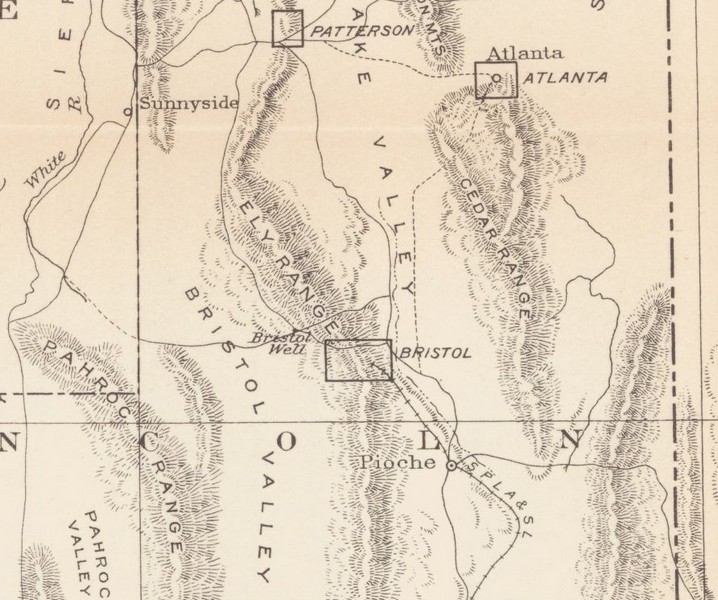
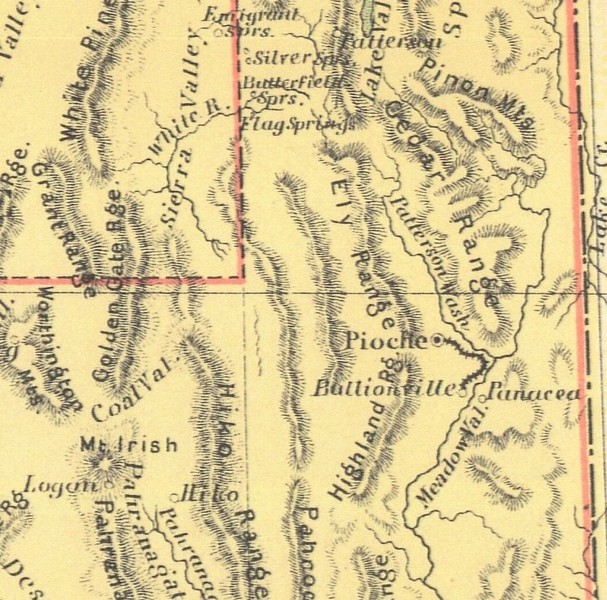
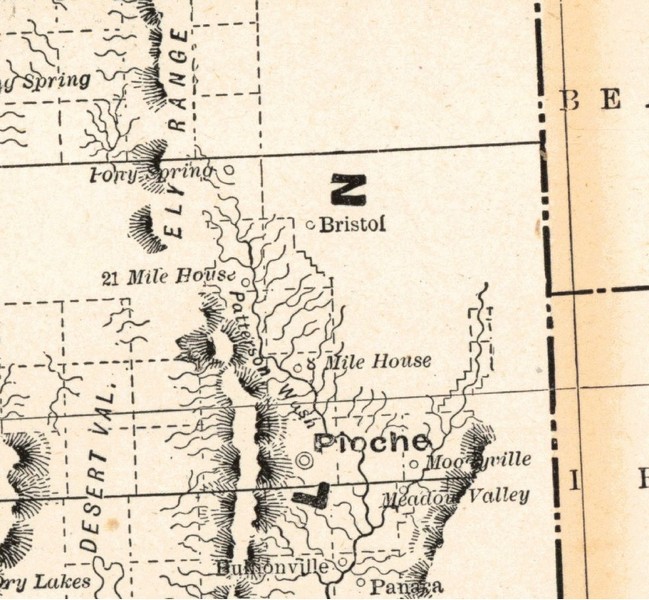
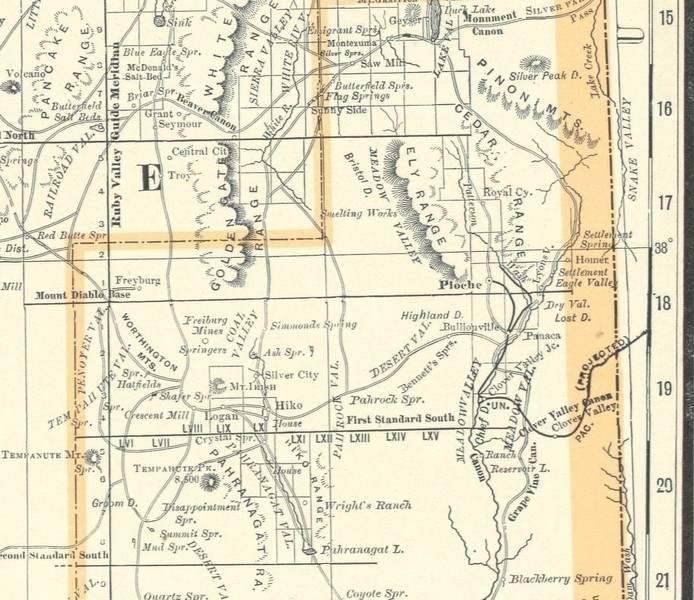
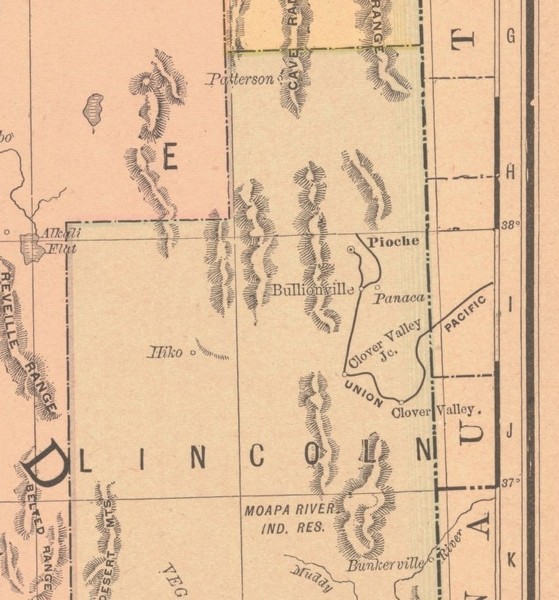
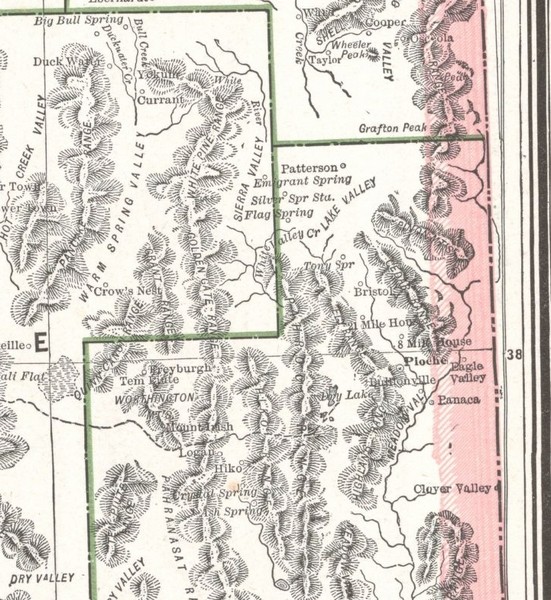
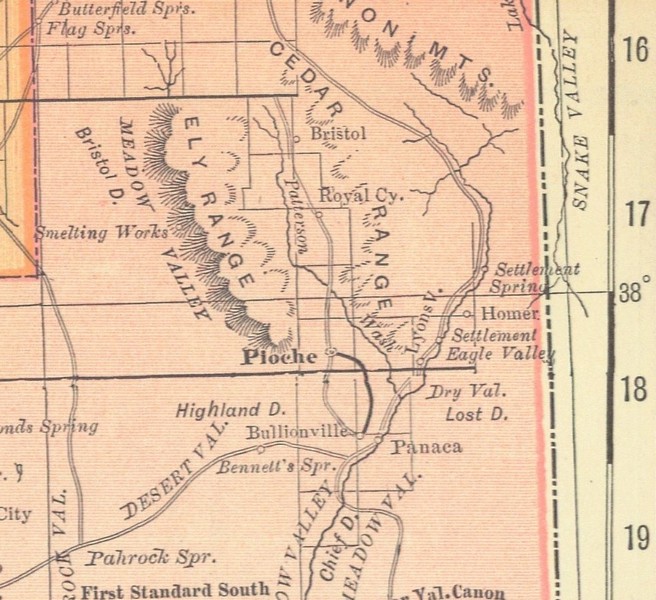
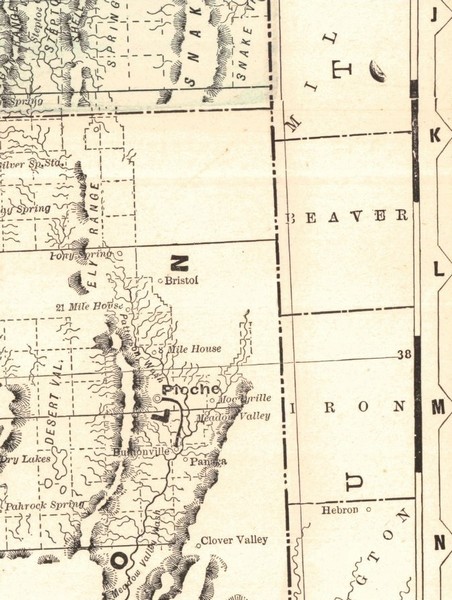
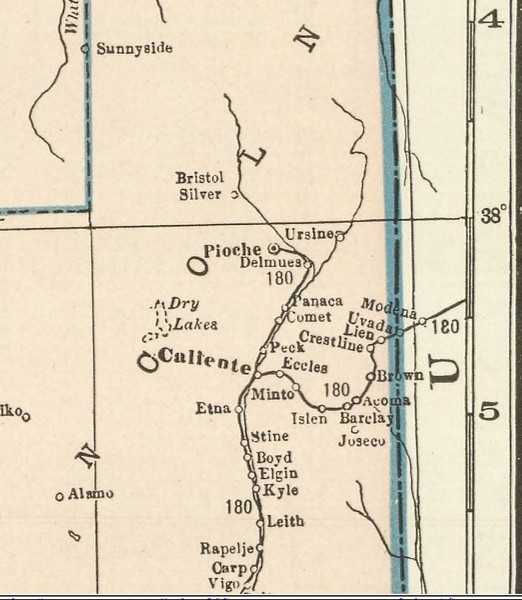
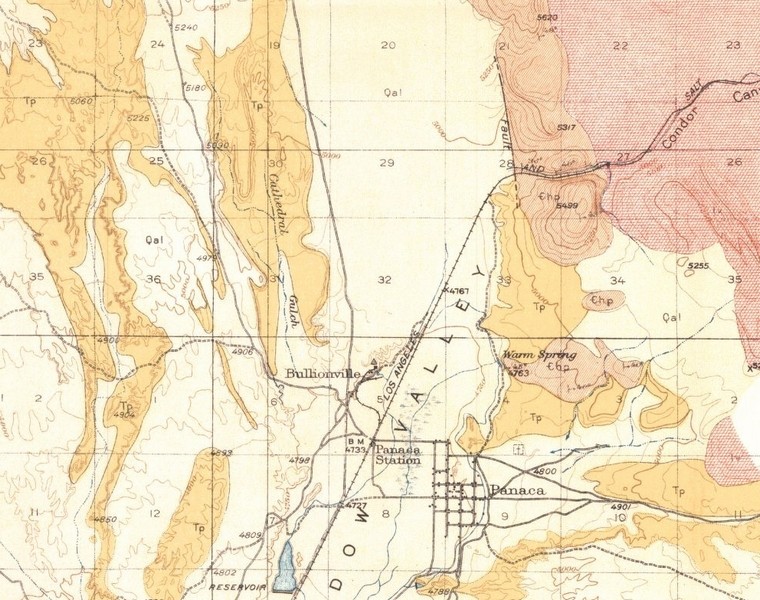
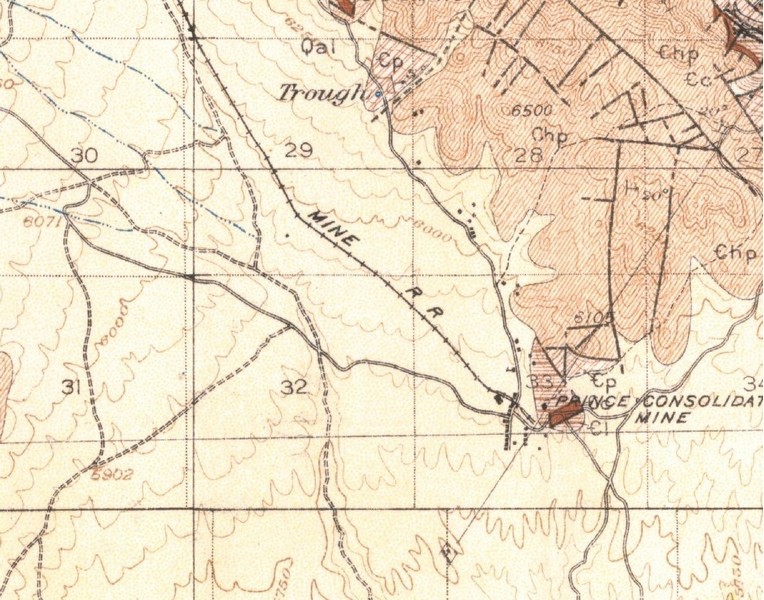
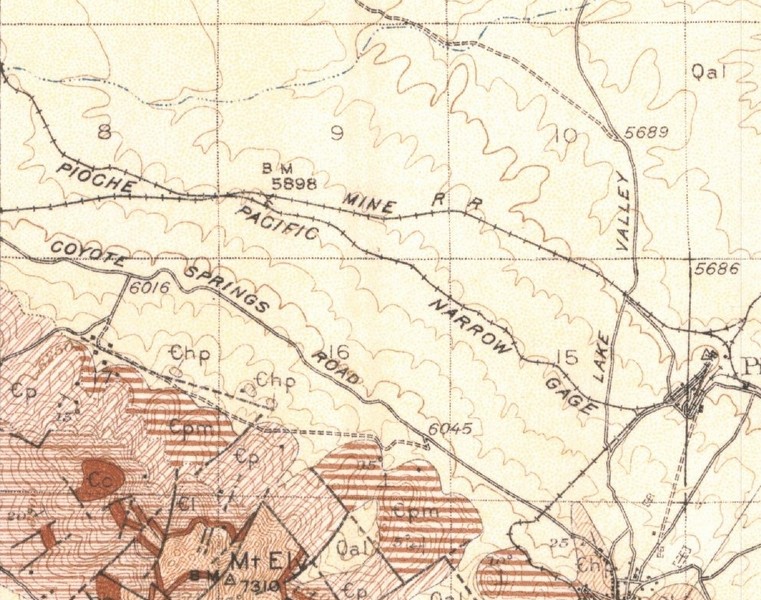
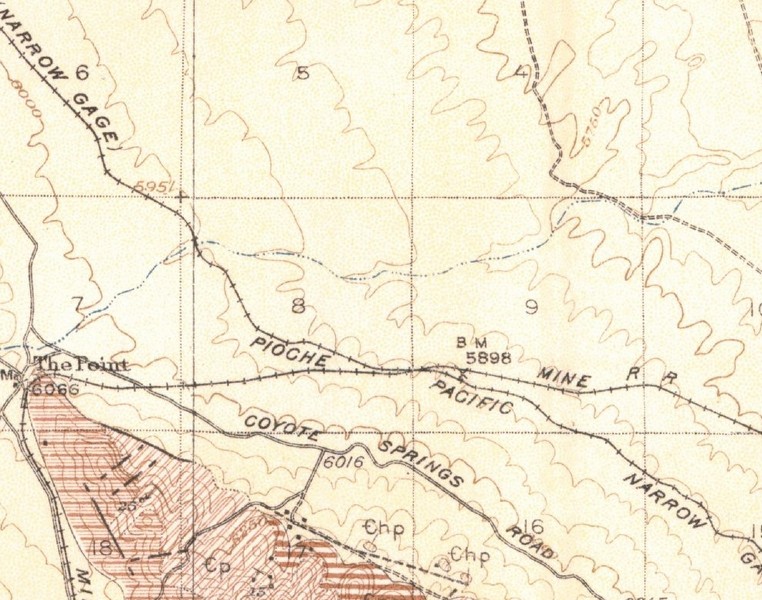
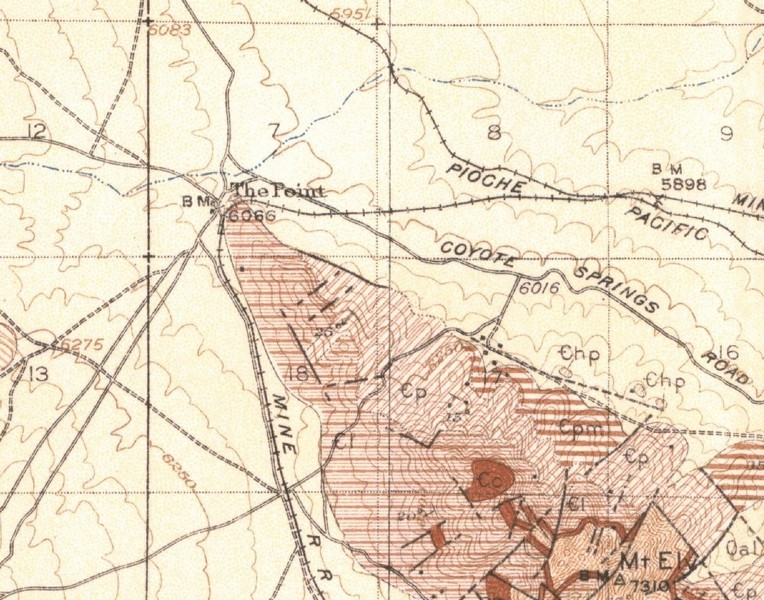
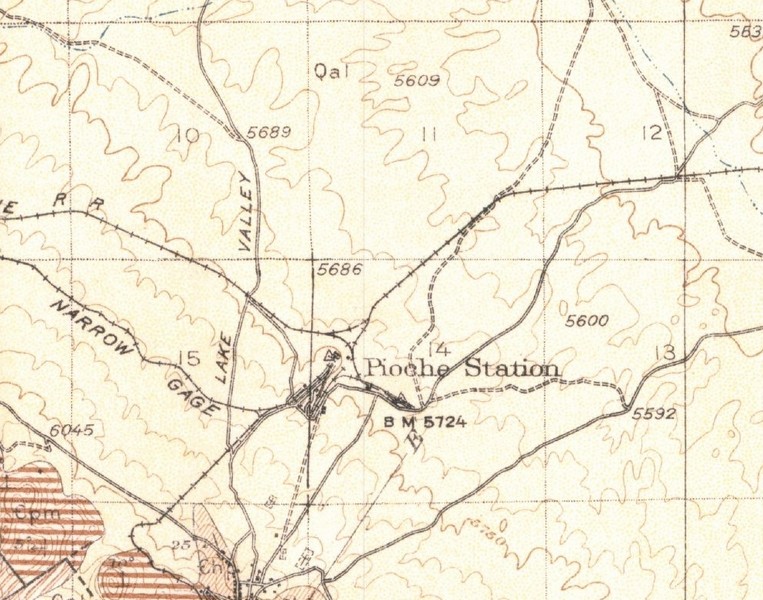
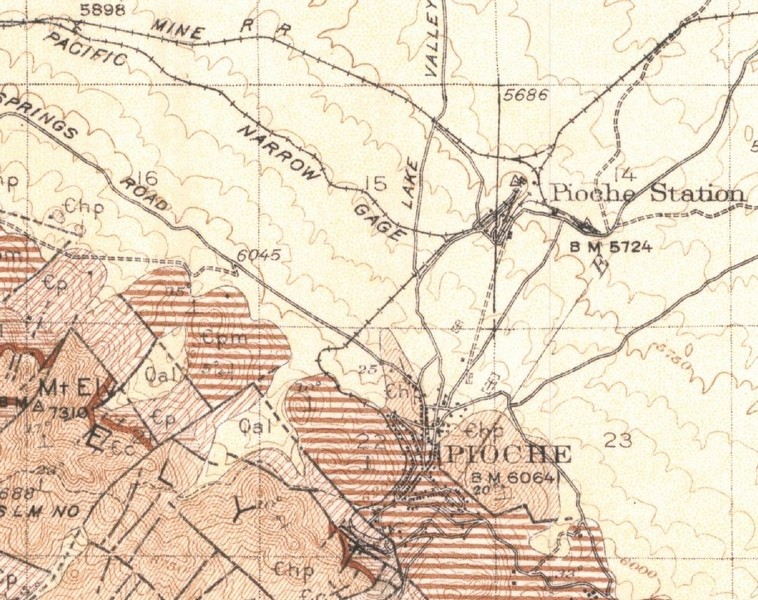
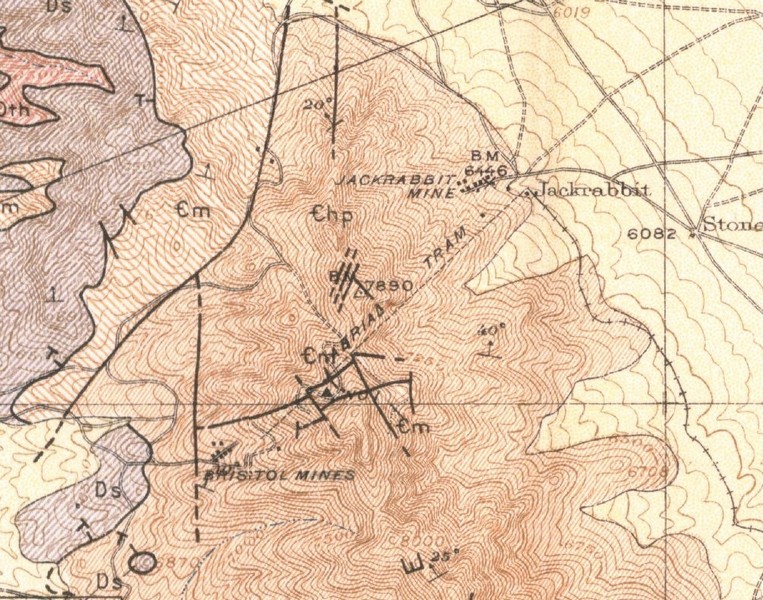
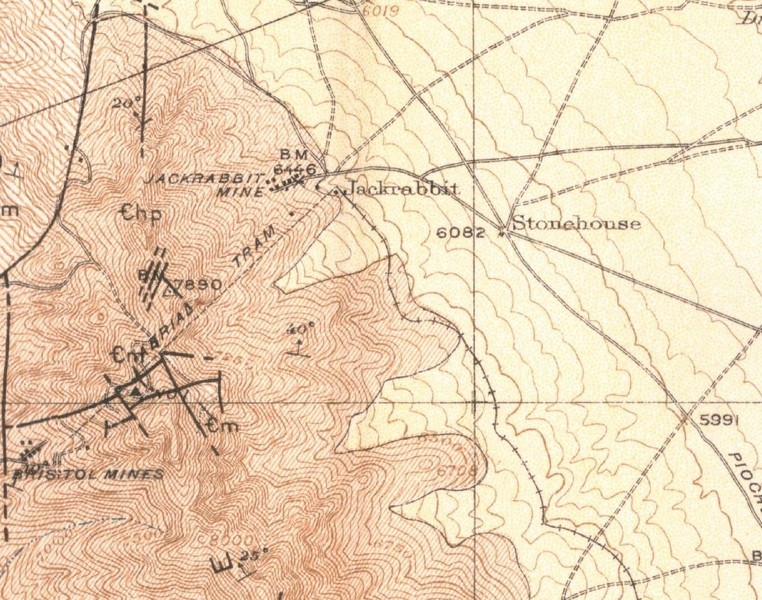
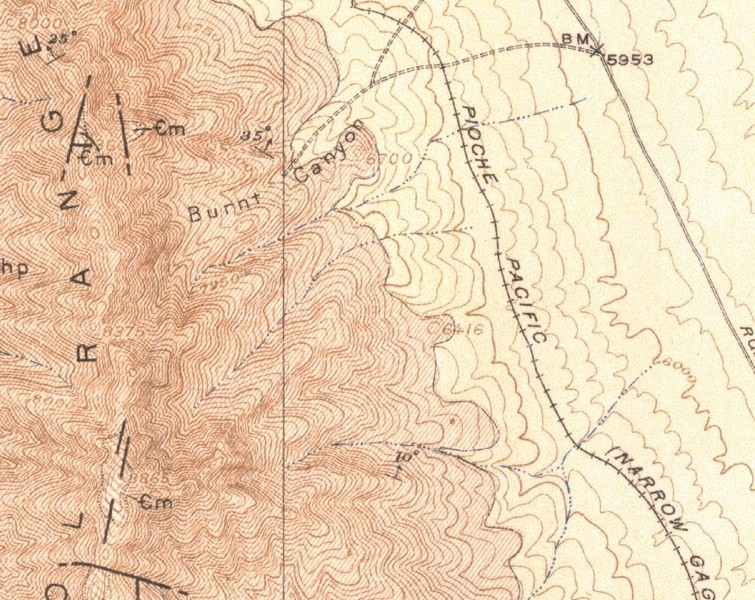
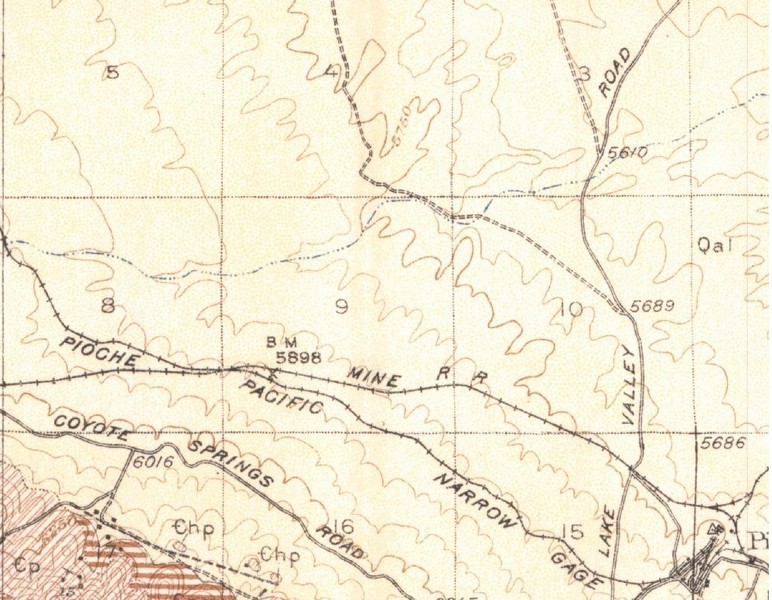
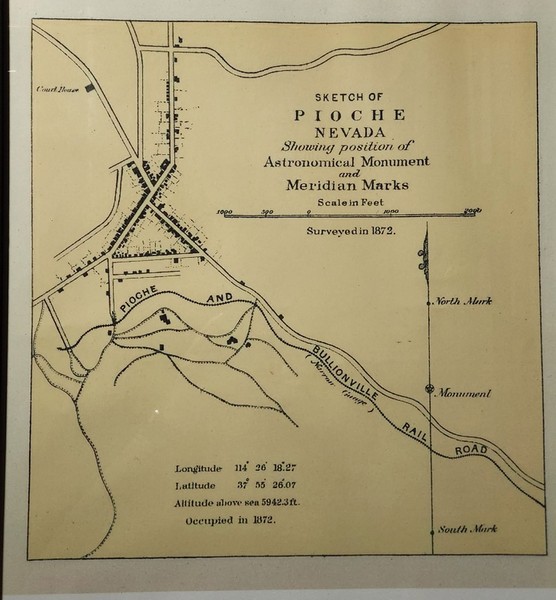
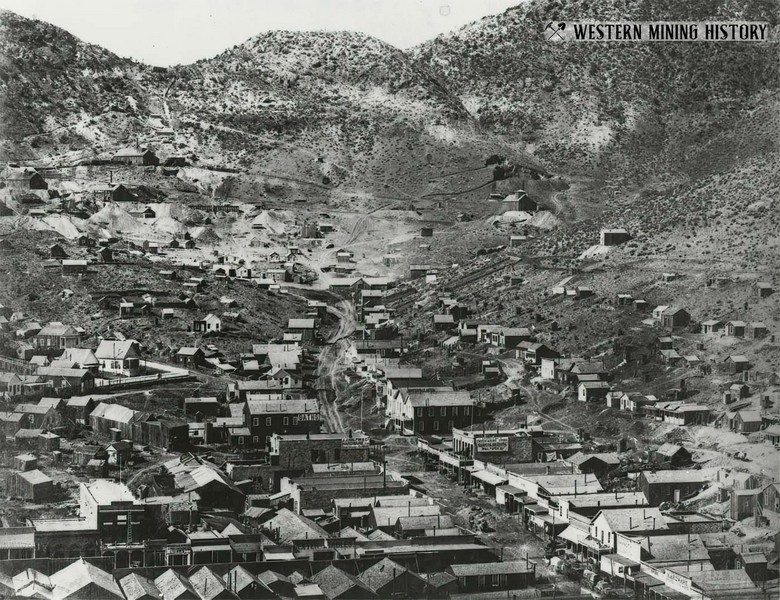
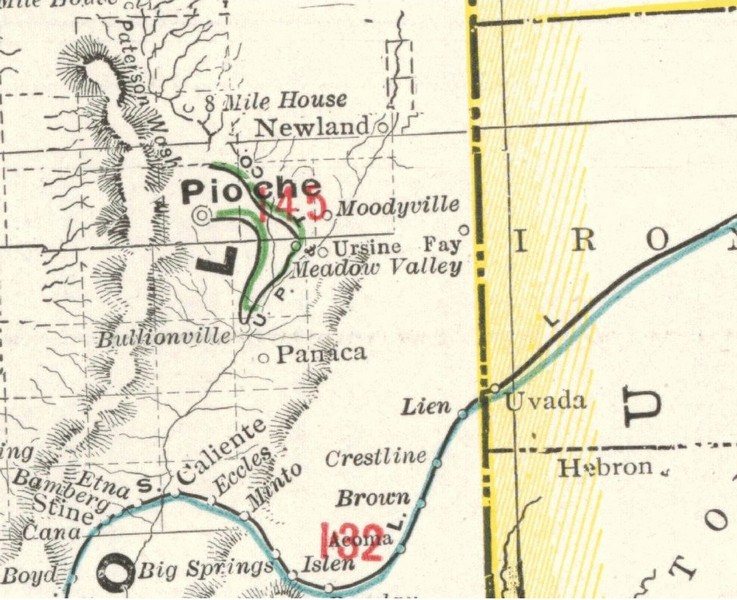
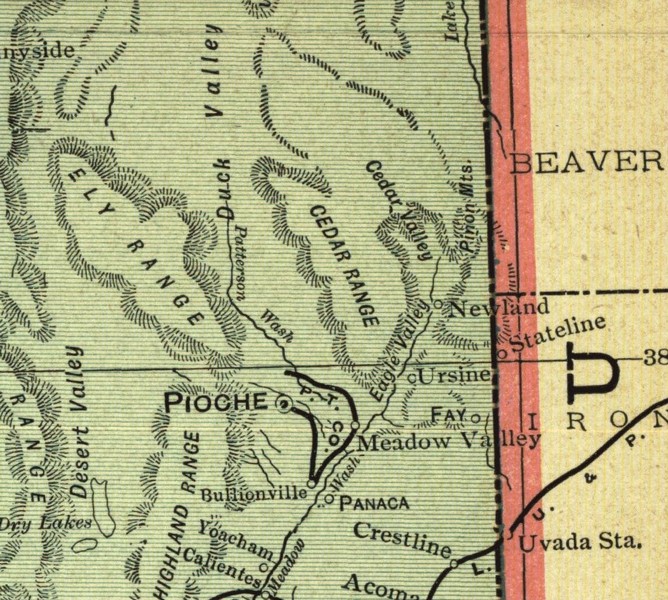
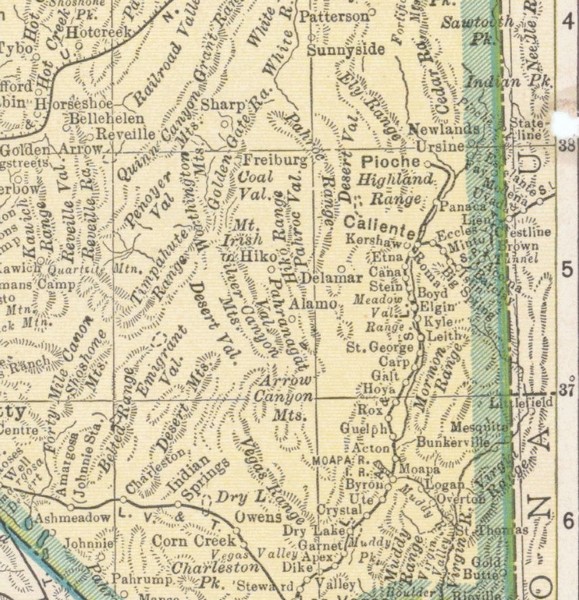
A good friend found this old map of Pioche while researching Utah Railroads. It was surveyed in 1873.
I've included some info on the Pioche and Bullionville Railroad shown on the map.
Pioche & Bullionville Railroad (1872-1883) The Pioche & Bullionville Railroad,
built in 1873, was reported as the first independent narrow-gauge railroad in Nevada.
The Pioche & Bullionville Railroad was organized to haul ore from the Pioche-area mines,
to milling facilities at Bullionville, a total distance of about 20 miles by way of Condor Canyon.
(In some newspaper stories of the day, the Pioche & Bullionville was mistakenly called the Nevada Central Railroad due to one or more promoters and newspaper editor's grand plans,
and the Pioche & Bullionville line's possible part in a railroad that was to span the state.
This should not be confused with the later Nevada Central Railway,
organized in 1878, and completed in 1880 between Austin and Battle Mountain.)
The Pioche & Bullionville Railroad, a narrow gauge line built in 1873 between those two settlements,
was torn up in 1884 and the rails and equipment reported sold to an iron mining and manufacturing company in Cedar City, Utah Territory.
However, the rails and equipment apparently did not leave Nevada ---------------
Pioche & Bullionville Railroad -- In 1872 Pioche was at the peak of a silver boom;
its output was second only to that of the Comstock Lode, and the population had reached 7,500. Nevertheless,
the town was isolated from the American railroad system.
The first railroad was not an effort to end this isolation, but rather a narrow gauge to serve local demands.
General A. L. Page and other local mine operators incorporated the Pioche & Bullionville Railroad early in 1872, but Page,
in association with W. H. Raymond, reincorporated the project in 1873 as the Central Nevada Railroad.
They opened the line, however, on June 8, 1873, under the name of the Nevada Central Railroad--unrelated to the later Nevada Central built to serve Austin.
The railroad connected Pioche with Bullionville (20 miles), a town of 450 people and the site of several mills.
Most of the traffic was ore from Pioche for processing at Bullionville.
The railroad was popularly known by its original name, Pioche & Bullionville.
Mining in the area began declining about 1874 with the exhaustion of the best ores and with chronic problems of underground water in the deeper mines.
The railroad passed through a succession of owners.
Regular ore trains apparently ended about 1878.
The railroad went bankrupt and was sold by the sheriff on March 3, 1881.
Operation is thought to have ceased about that time, and the property was sold for scrap in 1883.
Railroads were the best option for moving ore in the nineteenth and twentieth centuries.
For the mines of Pioche, four railroads eventually served the area.
The first was started in 1872.
Originally called the Pioche and Bullionville,
it was reincorporated as the Central Nevada Railroad in 1873, and renamed the Nevada Central,
though not related to the railroad near Ely. It went out of business in 1880.
In 1889, the Pioche Pacific Transportation Company, known as the Jackrabbit Line, built a new narrow-gauge line.
The Pioche Pacific connected with the Jackrabbit Mine to the east.
It did not finally close until 1948.
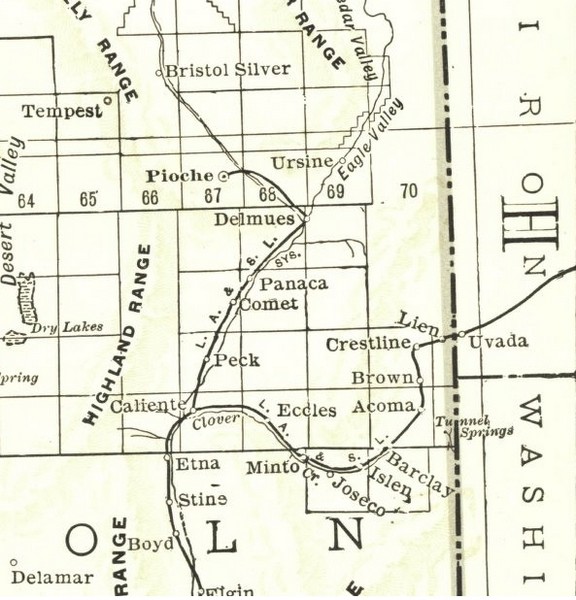
Next was the Caliente & Pioche Railroad.
It was built by San Pedro, Los Angeles, and Salt Lake Railroad starting in 1907,
and connected Pioche to the outside world. It became part of the Union Pacific.
The final Pioche railroad was the Price Consolidated Railroad which began constructed in 1912.
It too became part of the Union Pacific in 1940.
It's always an exciting day when a new engine arrives. Tell the photographer to take a picture !
This photo is of the Salt Lake, Sevier Valley & Pioche Railroad #2, the "Kate Conner," in 1873.
The Salt Lake, Sevier Valley & Pioche Railroad was organized in May 1872 to construct a narrow-gauge line from Salt Lake City to the silver mining town of Pioche, Nevada, 300 miles away.
Surveys started along the route, and grading began westward from Salt Lake City, but that's as far as it got.
The railroad failed financially and was never built.
In 1874, the Utah Western RR was organized and acquired the franchises of the defunct line.
The Utah Western built 37 miles of narrow-gauge line from Salt Lake City to Terminus, Utah).
This company defaulted on its bonds,
and attorney LeGrand Young (Brigham Young's nephew) was appointed trustee and later became its president.
Eventually, the line became part of the Union Pacific system.