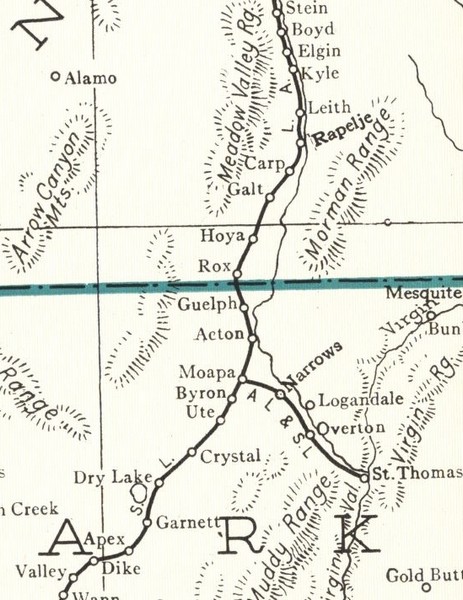
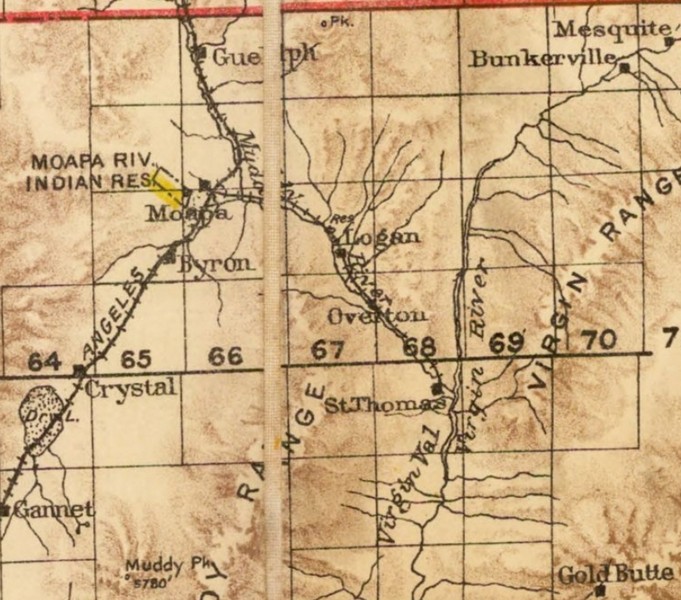

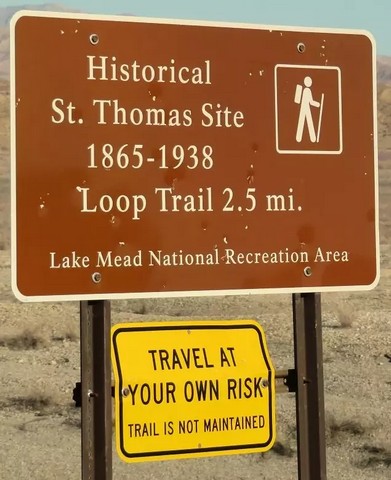

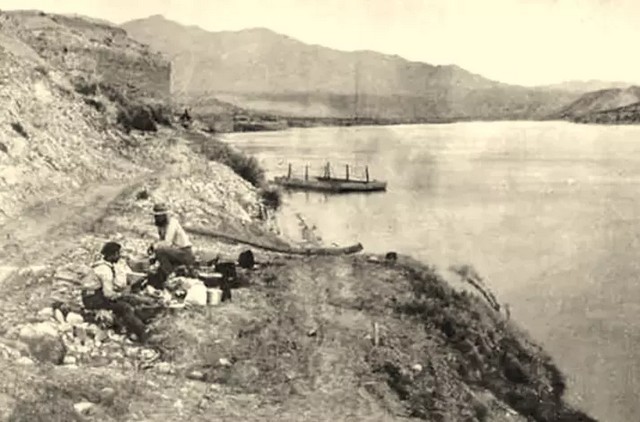
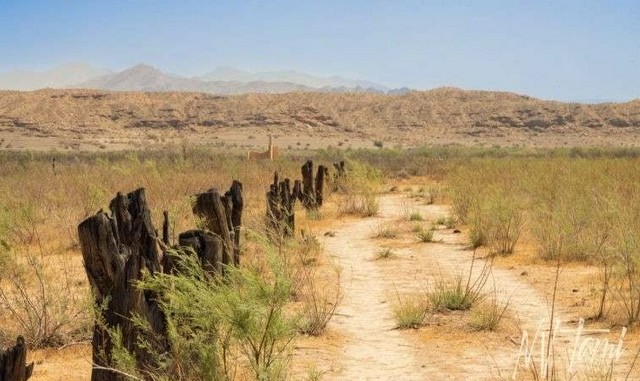
St. Thomas was established January 1865 after Brigham Young ordered the colonization of the Muddy River (Moapa) Valley a few months prior. A townsite was laid out near the confluence of the Virgin and Muddy Rivers, and 600 acres - divided into five-acre lots - were developed for crops. Meanwhile, Mormon settlement continued north where additional settlements were formed, including Overton, St. Joseph, and West Point.

Soon St. Thomas had 600 residents, an attractive community with streets lined with cottonwood trees. At the time, it was believed to be in the Utah Territory, but in 1867 the Arizona Territory named St. Thomas the seat of Pah-Ute County. Nevertheless, the Mormon settlers did not organize a government there, as their allegiance was with the Utah Territory. A boundary survey in 1870, however, showed that St. Thomas and the Muddy River Valley were actually in Nevada, not the Utah or Arizona Territories. Ordered to pay back taxes, most settlers abandoned the valley by February 1871. Among the only to remain was Daniel Bonelli, who continued to operate the post office and lodging for travelers.

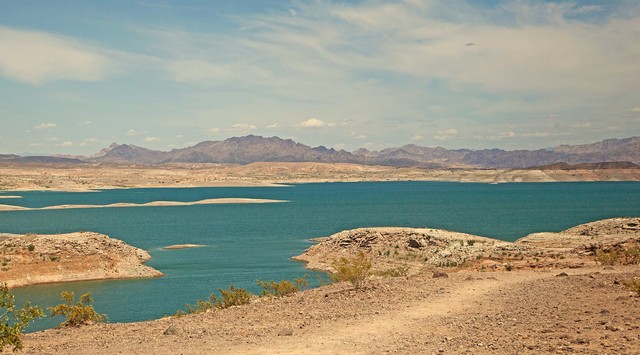
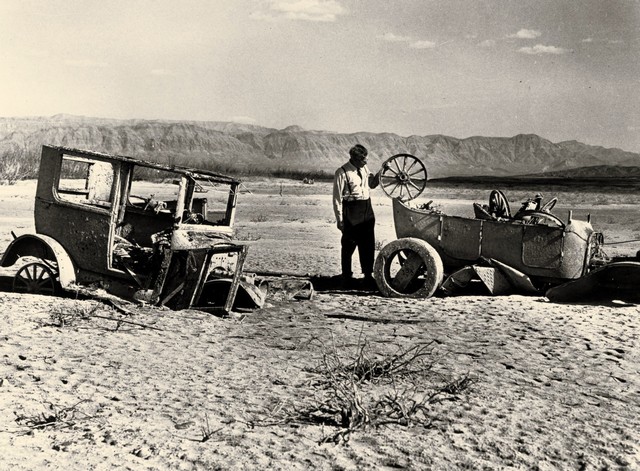
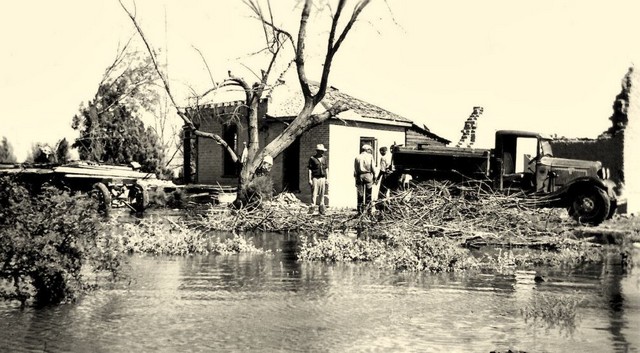
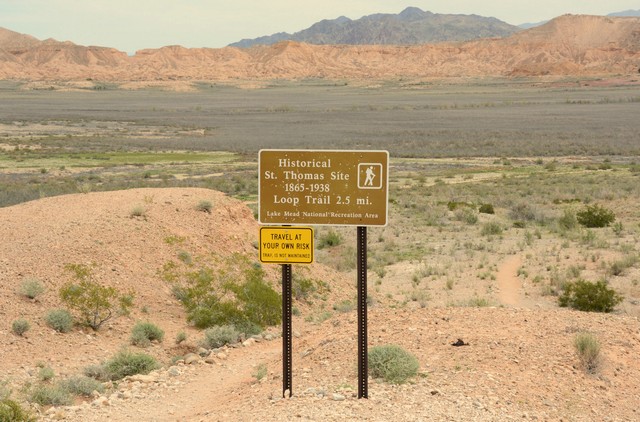
In another decade, Mormon settlers returned to the valley and St. Thomas gradually regained a population of a few hundred. In addition to agriculture, silica and salt mining were prominent aspects of the community's economy. In 1911-12, a railroad branch was built to St. Thomas by the San Pedro, Los Angeles and Salt Lake Railroad. The following year, it even became a stop along the Arrowhead Trail, the first automobile road between Salt Lake City and Los Angeles. Its prosperity came to an end in the 1930s, however, with the construction of Hoover Dam. Located in the path of what would become Lake Mead, St. Thomas residents were forced to vacate the community. While many dismantled and moved their homes, the final resident torched his when he left in 1938. For decades the town was submerged, but receding water levels have since allowed the ruins of the town to resurface. Today a trail among the remnants is maintained by the National Park Service as part of Lake Mead National Recreation Area.


Construction: The first 5 miles opened in mid-1911 to haul the local cantaloupe harvest, and the full line to St. Thomas opened on June 7, 1912. Operations: Owned by the Union Pacific Railroad (via the Salt Lake Route), the single-track line served local agriculture, silica, and salt mining. Abandonment: Between 1938 and 1939, the final 6 miles of the track were abandoned and submerged as rising waters from the Hoover Dam formed Lake Mead. Today, the ruins of St. Thomas operate as an exposed ghost town within the Lake Mead National Recreation Area during low-water periods.


The history of St. Thomas, Nevada, the remains of which today lay under the high water mark of Lake Mead, begins in 1865 with Mormon missionaries sent by Brigham Young to the Moapa Valley to grow cotton. In 1871 the boundary of Utah territory was shifted east by one degree longitude, and the town became part of Nevada. New settlers moved in, miners and farmers, interacting with the Mormons and native Paiutes. The building of Hoover Dam doomed the small settlement, yet a striking number of people still have connections to a town that ceased to exist three-quarters of a century ago. Today, the ruins of this ghost town, just sixty miles east of Las Vegas, are visible when the waters of Lake Mead are low. Located in a national recreation area, the National Park Service today preserves and interprets the remains of St. Thomas as a significant historical site. Touching as it does upon on early explorers, Mormons, criminals, railroad and auto transportation, mining, water, state and federal relations, and more...


Disclaimer: We search for HISTORY as a hobby. Endless souces. Much can come from others neverless endless sources. Does this website sell anything ? NO Donations ? NO. This is non-commercial. I consider my websites under copyright. Again..no money here !! Educational.


go back