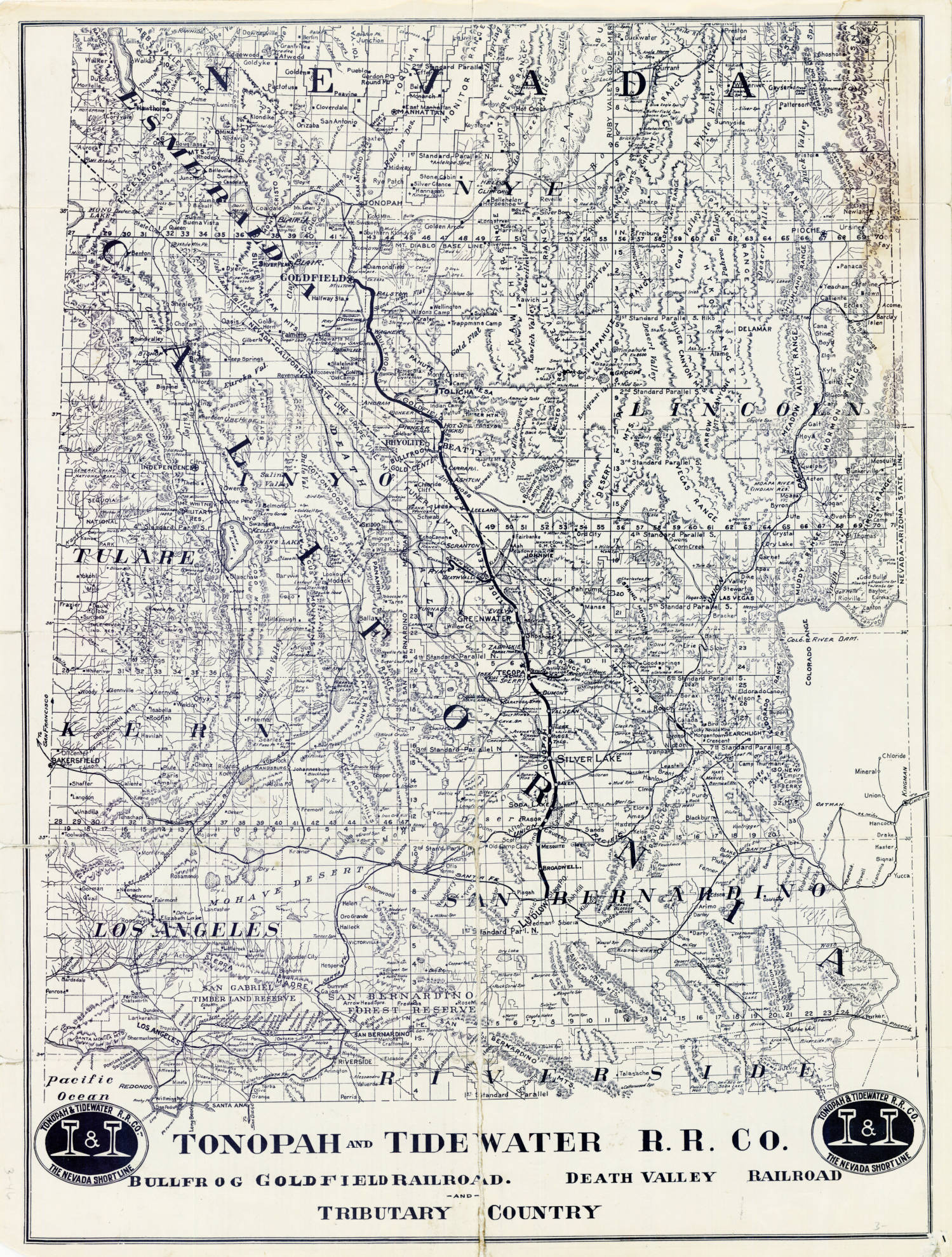
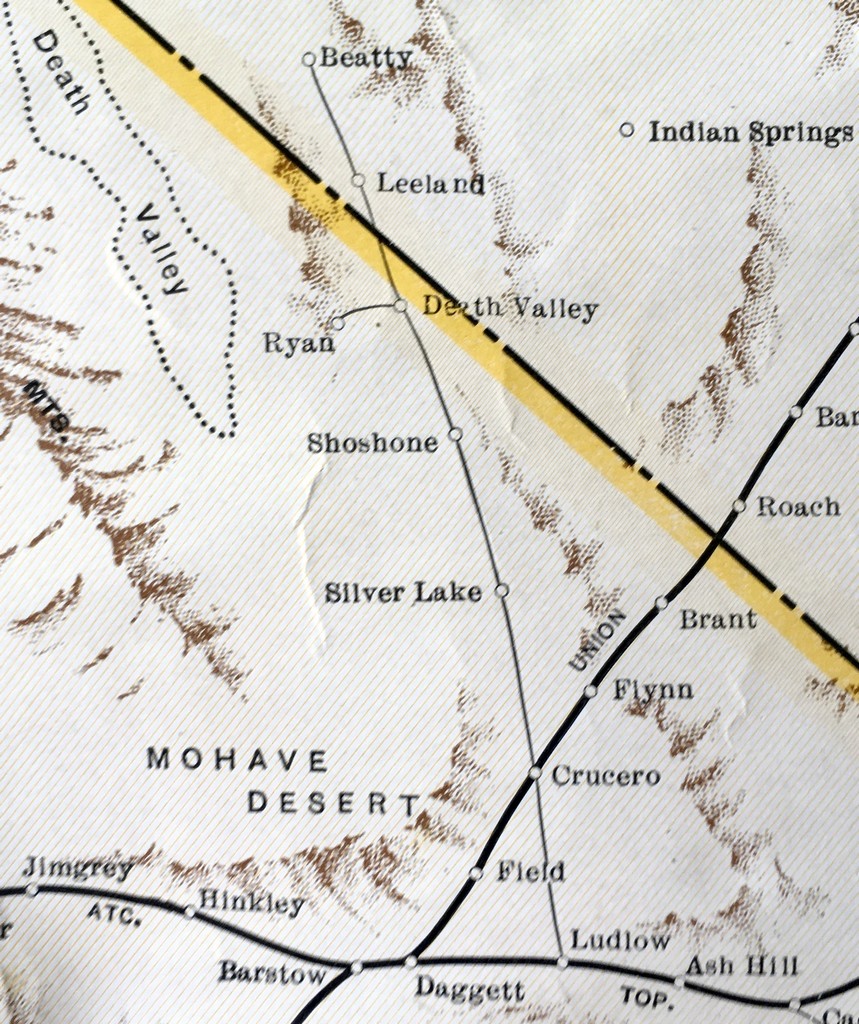
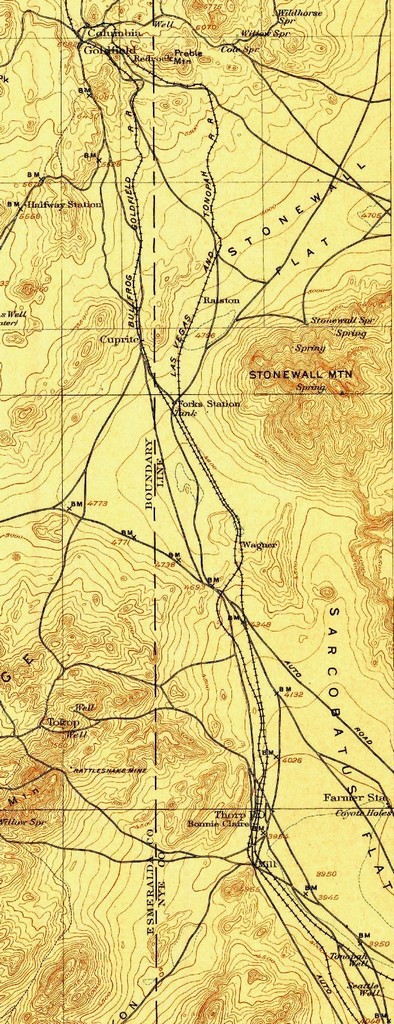
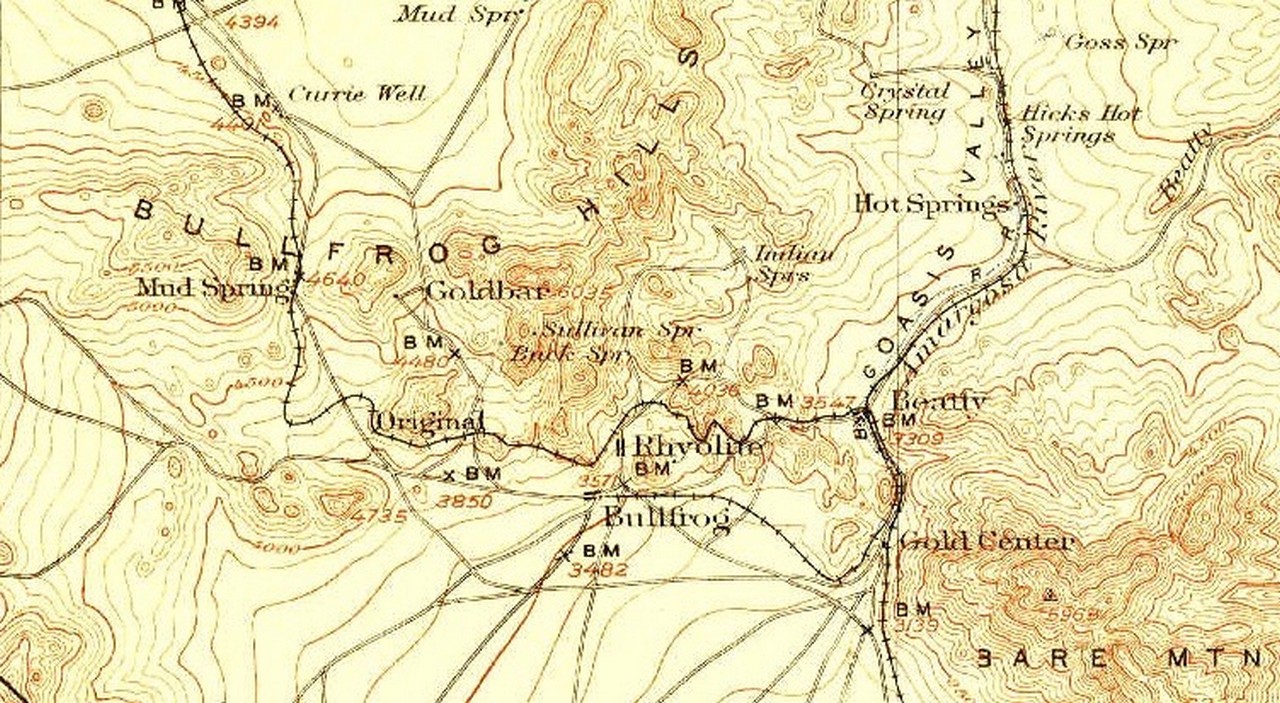
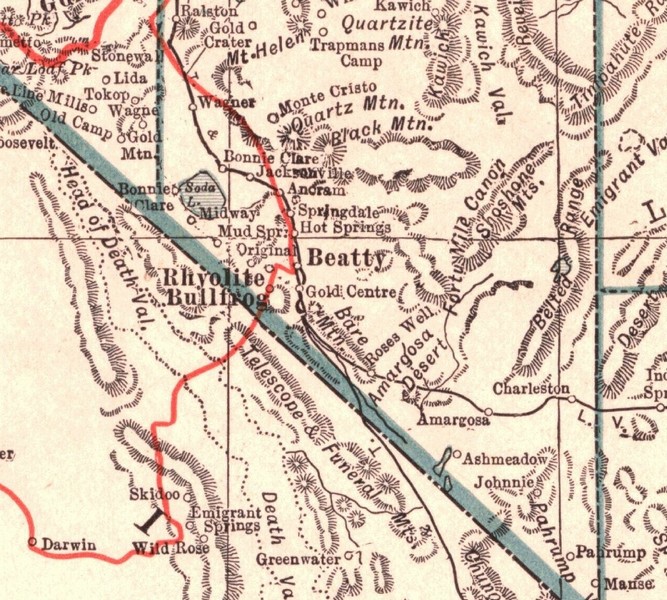

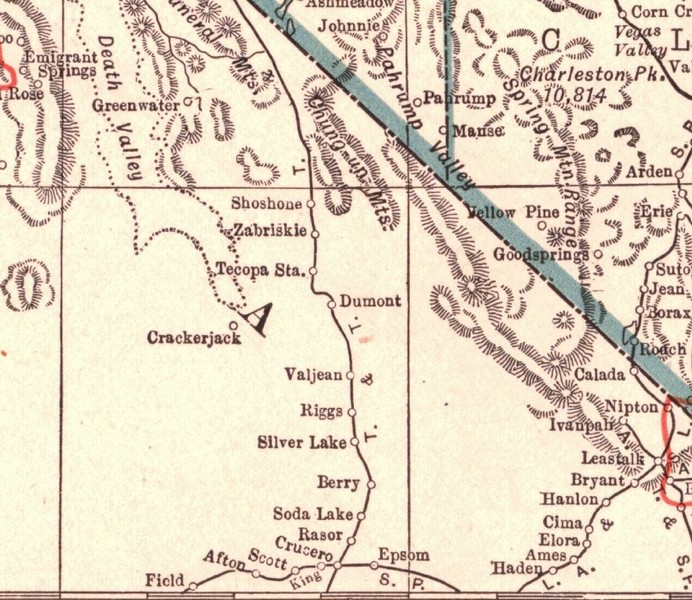
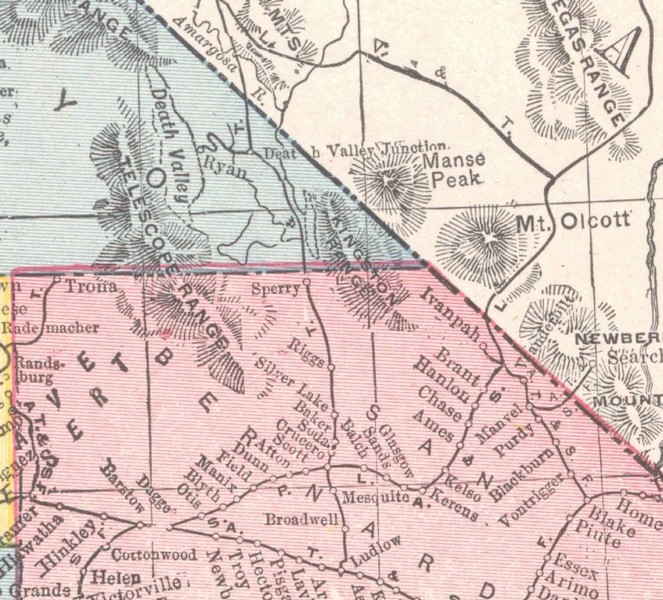
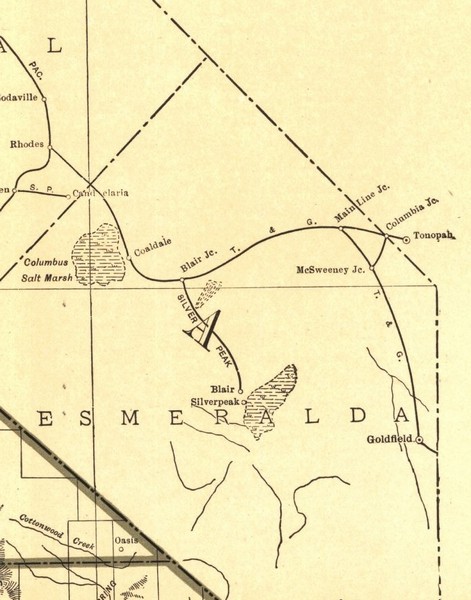
Headquarters Ludlow, California
Reporting mark T&T
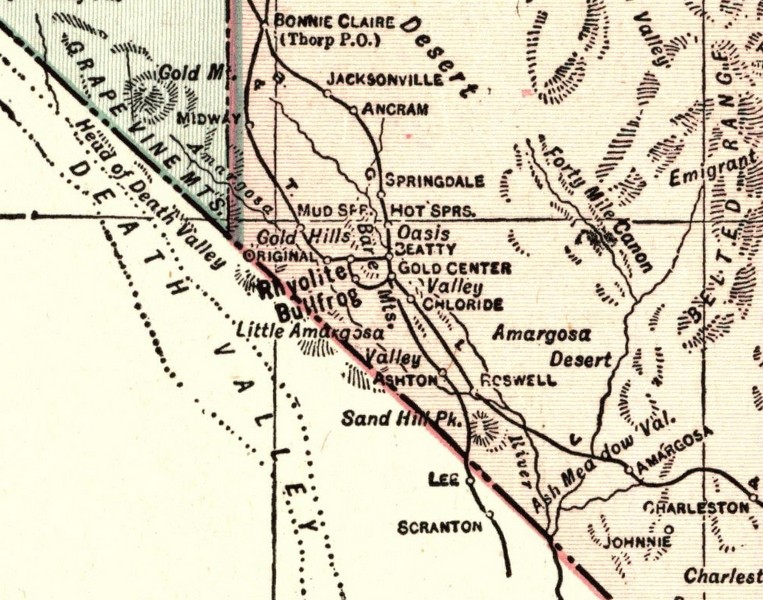
Locale Ludlow, California, to Gold Center, Nevada (later extended to Beatty, Nevada, and Goldfield, Nevada, by way of the Bullfrog Goldfield Railroad in 1908)
Dates of operation 1904; 122 years ago - 1940
Beatty
Bullfrog Goldfield Railroad
Carrara
Ashton
Leeland
Jenifer
Nevada
California
Scranton
Death Valley Railroad
Death Valley Junction
Death Valley Railroad
Evelyn
Shoshone
Zabriskie
Tecopa
Acme
Sperry
Dumont
Valjean
Riggs
Silver Lake
Baker
Soda
Rasor
Los Angeles and Salt Lake Railroad
Crucero
Mesquite
Broadwell
Atchison, Topeka and Santa Fe Railway
Ludlow
Ludlow and Southern Railway
The railroad was originally intended to run from Tonopah, Nevada, to San Diego, California (the "tidewater"), but never made it to either on its own rails. It was famous for being the last of the three railroads built to cross the Death Valley region, and outlasting them by over 30 years providing dedicated and reliable service to the desert residents. The T&T also formed part of a potential north-south transcontinental railroad route, connected together by four different US railway companies, later used as the basis to potentially form a Mid-Pacific Railroad.
The railroad operated from 1907 until 1940, when it suspended operations due to a lack of profitable traffic. The rails were taken up in 1943 for use in World War II and the company itself was officially abandoned by 1946.
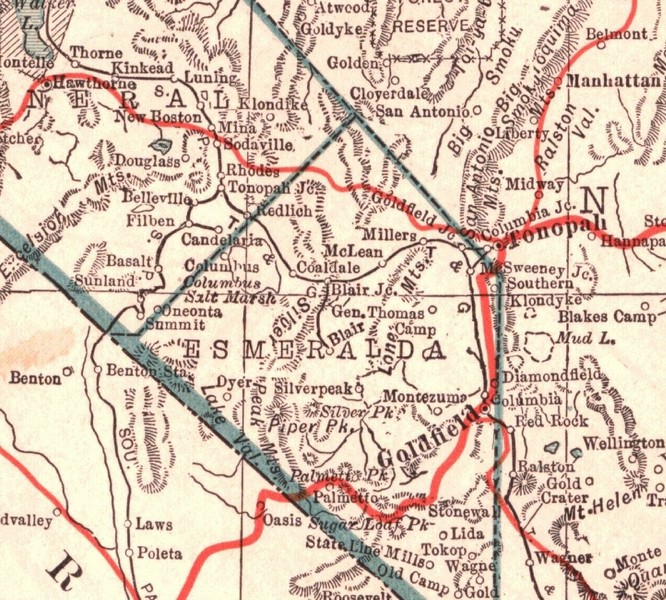
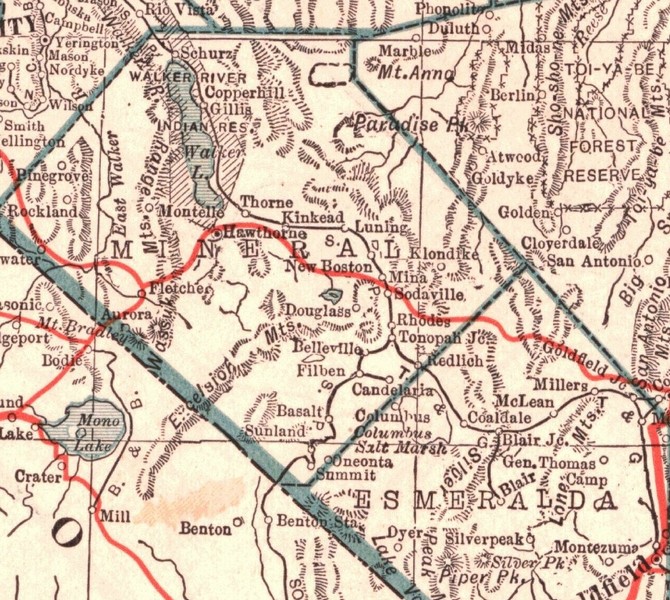
To bring the borax out from this remote region, he tried to use an old steam tractor to haul the ore, but it was not suited for the harsh desert conditions and was quickly taken out of service. Smith then considered the idea of building a railroad from the nearest point possible on the Santa Fe, to connect the Lila C. to the most intermediate route to his refineries at Alameda, California and Bayonne, New Jersey. He had also hoped of extending the railroad towards Tonopah, Nevada, as during that time there was a great mining boom going on in the region, with gold and silver mines popping out from all over the area, and even as far south as Beatty, Nevada, Goldfield and Rhyolite, Nevada. On July 19, 1904, Francis Marion Smith had incorporated the Tonopah & Tidewater Railroad Company in New Jersey, with Smith as president, and his associates DeWitt Van Buskirk as vice-president, C.B. Zabriskie as secretary-treasurer, and John Ryan as superintendent and general manager.
After considering building his railroad from several locations including Manvel, California (now Barnwell), and Daggett, California, Francis Smith eventually ran into William A. Clark, Montana senator and head of the Los Angeles and Salt Lake Railroad, at Las Vegas, Nevada. Clark proposed to Smith that the T&T could be built out of Las Vegas, as the quickest and most direct way to the borax mine and Tonopah goldfields. Smith reacted enthusiastically to Clark's proposal, and he agreed. However, Clark himself was considering building a railroad to Tonopah, and allowing a direct competitor to build right in his way put Clark in a very awkward position.
Despite Smith's disappointment, he held no resentment for Clark, and instead went to the Atchison, Topeka and Santa Fe Railroad to propose they use their stop at Ludlow, California, as the T&T's new terminus. This was the perfect get-back at Clark's double-cross, for Clark and the Santa Fe were in direct competition to one another. Plus, building north of Ludlow would bring about more business opportunities for the T&T to profit off of, as there were plenty of mines in the area where the Tonopah & Tidewater was planned to be built. The biggest drawback however, was that the railroad would be twice as long as it would've been if they built out of Las Vegas, about 200 miles (320 km) distance.
Francis Smith sold all of his Las Vegas railroad work, graded roadbed, property and supplies to Clark, and moved immediately to Ludlow and started building the T&T with new construction material provided by the Santa Fe. Starting construction in November, it soon got too hot for the railroad workers during the summer months. Water was the hardest to provide, but plenty of meat was made available by the butchers located in Daggett. The T&T construction crews eventually reached Crucero, California, by 1906, where they had to cross over the mainline of the Los Angeles and Salt Lake Railroad. An agreement was written by the T&T and the LA&SL to use Crucero as an interchange and crossover point between the two railroads, but it did not entirely suit either party. They eventually came to a mutual agreement, and the T&T construction crews pushed further north.
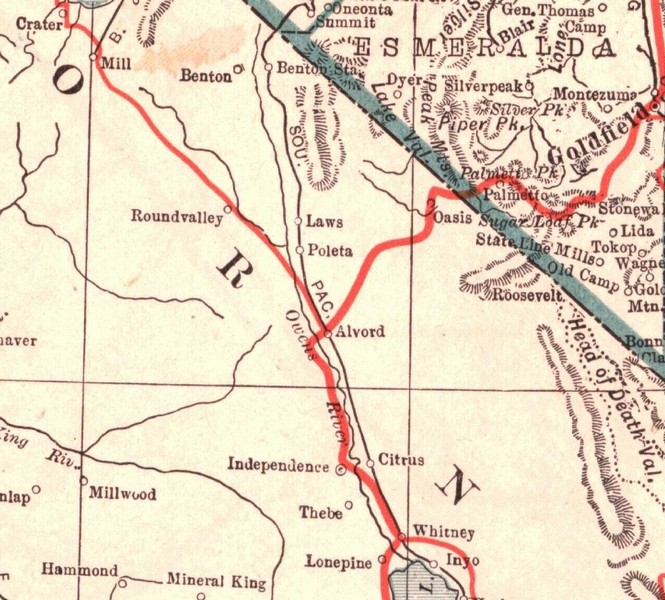
The hardest part of building the Tonopah and Tidewater Railroad was going through the Amargosa Canyon. It took several thousand head of mules and men to blast their way through the canyon, and took nearly three years to get to the other end where Tecopa, California now stands. The Tonopah and Tidewater reached Death Valley Junction, California, by 1907, the closest point to the Lila C. borax mine. Here, a branch line was built to the mine and trains immediately started transporting the borax to the Santa Fe. The last spike was hammered into place at Gold Center, Nevada, with no celebration, as the Las Vegas and Tonopah Railroad had already beat the T&T to Goldfield, and the financial panic of 1907 was severely crippling the operations of the gold mines.
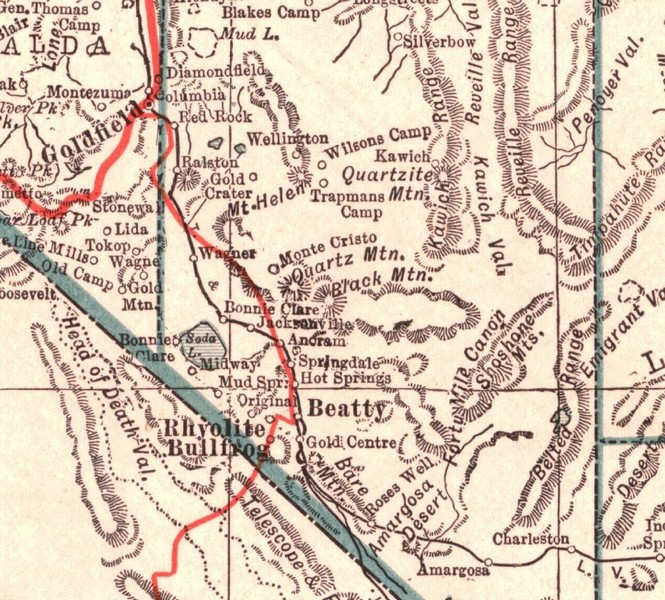
Nevertheless, the Tonopah and Tidewater was in a better position to be more profitable than the Las Vegas and Tonopah, and in 1908 merged with the Bullfrog Goldfield Railroad to reach Goldfield, also connecting to Tonopah by way of the Tonopah and Goldfield Railroad. The T&T's rates were cut shorter than the LV&T, and passengers preferred the shorter route of the T&T over the LV&T as it was 100 miles (160 km) shorter than it took to get to Los Angeles by the former. By the time World War I broke out, the Las Vegas and Tonopah Railroad was in a bad state. The United States Railroad Administration took over the T&T and the LV&T as with all the nation's railroads, but deemed the latter as an unnecessary route and had the LV&T taken up for scrap in 1918.
The Lila C. mines eventually ran dry by 1913, and the T&T filed to extend their branchline to the new mines at Ryan, California (formerly Devar). However, with their mounting debt of over $4.4 million they were denied to do so by the ICC, and instead Pacific Coast Borax organized a new railroad, the 3 ft-gauge Death Valley Railroad, to haul the ore from Ryan to the T&T at Death Valley Junction.
The T&T tried to campaign tourism to Death Valley in an effort to stay alive. The railroad campaigned with the Union Pacific to have a Pullman sleeper service run from Los Angeles, interchange with the T&T at Crucero, and be hauled as far as Death Valley Junction, where guests could explore the valley and stay at exquisite hotels such as the Furnace Creek Inn and the Death Valley View Hotel at Ryan, by way of the Death Valley Railroad. The Great Depression severely crippled the tourist trade for the Tonopah and Tidewater Railroad, and people began to use automobiles to get to and from the valley. It was soon becoming evident that the T&T was losing too much money to keep itself afloat, maintenance costs skyrocketed due to the many floods that plagued the right-of-way in several places. By 1938, the "Tired and Tardy" as the railroad was known by then, was over $5 million in debt.
Abandonment filings with the Interstate Commerce Commission were applied by the T&T as early as 1938. Many protests were made by the local businesses that relied on the T&T for their very existence, but the ICC eventually approved of the applications for abandonment by 1940. The railroad was laid in submission for a time in hopes of reopening to better traffic, but when the United States entered World War II in 1941, all of the T&T's rails and equipment were requisitioned by the War Department for use in Europe. It took nearly a year for Sharp and Fellows, Inc., to remove the entire railway between Ludlow and Beatty, leaving but the old trackbed behind, and a few ties in the lonely desert. Much of the salvageable wood from ties and bridges was used to build a few structures, most notably the Apple Valley Inn located at Apple Valley and the El Rancho Motel in Barstow. A few buildings in Tecopa, California, along with the facilities for the hot springs, were also built from old T&T railroad ties. Many of them built by Harry Rosenberg Sr., who was the section gang foreman for the railroad from 1927 till abandonment in 1943.
Other than that, only a boxcar #129, flatcar #205, caboose #402, parts of coach chair car #30 (car itself scrapped 2022), outfit diner car #506 (formerly coach #20), a handcar and a gas-driven railcar #99 still exist. Whatever else that remains of the once-great desert railroad is now scattered across many museums and private collections located in the Mojave Desert and around the world.
A portion of the route between China Ranch and Tecopa was converted to a rail trail, the Amargosa River Trail.
Broadwell (MP 12.68)
Mesquite (MP 21.49)
Crucero, California (MP 25.68), (interchange with the Los Angeles and Salt Lake Railroad, later Union Pacific Railroad.)
Rasor (MP 29.38), named for Clarence Rasor, Smith's employee. This area is privately owned within a remote public use area, the Rasor Off-Highway Vehicle Area.
Soda Lake (MP 33.34), later renamed Zzyzx
Baker (MP 41.82), formerly Berry, renamed for Richard C. Baker, Smith's business associate
Silver Lake (MP 49.50)
Talc (MP 56)
Riggs (MP 59.47), formerly named Alta.
Lore (MP 60)
Valjean (MP 65.11)
Dumont (MP 74.40), named after Harry Dumont who ran the company's San Francisco office.
Sperry (MP 78.84), named after Smith's niece Charlotte Grace Sperry
Acme (MP 82.97), formerly named Morrison.
Tecopa (MP 87.67), junction point with the Tecopa Railroad.
Zabriskie (MP 91.74), named for Christian Brevoort Zabriskie, superintendent at Columbus Marsh later in charge of New York operations.
Shoshone (MP 96.95)
Fitrol Spur (MP 97-98)
Gerstley (MP 101.26), named for James Gerstley, Smith's business partner and later U.S. Borax President from 1950-1961.
Jay (MP 106.00)
Death Valley Junction (MP 122.01), junction for the Lila C. Branch (1907–1915) and interchange with the narrow gauge Death Valley Railroad
Bradford Siding (MP 128.01), spur line went to clay pits from here.
Muck (MP 131)
Jenifer (MP 139.44), named for Frank Morgan Jenifer, president of the railroad.
Leeland (MP 144.51)
Ashton (MP 154.98)
Carrara (MP 160.55), junction point with a cable tramway that went to a stone quarry, built by the Las Vegas and Tonopah Railroad.[3]
Post (MP 166), later renamed Weslead.
Gold Center (MP 166.0), connection made here with the Bullfrog Goldfield Railroad heading up north to Beatty.
Beatty Junction (MP 169.07), junction point with the Las Vegas and Tonopah Railroad.
Beatty (MP 169.07), end track for the T&T and its facilities were joint owned with the Bullfrog Goldfield Railroad and the Las Vegas and Tonopah Railroad.
The following stops below are listed from the Bullfrog Goldfield Railroad as part of the Tonopah and Tidewater Railroad's route between Beatty and Bonnie Claire, Nevada. In operation from 1908 until 1927.
Also includes part of the Las Vegas and Tonopah Railroad, when it and the Bullfrog Goldfield merged in 1914, and had to cut off half of their routes and join together as there was not enough traffic to keep both routes going at the same time.
=================================================================================== Bullfrog (MP 170.18)
Rhyolite (MP 171.58), the T&T reached here by way of the Bullfrog Goldfield Railroad by way of a branchline out of Beatty, Nevada.
Wiggers (MP 172.49)
Rider or Ryders (MP 173)
Hot Springs (MP 174.49)
Silica (MP 178)
Springdale (MP 179.39)
Tolicha (MP 186)
Ancram (MP 188.59)
Jacksonville (MP 193.19)
Merger Mine (MP 194)
Bonnie Claire (Thorp/Thorp's Wells) (MP 206.59), here the line deviated over the Las Vegas and Tonopah Railroad route after the reroute made to the tracks in 1914. All railroad points below are ex-LV&T stops used by the T&T and the BG after 1914.
Wagner (MP 218.59)
Stonewall (MP 227.17)
Cuprite (MP 227.99)
Silica (MP 229)
Ralston (MP 231.47)
Stella (MP 233.69)
Keith (MP 240.19)
Milltown (MP 241.19)
Bullfrog Junction (MP 241.59), junction point for the Bullfrog Goldfield Railroad and the Tonopah and Goldfield Railroad.
Goldfield (MP 242.69), originally a station of the Tonopah and Goldfield Railroad, also joint operated with the Bullfrog Goldfield Railroad. The T&T had an agency here until 1914 when it was rerouted over the LV&T tracks to their station and yard in Goldfield.
