

Kansas City, Missouri
Los Angeles, California
Reporting mark ATSF
Dates of operation 1859-1996
Successor BNSF Railway
The Santa Fe was a pioneer in intermodal freight transport; at various times, it operated an airline, the short-lived Santa Fe Skyway, and the Santa Fe Railroad tugboats. Its bus line extended passenger transportation to areas not accessible by rail, and ferryboats on the San Francisco Bay allowed travelers to complete their westward journeys to the Pacific Ocean.
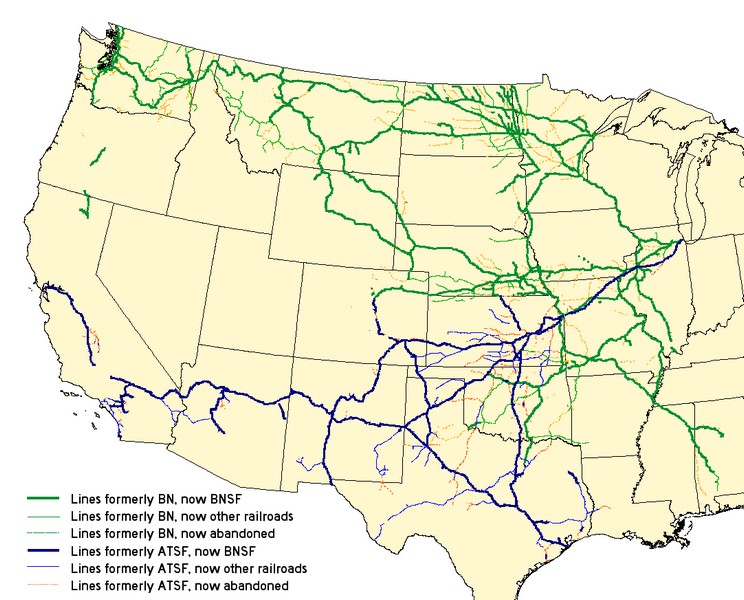
The railroad officially ceased independent operations on December 31, 1996, when it merged with the Burlington Northern Railroad to form the Burlington Northern and Santa Fe Railway.
As the railroad was first being built, many of the tracks were laid directly over the wagon ruts of the Santa Fe Trail. In 1869, the first general office building of the company was built in Topeka. This building also served as a passenger station and freight depot. When the line was extended to Newton, Kansas in 1871, the railroad became a major cattle shipper to ensure a steady revenue stream, at the end of Texas cattle drive trails.
Despite being chartered to serve the city, the railroad chose to bypass Santa Fe, due to the engineering challenges of the mountainous terrain. In 1880, a branch line from Lamy, New Mexico, brought the Santa Fe railroad the 20 miles to its namesake city. It continued to connect with the Southern Pacific at Deming.
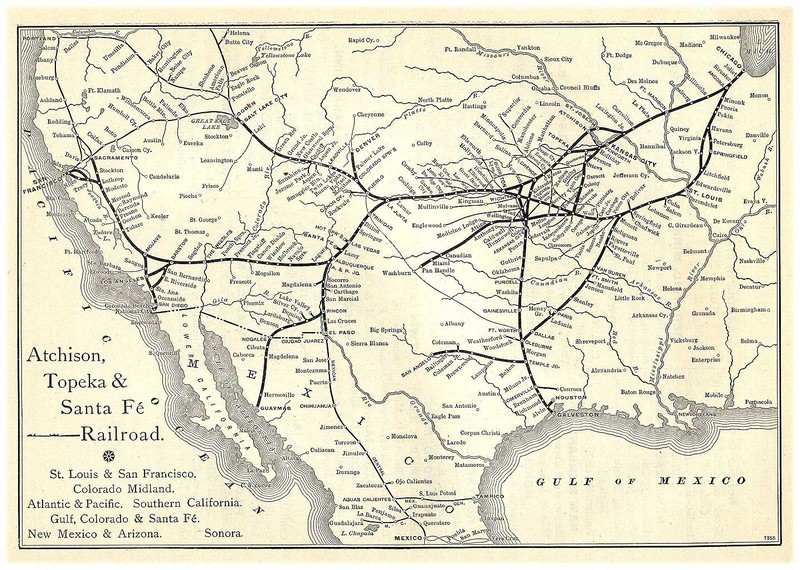
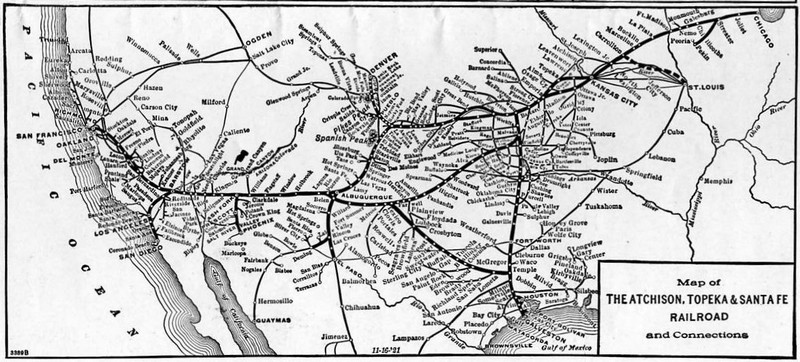
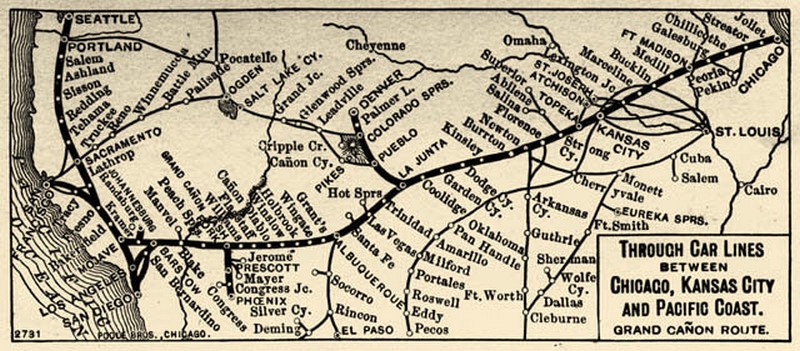
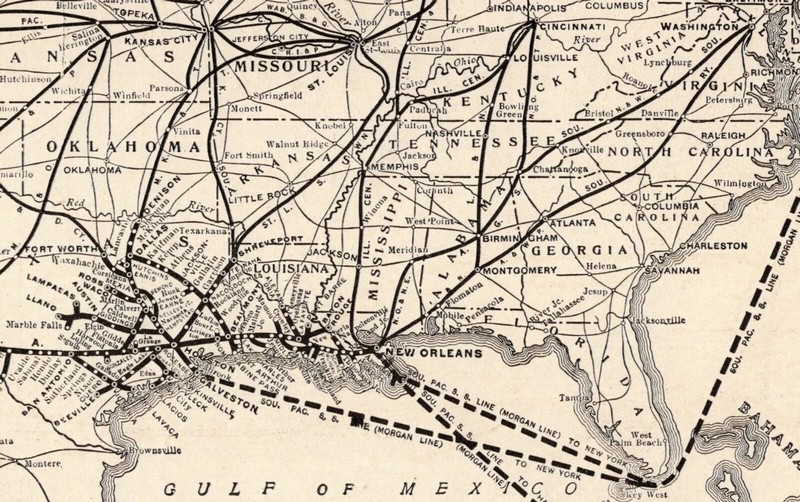
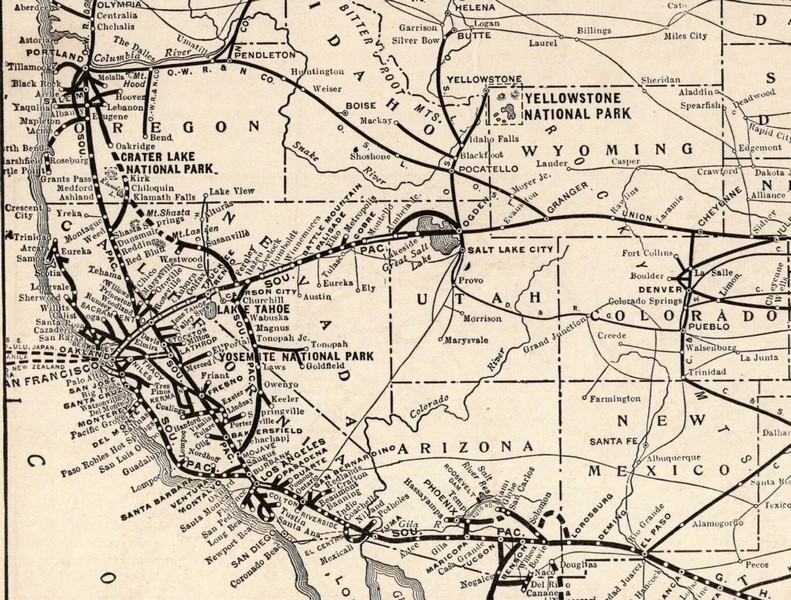
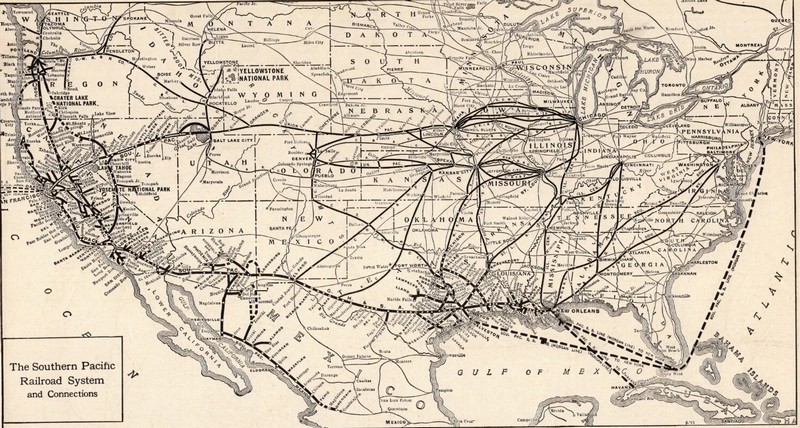
The system was eventually expanded with branch lines into California, Arizona, Texas, New Mexico, Colorado, Kansas, Missouri, Oklahoma, Louisiana, and Illinois. It reached Arizona and California by acquiring control of the western portion of the Atlantic and Pacific Railroad in 1880. It reached Chicago by acquiring the Chicago and St. Louis Railway in 1887. By 1887 the mainline had been completed from Chicago to Los Angeles, making it one of the country’s most important railroads and one of the few that directly connected the Midwest with the Gulf of Mexico and the Pacific Ocean under one corporation.
Emporia, Kansas, to Oklahoma City to Fort Worth to Houston;
Emporia, Kansas, to Dalies, New Mexico;
Barstow to Richmond, California (the Valley Division);
Temple to Farwell, Texas;
Denver to La Junta, Colorado;
Albuquerque, New Mexico, to El Paso, Texas;
Dallas to Presidio, Texas; and
Kansas City to Tulsa.
An AT&SF trademark in the late 19th century incorporated the British lion out of respect for the country's financial assistance in building the railroad to California. Gold bond of the Atchison, Topeka and Santa Fe Railroad Company, issued October 1, 1889
Physical confrontations led to two years of armed conflict that became known as the Royal Gorge Railroad War. Federal intervention prompted an out-of-court settlement on February 2, 1880, in the form of the so-called "Treaty of Boston", wherein the Denver & Rio Grande railroad was allowed to complete its line and lease it for use by the Santa Fe railroad.
Building across Kansas and eastern Colorado was simple, with few natural obstacles, but the railroad found it almost economically impossible because of the sparse population. It set up real estate offices in the area and promoted settlement across Kansas on the land granted to it by Congress in 1863.
The Santa Fe entered Texas by starting what became the Panhandle and Santa Fe Railway in 1886 and acquiring the Gulf, Colorado and Santa Fe Railway in 1887. The Santa Fe reached San Francisco by buying the San Francisco & San Joaquin Valley Railway in 1891. They completed a Grand Canyon branch in 1901. The Santa Fe acquired the properties of the Southern California Railway in 1906. They acquired a Phoenix branch with the purchase of the Santa Fe, Prescott and Phoenix Railway in 1911.
On March 29, 1955, the railway was one of many companies that sponsored attractions in Disneyland with its five-year sponsorship of all Disneyland trains and stations until 1974. In 1960, AT&SF bought the Toledo, Peoria & Western Railroad (TP&W); then sold a half-interest to the Pennsylvania Railroad (PRR). The TP&W cut straight east across Illinois from near Fort Madison, Iowa (Lomax, IL), to a connection with the PRR at Effner, Indiana (Illinois-Indiana border), forming a bypass around Chicago for traffic moving between the two lines. The TP&W route did not mesh with the traffic patterns Conrail developed after 1976, so AT&SF bought back the other half, merged the TP&W in 1983, then sold it back into independence in 1989.
The companies were so confident the merger would be approved that they began repainting locomotives and non-revenue rolling stock in a new unified paint scheme. While Southern Pacific (railroad) was sold off to Rio Grande Industries, all of the SP's real estate holdings were consolidated into a new company, Catellus Development Corporation, making it California's largest private landowner, of which Santa Fe remained the owner. In the early 1980s, gold was discovered on several properties west of Battle Mountain, Nevada along I-80, on ground owned by the Santa Fe Railroad (formerly SP). The Santa Fe Pacific Corporation (a name correlation of Santa Fe and Southern Pacific) was to develop the properties. They were sold to Newmont during 1997 in preparation for the merger with Burlington Northern). Sometime later, Catellus would purchase the Union Pacific Railroad's interest in the Los Angeles Union Passenger Terminal (LAUPT).
Total track length 62 miles (100 km) 13,115 miles (21,107 km)
Freight carried 98,920 tons 59,565,100 tons
Passengers carried 33,630 11,264,000
Locomotives owned 6 1,759
Unpowered rolling stock owned 141 81,974 freight cars
1,436 passenger cars
Revenue Freight Ton-Miles (Millions)
ATSF/GC&SF/P&SF Oklahoma City-Ada-Atoka FtWorth & Rio Grande KCM&O/KCM&O of Texas Clinton & Oklahoma Western New Mexico Central
1925 13,862 14 42 330 2 1
1933 8,712 12 18 (incl P&SF) (incl P&SF) (incl ATSF)
1944 37,603 45 (incl GC&SF)
1960 36,635 20
1970 48,328 (merged)
Revenue Passenger-Miles (Millions)
ATSF/GC&SF/P&SF Oklahoma City-Ada-Atoka FtWorth & Rio Grande KCM&O/KCM&O of Texas Clinton & Oklahoma Western New Mexico Central
1925 1,410 5 6 8 0.1 0.1
1933 555 0.1 0.8 (incl P&SF) (incl P&SF) (incl ATSF)
1944 6,250 0.2 (incl GC&SF)
1960 1,689 0
1970 727 (merged)
To reach smaller communities, the railroad operated mixed (passenger and freight) trains or gas-electric doodlebug rail cars. The latter were later converted to diesel power, and one pair of Budd Rail Diesel Cars was eventually added. After World War II, Santa Fe Trailways buses replaced most of these lesser trains. These smaller trains generally were not named; only the train numbers were used to differentiate services.
AT&SF ceased operating passenger trains on May 1, 1971, when it conveyed its remaining trains to Amtrak. These included the Super Chief / El Capitan, the Texas Chief and the San Diegan (though Amtrak reduced the San Diegan from three daily round trips to two). Discontinued were the San Francisco Chief, the ex-Grand Canyon, the Tulsan, and a Denver–La Junta local. ATSF had been more than willing to retain the San Diegan and its famed Chiefs. However, any railroad that opted out of Amtrak would have been required to operate all of its passenger routes until at least 1976. The prospect of having to keep operating its less-successful routes, especially the money-bleeding 23/24 (the former Grand Canyon) led ATSF to get out of passenger service altogether.
Amtrak still runs the Super Chief and San Diegan today as the Southwest Chief and Pacific Surfliner, respectively, although the original routes and equipment have been modified by Amtrak.
The Angelo: San Angelo, Texas - Fort Worth, Texas (on the GC&SF)
The Antelope: Oklahoma City, Oklahoma - Kansas City, Missouri
Atlantic Express: Los Angeles, California - Kansas City, Missouri (this was the eastbound version of the Los Angeles Express).
California Express: Chicago, Illinois - Kansas City, Missouri - Los Angeles, California
California Fast Mail: Chicago, Illinois - Los Angeles, California - San Francisco, California
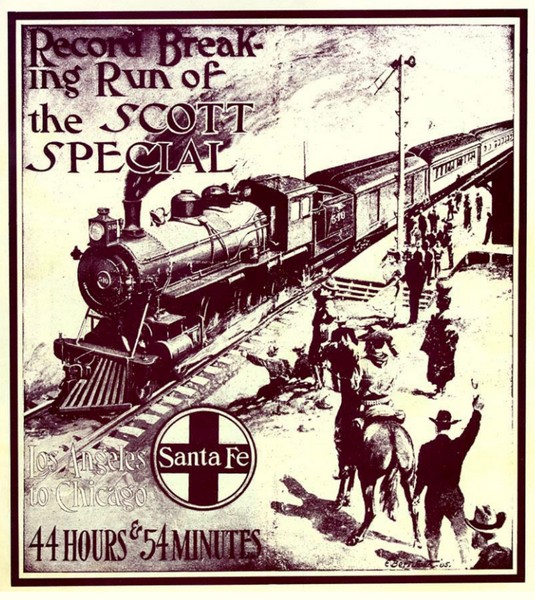
California Limited: Chicago, Illinois - Los Angeles, California
California Special: Clovis, New Mexico - Houston, Texas (with through connections to California via the San Francisco Chief at Clovis)
Cavern: Clovis, New Mexico - Carlsbad, New Mexico (connected with the Scout).
Centennial State: Denver, Colorado - Chicago, Illinois
Central Texas Express: Sweetwater, Texas - Lubbock, Texas
Chicagoan: Kansas City, Missouri - Chicago, Illinois (this was the eastbound version of the Kansas Cityan passenger train).
Chicago Express: Newton, Kansas - Chicago, Illinois
Chicago Fast Mail: San Francisco, California - Los Angeles, California - Chicago, Illinois
Chicago-Kansas City Flyer: Chicago, Illinois - Kansas City, Missouri
The Chief: Chicago, Illinois - Los Angeles, California
Eastern Express: Lubbock, Texas - Amarillo, Texas (this was the eastbound version of the West Texas Express).
El Capitan: Chicago, Illinois - Los Angeles, California
El Pasoan: El Paso, Texas - Albuquerque, New Mexico
El Tovar: Los Angeles, California - Chicago, Illinois (via Belen)
Fargo Fast Mail/Express: Belen, New Mexico - Amarillo, Texas - Kansas City, Missouri - Chicago, Illinois
Fast Fifteen: Newton, Kansas - Galveston, Texas
Fast Mail Express: San Francisco, California (via Los Angeles) - Chicago, Illinois
Golden Gate: Oakland, California - Bakersfield, California, with coordinated connecting bus service to Los Angeles and San Francisco
Grand Canyon Limited: Chicago, Illinois - Los Angeles, California
Hassayampa Flyer: Phoenix, Arizona - Ash Fork, Arizona (later Williams Junction, Arizona)
The Hopi: Los Angeles, California - Chicago, Illinois
Kansas Cityan: Chicago, Illinois - Kansas City, Missouri (this was the westbound version of the Chicagoan passenger train).
Kansas City Chief: Kansas City, Missouri - Chicago, Illinois
The Kite-Shaped Track: Los Angeles-area excursion
Los Angeles Express: Chicago, Illinois - Los Angeles, California (this was the westbound version of the Atlantic Express).
The Missionary: San Francisco, California - Belen, New Mexico - Amarillo, Texas - Kansas City, Missouri - Chicago, Illinois
Navajo: Chicago, Illinois - San Francisco, California (via Los Angeles)
Oil Flyer: Kansas City, Missouri - Tulsa, Oklahoma, with through sleepers to Chicago via other trains
Overland Limited: Chicago, Illinois - Los Angeles, California
Phoenix Express: Los Angeles, California - Phoenix, Arizona
The Ranger: Kansas City, Missouri - Chicago, Illinois
The Saint: San Diego, California - Los Angeles, California - San Francisco, California (this was the northbound version of the "Angel")
San Diegan: Los Angeles, California - San Diego, California
San Francisco Chief: San Francisco, California - Chicago, Illinois
San Francisco Express: Chicago, Illinois - San Francisco, California (via Los Angeles)
Santa Fe de Luxe: Chicago, Illinois - Los Angeles, California - San Francisco, California
Santa Fe Eight: Belen, New Mexico - Amarillo, Texas - Kansas City, Missouri - Chicago, Illinois
The Scout: Chicago, Illinois - San Francisco, California (via Los Angeles)
South Plains Express: Sweetwater, Texas - Lubbock, Texas
Super Chief: Chicago, Illinois - Los Angeles, California
The Texan: Houston, Texas - New Orleans, Louisiana (on the GC&SF between Galveston and Houston, then via the Missouri Pacific Railroad between Houston and New Orleans).
Texas Chief: Galveston, Texas (on the GC&SF) - Chicago, Illinois
Tourist Flyer: Chicago, Illinois - San Francisco, California (via Los Angeles)
The Tulsan: Tulsa, Oklahoma - Kansas City, Mo. with through coaches to Chicago, Illinois, via other trains (initially the Chicagoan/Kansas Cityan)
Valley Flyer: Oakland, California - Bakersfield, California
West Texas Express: Amarillo, Texas - Lubbock, Texas (this was the westbound version of the Eastern Express).
