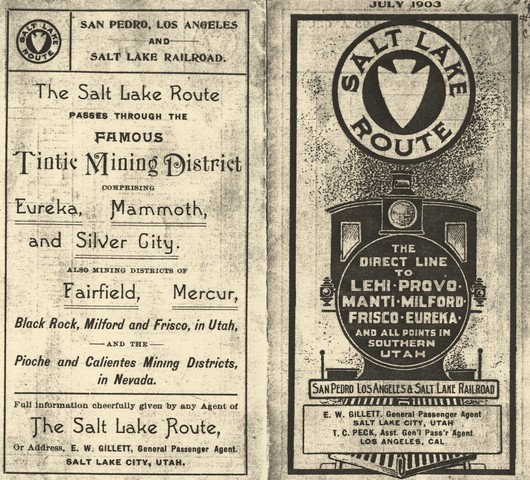
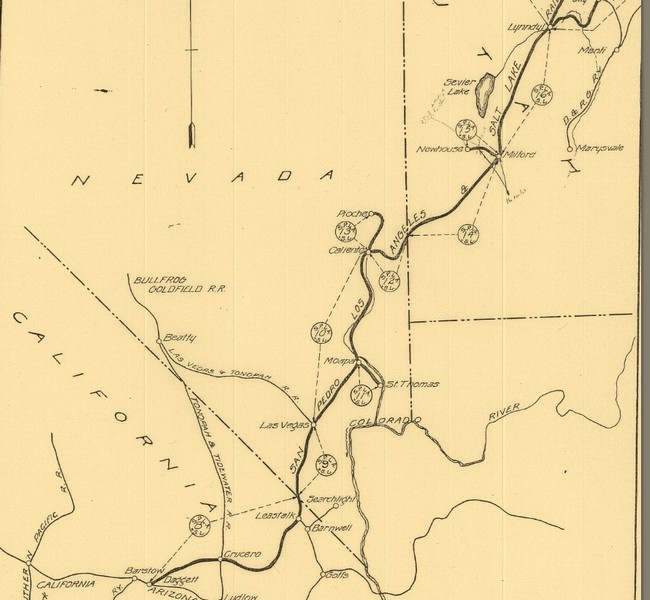
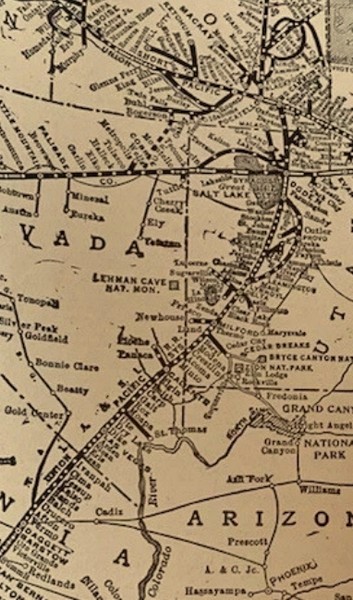
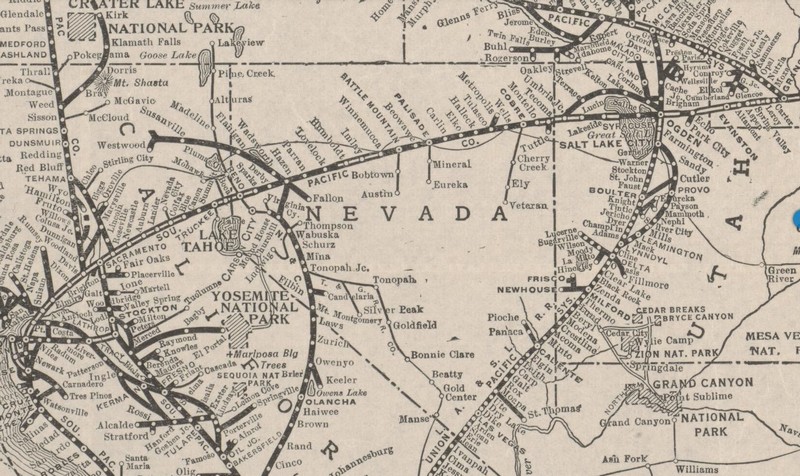
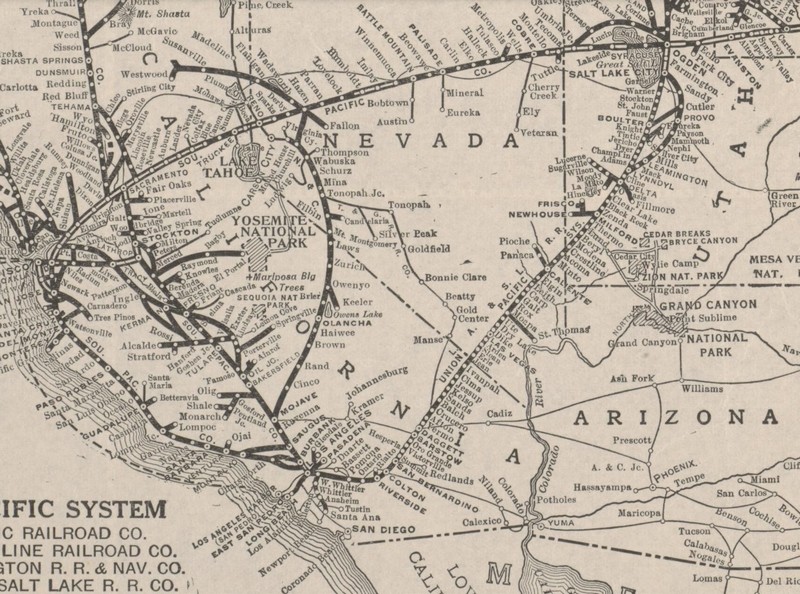
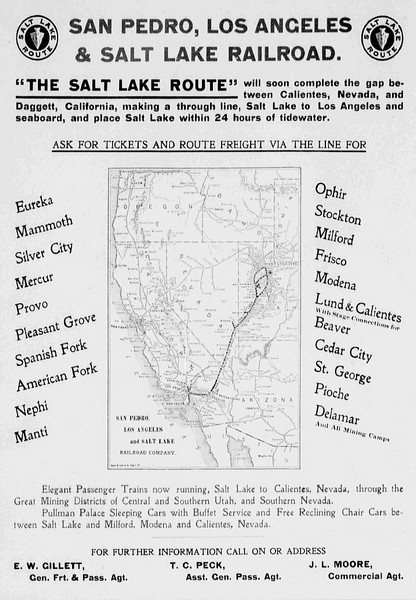
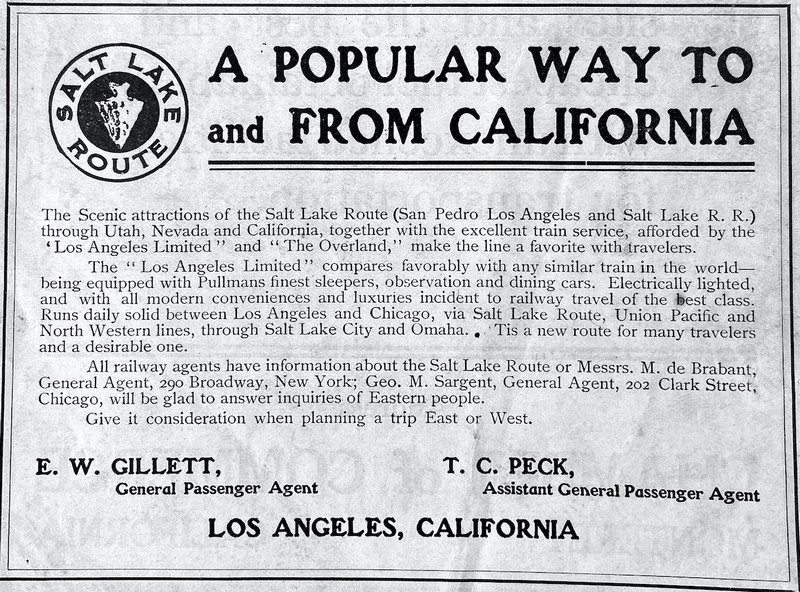


Clark's forces began construction work in Nevada, along the existing UP grade, and a brief "railroad war" ensued before Clark and the UP called a truce in 1903. Their agreement called for Clark's railroad to acquire the existing UP trackage south of Salt Lake City. In turn, the UP received a 50% interest in Clark's railroad. Construction of the remaining line proceeded rapidly to Daggett, California, where it connected to the Atchison, Topeka and Santa Fe Railway (ATSF), and the complete Salt Lake–Los Angeles line was opened on May 1, 1905. In California, Clark negotiated a trackage rights agreement from Daggett to Riverside, California, allowing his new line to use the existing ATSF route over Cajon Pass, in lieu of constructing its own tracks across the pass.
On April 16, 1916, the railroad’s stockholders voted to remove "San Pedro" from the corporation's name. The former town of San Pedro had been consolidated within Los Angeles in 1909. The LA&SL operated independently until April 27, 1921, when the UP agreed to acquire Clark's half-interest in the railroad. After 1921 the LA&SL lines were operated as part of the UP system, although the LA&SL corporation continued to exist on paper until January 1, 1988. The former LA&SL main line remains part of the UP network today as the Caliente and Lynndyl subdivisions.
In 1925, LA&SL reported 1,158 million ton-miles of revenue freight and 192 million passenger-miles. At the end of that year it operated 1,208 miles (1,944 km) of road and 1,970 miles (3,170 km) of track.
Originally, the LA&SL tracks through Utah were the approximate boundary between the Pacific Time Zone and the Mountain Time Zone. However, in April 1969, the time zone boundary was moved such that all of Utah was in the Mountain Time Zone.
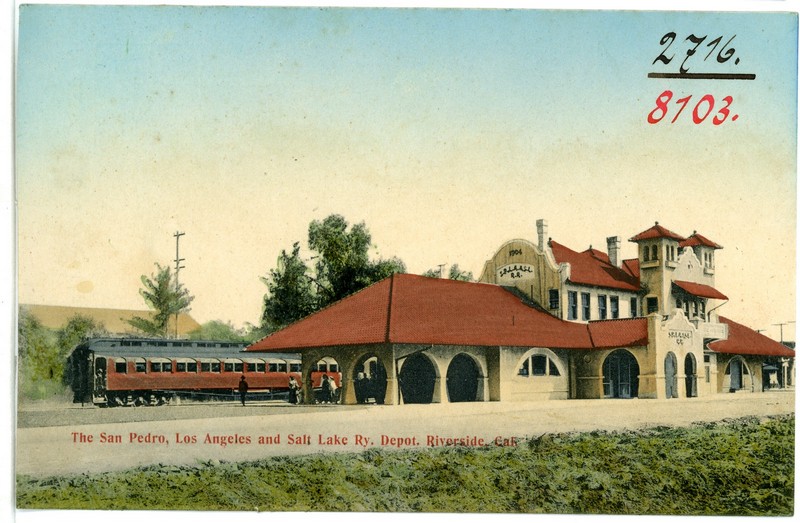
The LA&SL was known for its depot buildings, many of which were imposing structures in the Mission Revival architectural style. The largest such depot, at Milford, was razed in 1981 and replaced with a smaller rail office, which remains in use today. The landmark LA&SL stations in Caliente and Kelso survive today. Several smaller Mission Revival depots erected by the railroad still exist in southern California. At least two of the railroad's smaller stations, at Lund and Black Rock in Utah, were designed by the noted architect Gilbert Stanley Underwood. The Salt Lake City depot was built in the French Renaissance style and is a landmark in that city.
An auxiliary locomotive repair shop erected in 1917 at 516 South Anderson Street in Boyle Heights, Los Angeles, stands as a rare surviving piece of the network's local infrastructure. The concrete and steel frame warehouse retains a faded, original painted arrowhead logo of the "Salt Lake Route" near the roof apex of its eastern elevation, confirming its historical use as a maintenance facility for the line.
