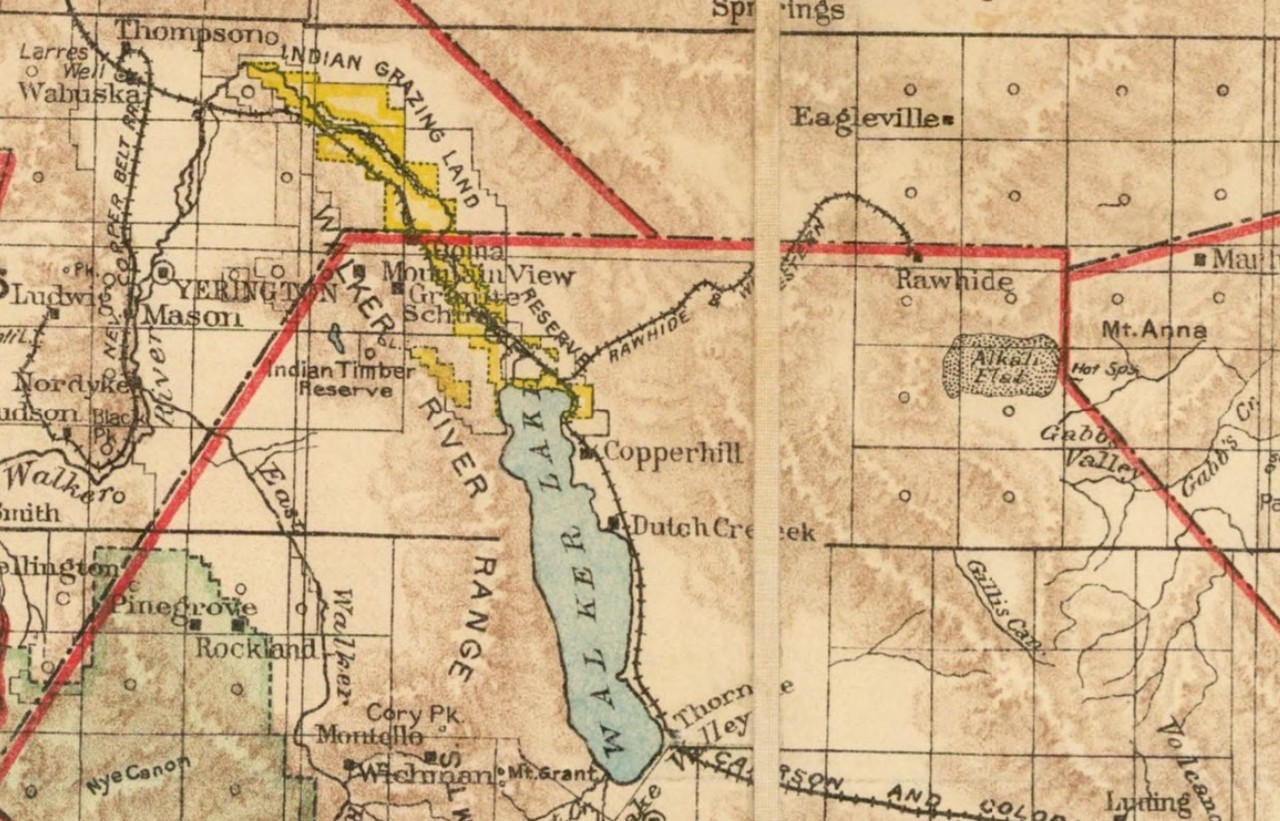
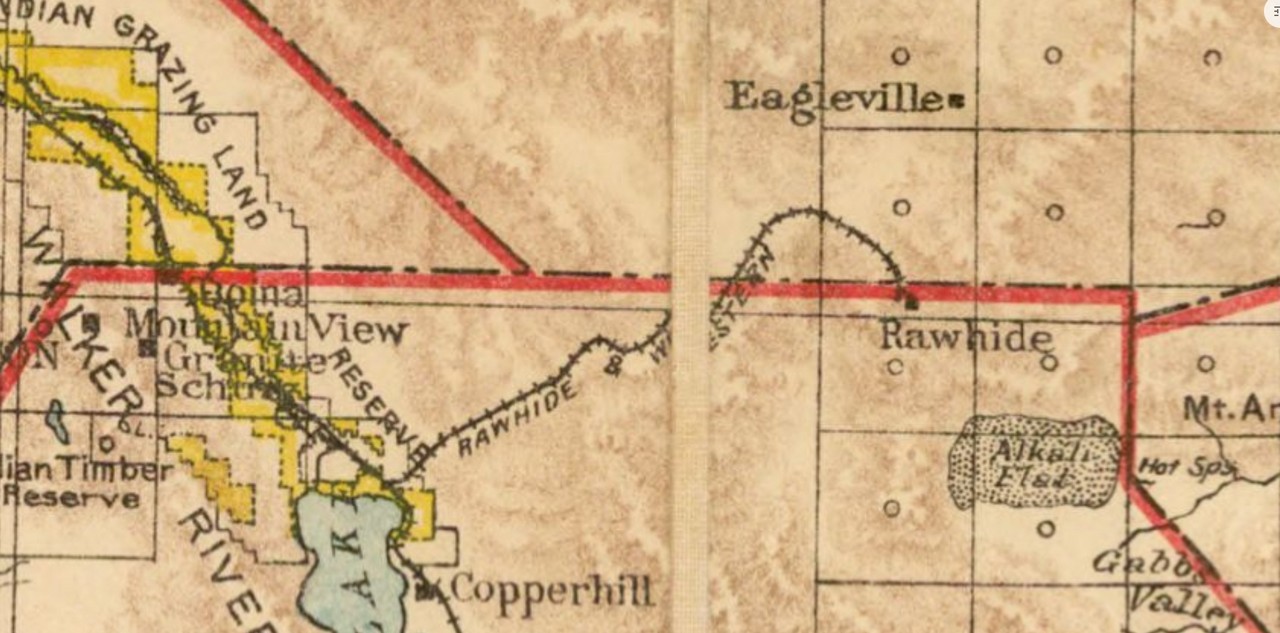
The Rawhide Western Railway was a proposed railroad to run from Rawhide, Nevada to Schurz, Nevada on the Southern Pacific Railroad line; by 1908 the company completed grading of the roadbed but no track was ever laid.

The Rawhide Western Railway was a proposed railroad to run from Rawhide, Nevada to Schurz, Nevada on the Southern Pacific Railroad line. -- contracts between the company and mine owners, and maps of railroad rights-of-way through some Rawhide mines.


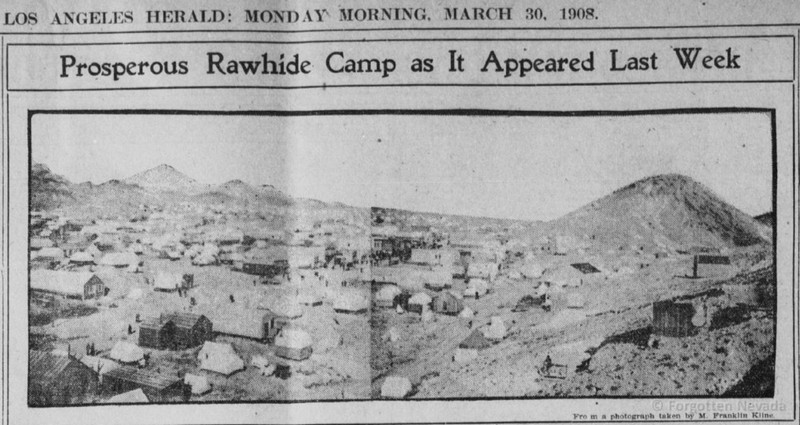
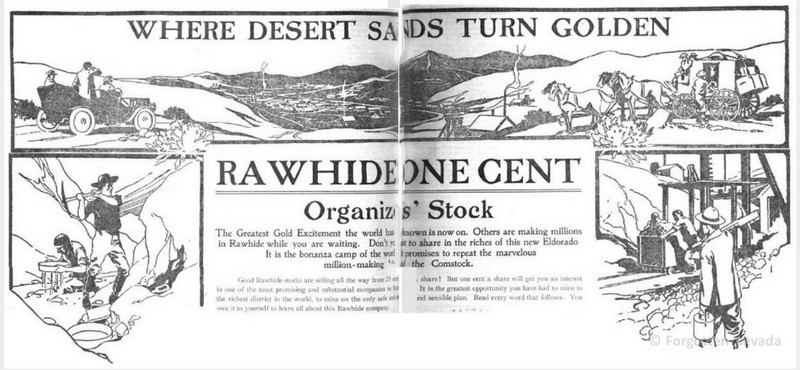
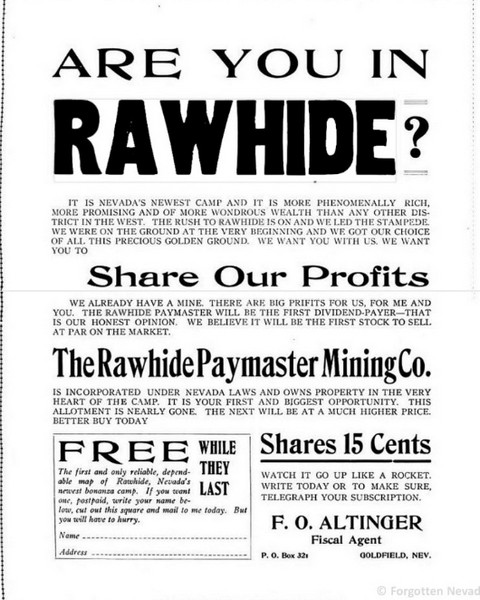
Despite the fact that virtually nothing remains of the old Nevada mining town of Rawhide, the place continues to fascinate ghost town explorers and historians. Perhaps it's because of its colorful name - Rawhide - which conjures images of old prospectors wandering the streets with their burros and pickaxes and streets lined with frontier false storefronts offering everything from overnight accommodations to adult beverages. But while once upon a time Rawhide might have been able to boast all of those iconic Old West amenities, it's been a long time since anyone has been able to belly up to a bar or pick up a sack of flour. Rawhide traces its origins to December 1906, when a miner named Jim Swanson is said to have found gold in the area, which is west of the Buckskin Mountains of central Nevada. A few months later, Charles Holman and Charles McLeod joined Swanson in working the site. Holman, in fact, is credited with naming the town. Allegedly, he called it Rawhide as a play on words to indicate his dislike for a nearby mining camp called Buckskin, which had tossed him out. McLeod and Holman staked several claims on a mound that became known as Hooligan Hill. Their holdings proved promising and they sold them to a larger mining operation for $20,000 plus 10 percent of the profits. By the end of 1907, word about Rawhide's riches had spread and it became a classic Nevada mining boomtown that swelled to about 7,000 people. The rush to Rawhide attracted a number of well-known - and notorious - western figures including Bill "Swiftwater" Gates, who had made a fortune in the Alaska gold rush, as well as "Diamondfield" Jack Davis, who occasionally worked as an enforcer and strike-breaker for Goldfield’s mining boss, George Wingfield. Additionally, among those early residents was George Graham Rice, a legendary conman who reportedly had embezzled about $100,000 from investors during the earlier Goldfield mining boom. Other, more reputable arrivals included George "Tex" Rickard, who opened a bar in Rawhide called the Northern, and invested in several local mines. Despite all the interest and feverish activity, Rawhide’s glory days were brief, less than a half dozen years. One of the town’s main challenges was a lack of a water source. The precious liquid had to be hauled in from a distant well and was sold at the incredible price of 5 cents per gallon. Still, at its peak Rawhide had a telegraph and long distance telephone service as well as three banks, five newspapers, a half-dozen restaurants, several dozen shops and hotels, more than 30 saloons, a school and a thriving red light district known as Stingaree Gulch. It was also served by a daily automobile-stage with mail service from several surrounding communities. In September 1908, however, tragedy struck the town when fire destroyed a third of a mile of local businesses and residences. While some of Rawhide was immediately rebuilt, the community didn’t entirely recover as mining revenues began to dip. Less than a year later, the Rawhide boom was over. Most of the population moved on to other, more promising communities. By the 1920s, Rawhide was almost completely abandoned. But while the town didn’t last very long, it did make an impression. In 1908, famous British romance novelist Elinor Glyn came to Rawhide to get the flavor of a real western town for her books and wrote about her visit.


Rawhide also experienced several unsuccessful railroad-building attempts. The closest to becoming a reality was the Rawhide Western Railroad, which would have linked the town to the Nevada-California Railroad at Schurz. With less than three miles of grading to be completed, the railroad line was abandoned after investors bailed following the 1908 fire. Today, old Rawhide is long gone. Modern mining operations can be seen in the area, but there is little to mark the town beside a small cemetery. Even the original Rawhide Jail has been relocated to the city complex in Hawthorne. The former site of Rawhide is located about 55 miles southeast of Fallon via U.S. 50 (go about 30 miles), Nevada State Route 839 (turn right and continue another 10 miles) and about two miles of dirt roads.


The Rawhide mine is located approximately 50 miles from Fallon, along the Walker Lane Trend, in Nevada amidst multiple historic mines. These operations, including Comstock, Round Mountain, Borealis, and Tonapah, produced more than 1M ounces of gold. Rawhide was formerly operated as a subsidiary of Kennecott Corporation prior to Coral Reef Capital, a private investment firm based in New York City, partnering with the Rawhide mine management team to acquire the property from Rio Tinto Plc in 2010.

Rawhide is a fully permitted open pit heap leaching operation that would produce gold and silver ore. Operations are currently under care and maintenance due to financial difficulties faced by the operator. Since 1990, more than 1.96MM gold equivalent ounces have been produced.

Rawhide is fully permitted for expansion with numerous identified exploration targets and thus, it has the potential to increase both the life of mine and production scale. As a privately owned operation, there is no publicly available mineral resource estimate for Rawhide.


In the early years placer gold was produced and were still being worked during lode mining. The largest nugget being 4 Troy Oz. To be a bit more fair to the promoters and stock brokers who got a bum rap for Rawhide not turning out to be another Comstock or Goldfield, they didn’t have a crystal ball and in the beginning all indications were that it was another big bonanza. In the early years it did produce some high grades. Between 1908-1916 the mines produced $933,833.00 in gold or 46,691 Troy ounces gold and $350,476.00 or an equivalent in Troy ounces in silver. After the boom years, some mines produced up to 1943 totaling $1,610,246.00 with about $3,000 in copper & lead. Often we read mining history or hear documentary narrators say "the ore played out" or "the gold and silver was gone" and in most cases this is false. For early miners it was a matter of economics, ore grades and technology of the time. Initially it took 2+ OPT gold ore to mine at a profit and gradually they could mine lower grades to a cut off grade of about 1/2 OPT as methods improved. Ultimately the early miners left most of the gold and silver in the ground. By the late 1980s exploration started for modern mining potential and by around 1990 mining started again. Kennicott put the low sulfide Epithermal ore deposit back into production known as the Denton Rawhide Mine. Bill Denton owned most of the mining claims but didn't live long enough to see his dream of mining come to fruition. Fortunately his family kept the dream alive and benefited greatly through the acquisition of those mining claims.

Ultimately over a decade of Kennecott mining produced 1.2 million ounces of gold and 12 million ounces of silver. After the Kennicott years ending in 2002 the mine sat idle for a few years until it was sold to investors and became Rawhide Mining LLC, bringing total production to about 2 million ounces gold and 15 million silver ounces. The mine is now shut down.

Back filling of Crazy Pit completed. Murray Pit deeper now and leach pad now grown in size with millions of tons of ore from structurally controlled stock work veins and disseminated gold and silver. Over forty times more gold was left in the ground by early miners of the boom town era. The ore deposits were not worked out or depleted and still aren’t. Considerable ore was left between Murray and Crazy Pits as well as under the waste dump next to Crazy Pit. Also ore left at Regent 1/2 mile to the west, right side of photo. The mine will likely never see further production at this point.


For a period of time the road between Hawthorne and Fallon was closed. There was a detour that would take you through Gabbs. I did a bit of driving around the area out there and you could see old mines. I said I was going to go back but I never did with a detector.

I'm told there could be some gold around Luning and Mina but I don't know how to access the area.

For a period of time the road between Hawthorne and Fallon was closed. There was a detour that would take you through Gabbs. I did a bit of driving around the area out there and you could see old mines. I said I was going to go back but I never did with a detector.


Disclaimer: We search for HISTORY as a hobby. Endless souces. Much can come from others neverless endless sources. Does this website sell anything ? NO Donations ? NO. This is non-commercial. I consider my websites under copyright. Again..no money here !! Educational.


go back