Job's trading post nestled right beside the Emigrant Trail, a convenient spot for both passing emigrants and nearby settlers. Soon, a small cluster of homes and businesses sprang up beside Job's early store.
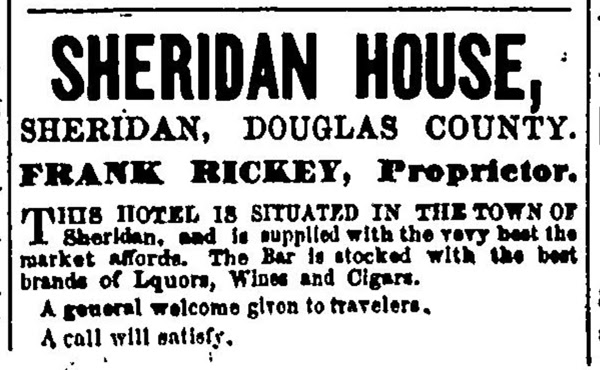
The Sheridan Hotel first opened its doors in the early 1860's - yet another convenience for travelers on the dusty Emigrant Trail. Soon, Sheridan could boast two hotels - along with (no surprise) two saloons. The Sheridan store became a surprisingly large, well-stocked operation; in 1865, for example, some 9,000 pounds of merchandise were shipped in for winter supplies. A small branch post office inside the store opened that same year, with James Billis as Sheridan's first postmaster. For a short time the tiny town even boasted its own newspaper, though editor Will Lee "failed to keep the wolf from the door," and by 1881 the paper had folded.
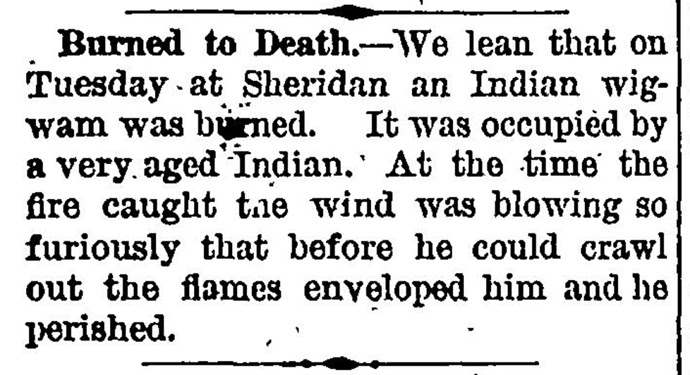
The first inhabitants near Sheridan, of course, were the Washoe people, and a few Native Americans continued to reside nearby even as the town grew. Sadly, little history of the Washoe presence at Sheridan has been documented. But one tragic tale did make the local newspaper - and confirms that traditional shelters were still being used in 1877.
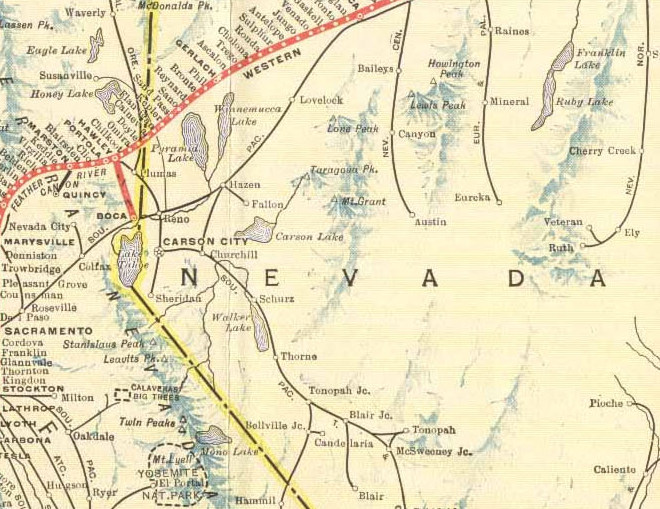
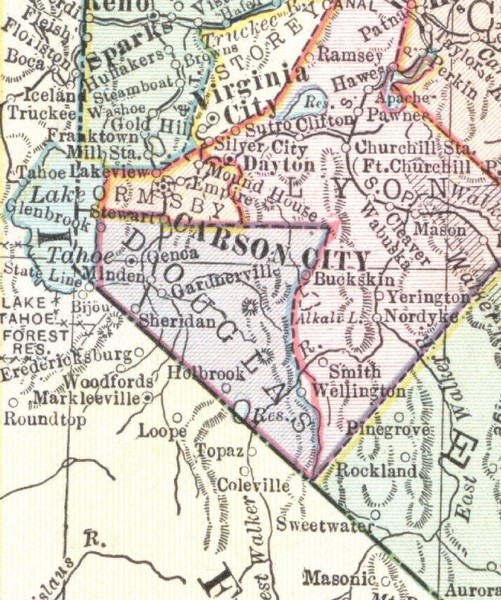
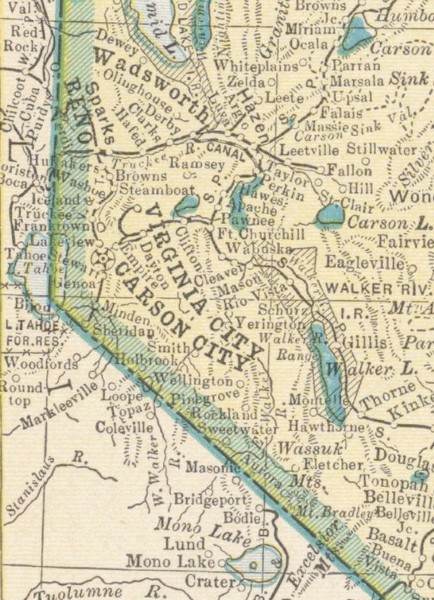
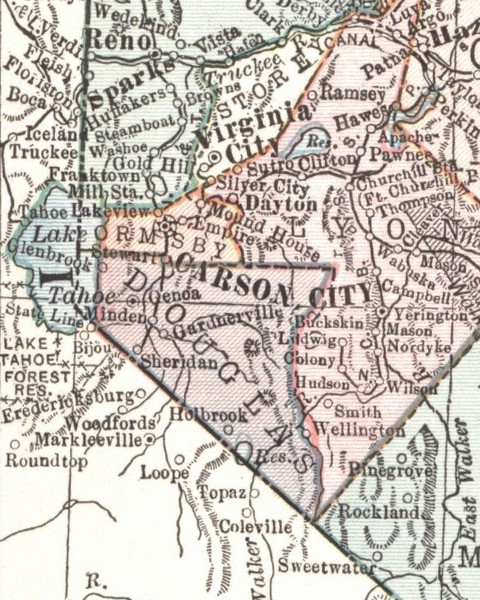
Tragic story of a "very aged Indian" who perished in a fire at Sheridan in 1877. (Carson Valley News, May 11, 1877). By the mid-1870s the flow of emigrant wagons past the Sheridan House's front door had largely ceased. So in 1878, resourceful landlady Mrs. Laughan simply converted the hotel to a boarding house. Still, at least one Sheridan saloon was doing well enough at the time to invest in a brand new billiard table. And an 1879 Nevada map depicted Sheridan as larger than Las Vegas !
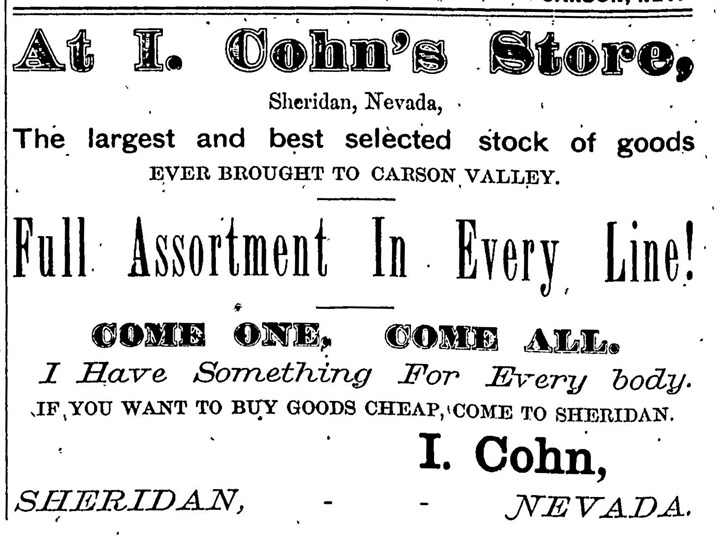
A dance hall was erected at Sheridan in 1884 by Will Wyatt. And by the late 1880's, Sheridan had grown into what one Surveyor-General's report would call "the metropolis of the Carson River West Fork farmers." The early store was now flanked by two hotels, a post office, a saloon, and a blacksmith/wagon shop. The Sheridan store changed hands again in the 1880's, and was acquired by Casper Tucke. This building, too, boasted a dance hall on the second floor. By 1889, the Sheridan store was operated by I. Cohn. About 1900 it became Barrett & Tucke. Sheridan was the backdrop for several local dramas.
In 1874, love-lorn Billie Summers shot an unarmed man named Frank Ben just up the road at the Sophie Miller ranch. Frank, it seems, had "been maligning [Billie] to his sweetheart." Billie, just 24 years old and "crazy drunk" at the time, was sentenced to hang for the murder. But just two days before Billie's scheduled demise, the Nevada Board of Pardons granted clemency, commuting his sentence to life imprisonment instead.
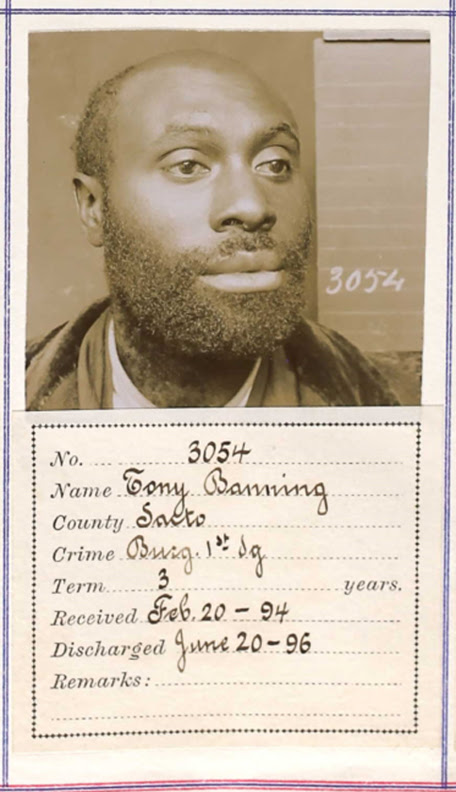
The Sheridan House itself was the scene of both happiness and tragedy. A baby was born there in April, 1875, for example, to the wife of hotel proprietor Frank Rickey. Birth announcement showing baby born to Mrs. Rickey "at Sheridan" on April 19, 1875 (Carson Valley News, April 24, 1875). But a different happy occasion at Sheridan House - a wedding - would spiral into tragedy. Pretty Julia Bailey married Antoine Banning at Sheridan House in 1882, with some 60 guests helping them celebrate. The Bannings went on to have three children together. But Antoine developed a reputation as a "bad egg." He was suspected of killing "Old Bailey" at a cabin on Old Clear Creek Road (though he was never prosecuted for that murder). Then in 1892, Banning got arrested for holding a razor to wife Julia's throat. The charges were dismissed, but Julia wisely left him. Nine months later, Banning was arrested again in Sacramento for violently assaulting the man who'd probably helped Julia to escape. Julia testified against her husband, but again, Banning was let go. Instead, Julia was suspected of being a street-walker and was convicted on a charge of vagrancy. The law finally caught up with Antoine Banning in 1894. He was arrested for stealing wheat from his employer near Sacramento - using his employer's own team and wagon to ferry the stolen wheat to a mill to be sold. Banning spent three years in Folsom Prison for that crime. He eventually died in Carson City in 1917. It wasn't first wife Julia at his bedside as Tony breathed his last, but perhaps a common-law wife - "Lottie Banning, as she calls herself."
As for the town of Sheridan ? Well, a fire broke out at store-owner Isador Cohn's house in late March, 1893. The fire engine was successfully rolled out, but "on account of not having had a fire here for a good many years," the boiler was found to be "out of order." A hasty bucket-brigade was formed, and the newspaper happily reported that "by hard and faithful work the boys got the fire under control," after working "like tigers." The store was saved - that time.
But in 1911, another major fire at Sheridan broke out. This time it started in the two-story wooden store, recently taken over by the Russell Brothers. The flames spread quickly to neighboring structures. Once again, fire-fighting equipment wasn't available. Sadly, this time, the flames won out. The store about 1900, roughly ten years before its demise, as the "Barrett & Tucke" store. Lost in the 1911 fire were not only some $5,000 in store merchandise but also the contents of the post office inside and the dance hall above. The Tucke home, a saloon, and nearby outbuildings were also lost. Total damage from the fire came in at nearly $25,000.
The only good news? The early Sheridan House, slightly to the south, remained untouched. The old stone grist mill, too, survived. They're both still here today - all that's left of the once-bustling town that was Sheridan.
After the discovery of the Comstock Lode (1858) settlers extended the natural meadows by irrigation to provide hay, meat, and butter for the miners in Virginia City and neighboring towns. Starting in 1870, German, Danish, and Swiss immigrants enlarged the area again to supply produce to booming Bodie and, after 1905, to supply Tonopah and Goldfield. Good range and agricultural practices have allowed Carson Valley to continue to be one of Nevada's finest agricultural areas.
The road and bridge were purchased by Douglas County in 1895 for $5,000.
When the telegraph line from Placerville through Genoa was strung along it in 1863, the Boyd Road was also called "Telegraph Road." It was purchased by Douglas County from Henry Van Sickle and Lawrence Gilman in 1876 for $2,650.
About four miles north along the highway is the former location of Mammoth Ledge, also known as Carter's Station. That site served as the post office for the Eagle Mining District, and the polling place in 1861 of the Mammoth Precinct of Douglas County. Stations like these provided water, supplies, and rest for travelers prior to the popularization of the automobile.
Thousands of emigrants moved over the old road skirting the west bank of the Carson River they prepared to cross the Sierra, feeding their livestock on grass cut along the river. At Genoa; at Mottsville, settled in 1852; and at Sheridan, settled by Moses Job about '54; emigrants stopped to enjoy produce from the region's first gardens. Pony Express riders used this route in 1860, switching a year later to the shorter Daggett Trail, now Kingsbury Grade.
Before the intrusion of European Americans in the 1850's, Washoes spent the winter in the Pinenut Hills, where they stored autumn harvested pinenuts. In summer, they lived in the Lake Tahoe Basin, fishing the tributary streams and gathering roots and berries. In fall, they hunted rabbits and gathered seeds in Carson Valley.
The men spent about $70,000 to construct a wagon road to meet the demand for a more direct route from California to the Washoe mines and to shorten the distance between Sacramento and Virginia City by ten miles. The new 16-foot wide road, supported in some places by granite retaining walls on both sides, made the passage easier for travelers on this main route from California. Merchants and teamsters frequently traveled this road moving goods and people in and out of Nevada.
In 1863, some of the tolls were 50 cents for a man and horse and $2.00 for a horse and buggy. That year the estimated tolls collected were $75,000.
Moses Job, an irrepressible man, climbed the peak above this location, planted the American flag and with a shout named the peak after himself. Job's Canyon is above, and to its left is Job's Peak. To its right is Job's Sister.
Just as Genoa was the center for British (largely Mormon) settlers after 1851, so Gardnerville, after 1879, became the center for 1,870 Danish immigrants, who founded the Valhalla Society in 1885 and met in Valhalla Hall, one block south.
Starting in 1898, Spanish and French Basque shepherds tended some 13,000 sheep in Carson Valley, which increased to 25,000 by 1925, when the Basques began acquiring their own sheep and land. After 1918, several Basques in Gardnerville opened inns which flourished during Prohibition in the 1920's.
In 1862, along the Carson branch of the emigrant trail, David and Harriet Walley developed a $100,000 spa, eleven beds, a ballroom, and gardens. The thermal water (136 to 160 degrees F) became well known as a cure for "rheumatism and scrofulous afflictions."
Walley's Hot Springs sold for a mere $5,000 in 1896, but operated until 1935 when it burned down. Its formal cool cellar was integrated into the complex during a 1970's renovation.
In 1962, trial hydrothermal power holes were drilled here as deep as 1,250 feet and found thermal water with a maximum temperature of 181 degrees.
Principal promoter of the town, and its related development was H.F. Dangberg Jr., secretary of the company and son of the founder.
