Along the first 2.5 miles, hikers and cyclists pass through five enormous tunnels that burrow through rugged volcanic rock. A sign along the way explains that workers toiled around the clock in three shifts in 1931 and got the railroad project done in just five months. The railroad ceased to operate soon after the completion of the Hoover Dam in 1935, and the railroad tracks were removed in the 1960's. The route opened as a recreational trail in 1995.
Today, the trail's shady tunnels offer a startling contrast to the sunny blue skies of southern Nevada, and hikers silhouetted against the bright horizon are iconic images from the trail.
As enthralling as it is, though, the railroad history is just one of the trail's treasures. For much of the route, trail users are treated to sweeping views of the electric-blue waters of Lake Mead, dotted in the distance with boaters, water skiers and personal watercraft. Christie Vanover, public affairs officer for the Lake Mead National Recreation Area, says the trail's beauty, its accessibility, and its easy, flat surface combine to make the Historic Railroad Trail the recreation area’s most popular trail.
Typically, the trail provides access to the Hoover Dam, but that section of the trail was shut down temporarily in March 2020 because of the COVID-19 pandemic. Officials with the U.S. Bureau of Reclamation, which manages the dam, say it is uncertain when the section of the trail will open back up.
Meanwhile, the first 2.5 miles or so of the trail remain open to the public.
The trail, near Boulder City, attracts a steady stream of runners, walkers and cyclists.
Traversed by Boulder City spur (Union Pacific Railroad)
Location Henderson, Nevada
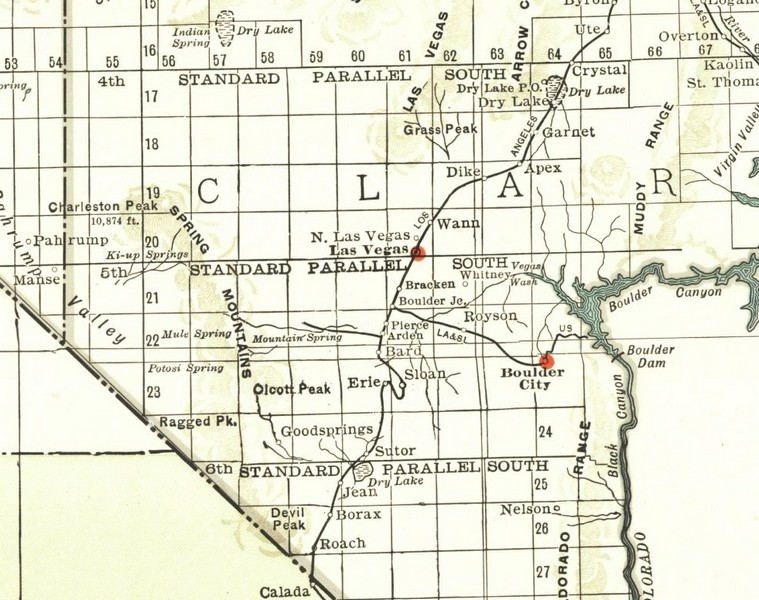
In 1998, the Nevada Department of Transportation (NDOT) paved over the at-grade crossing of the railroad tracks on Boulder Highway. The sharp skew angle (64 degrees) at this junction, high speeds on the highway, and little to no rail usage made this dangerous crossing a prime candidate for elimination. However, the historical significance of this rail spur and future potential for use by excursion and/or commuter trains merited its preservation. The initial phase of NDOT's Boulder City Bypass project will result in a new grade separation of the highway by 2015, allowing the rails to be reconnected so trains can once again reach Boulder City via Railroad Pass, As of April 10, 2018 the grade separation was complete, effectively allowing trains to reach Henderson.
The Railroad Pass Hotel/Casino, is sited on the south side of the pass. Opened on August 1, 1931, it is one of the oldest casinos still operating in Nevada.
The original casino at Railroad Pass opened in the summer of 1931, as the Railroad Pass Club. With air conditioning not yet available and faced with the triple digit heat of the Mojave Desert, there were a reported 25 electric fans blowing air through damp sheets to cool the casino. At opening, the casino featured a five-piece orchestra for dancing, roulette, craps, big six, twenty-one, and poker. Men working long hours building Boulder Dam in the heat of Black Canyon left some of their hard-earned money at Railroad Pass.
The casino at Railroad Pass is one of Nevada's oldest operating gambling casino licenses, having held Gaming License Number 3 and Gaming License Number 4. It is common knowledge the 1931 gambling casino was a cover for the speakeasy, whose secret password was "gaiety".
According to oral histories of the 1931 pioneers, the Pass obtained 200-proof alcohol, diluted it, added flavoring, and served it on ice. The ice was welcomed by those coming in from the heat, one early resident joking "I hate to drink all this whiskey to get to that ice."
Gaming and alcohol made the Pass a popular getaway for those who lived in the federal government reservation town of Boulder City. Workers returning to town had to pass through a guard gate, where they might be checked for bootleg liquor.
Prohibition agents often raided Railroad Pass for liquor. Newspapers during Boulder Dam's construction frequently reported on men arrested at the Pass for disorderly behavior and possession of liquor. The fine amount averaged $100, which was steep considering the basic wage for unskilled Boulder Dam workers was 50-cents an hour. The casino and nearby Bootleg Canyon were an annoyance to Boulder City's federal authorities, due to the free-flowing booze and vice.
Thousands came to work on the Boulder Dam Project and housing was scarce. Some preferred to live outside the government reservation. Despite its wild reputation, a tent camp of families formed at Railroad Pass. This prompted the creation of a small one-room school and the creation of the Railroad Pass School District, which existed until the town of Basic, now Henderson, established in the early 1940's.
The wild tent camp days at Railroad Pass are long gone. The former Railroad Pass Club, now the Railroad Pass Casino, has been remodeled and expanded, but includes the footprint of the original casino around which the labor camp formed. Along with Boulder City, Railroad Pass will mark its 90th anniversary in 2021.
"There's a romance to trains, a kind of magic," says Peter Barton, administrator for the Nevada Division of Museums and History. "Riding one never seems to lose its charm."
Indeed, this charm is felt by all the guests at the Nevada State Railroad Museum in Boulder City as they ride inside a 100-year-old train car (with the modern bonus of air conditioning), speak with the friendly attendants in traditional railroad uniforms, wave from the window to cyclists on the nearby bike path, and hear the quintessential train whistle that draws gasps and emblazoned smiles from toddlers to retirees.
The museum offers train rides every Saturday and Sunday, plus access to a model railroad and several historical trains, including an old post office car. It relies almost entirely on a crew of more than 80 volunteers, all of whom have earned their Federal Railroad Administration licenses.
Union Pacific discontinued its train service between Henderson and Boulder City in 1985 and offered the line to the state. Eager to acquire a piece of such significant history, the state spent several years building the facilities necessary for a museum, then began its search for a collection. The equipment includes two engines that were used to carry rockets at the Nevada Test Site: a 1939 diesel locomotive (the first of its kind on the Union Pacific Railroad); a 100-year-old caboose; and even a small, 7.5-inch gauge train that passengers sit atop to ride.
Perhaps one of the most meaningful special events held, Peter says, was when the museum hosted five surviving sailors who were stationed on the USS Nevada in World War II. The veterans were treated to an old-fashioned train ride complete with a reenactment group and '40s-era singers. "All five men rode trains to get almost everywhere throughout their time in the war," Peter says. "We were happy to stir some of their memories from that time and give them some new ones."
The museum's continually growing success is largely responsible for the expansion possibilities.
"It’s just amazing," Peter says. "Of all seven state museums, this one has the most consistent growth." Randy Hees, director of the museum, agrees. "We're seeing about a 5 percent growth in visitors per year, and the museum is earning just over half of the cost of operations," he says. "It’s able to, little by little, reduce its dependence on the state." The romance of this upwardly mobile Boulder City gem, it seems, will continue to grow along with the rest of it.
