Key Facts
Size & Capacity: Covers 147,000 acres (226 square miles) and features 2,427 ammunition bunkers providing 600,000 square feet of storage space. It claims to be the world's largest ammunition depot.
History: Established in September 1930 as the Naval Ammunition Depot Hawthorne following the 1926 Lake Denmark ammunition depot disaster in New Jersey. Transferred to the U.S. Army in 1977 as the Hawthorne Army Ammunition Plant and renamed Hawthorne Army Depot in 1994.
Operations: Government-owned, contractor-operated facility (currently run by an independent contractor like Day & Zimmermann Hawthorne Corporation).
Functions: Stores reserve ammunition for major conflicts, performs ammunition demilitarization, renovation, container maintenance, quality assurance, and hosts desert military training. You can read more detailed history
Carson and Colorado Railway (1881): The rails originally reached Hawthorne in April 1881 as part of the Carson and Colorado Railway, later acquired by the Southern Pacific Railroad in 1900.
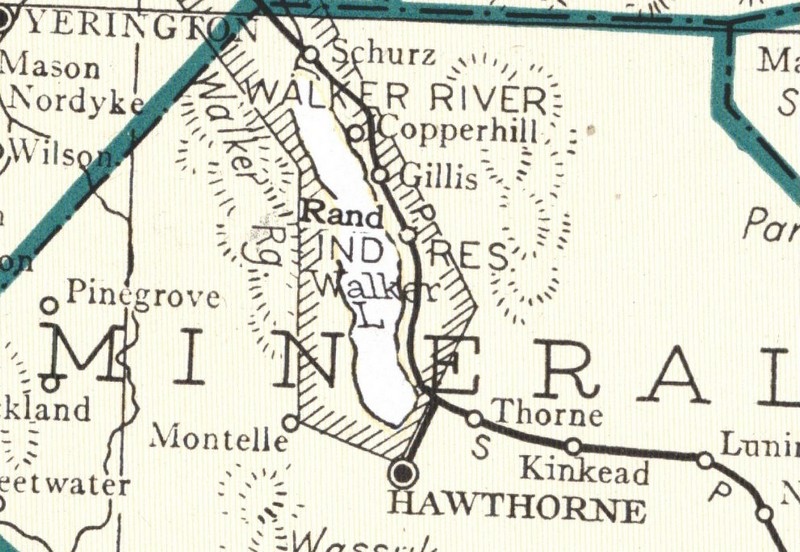
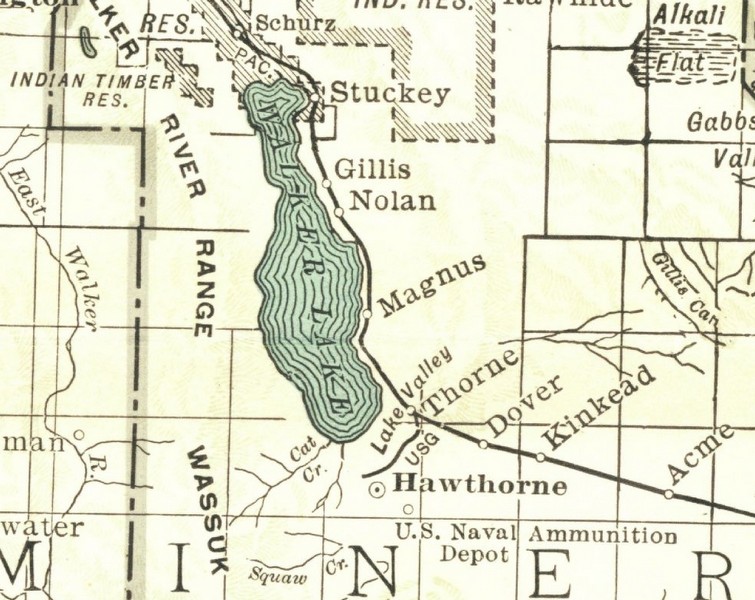
Shift to Thorne (1905): Southern Pacific bypassed Hawthorne in favor of nearby Thorne, which became a key shipping and interchange point for the region.
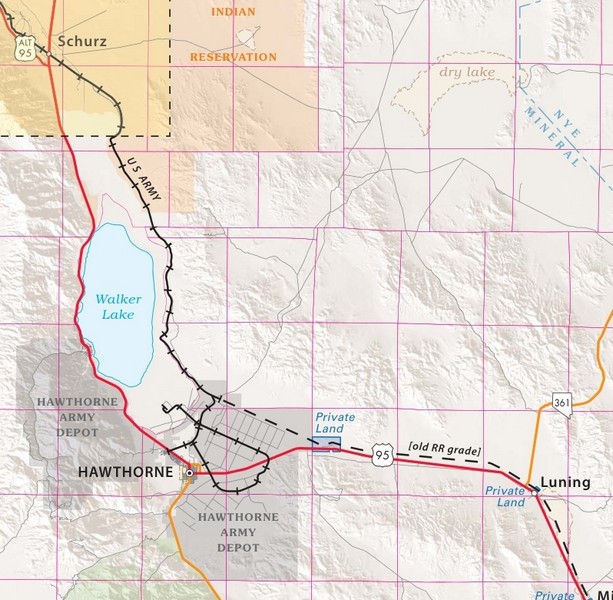
Naval Ammunition Depot Era (1930): Following the 1926 Lake Denmark naval depot explosion in New Jersey, Congress selected Hawthorne for a massive new ammunition storage facility. The base expanded to include over 200 miles of internal railroad tracks linking thousands of storage bunkers.
World War II Peak: During WWII, rail traffic into the depot soared to handle hundreds to thousands of carloads per month, functioning as a primary Pacific Theater ordnance lifeline.
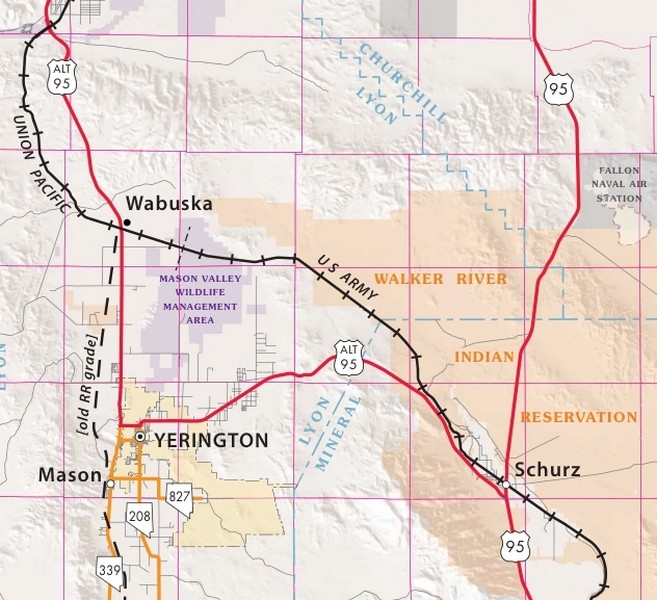
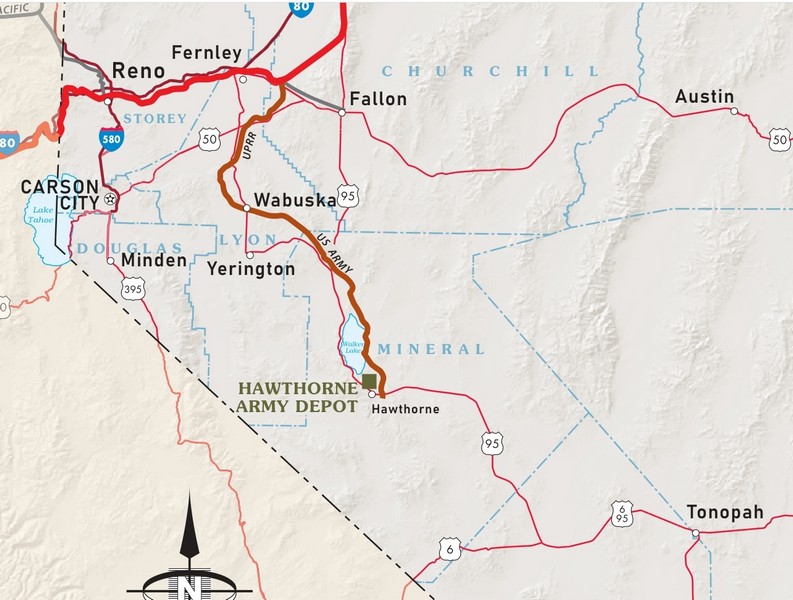
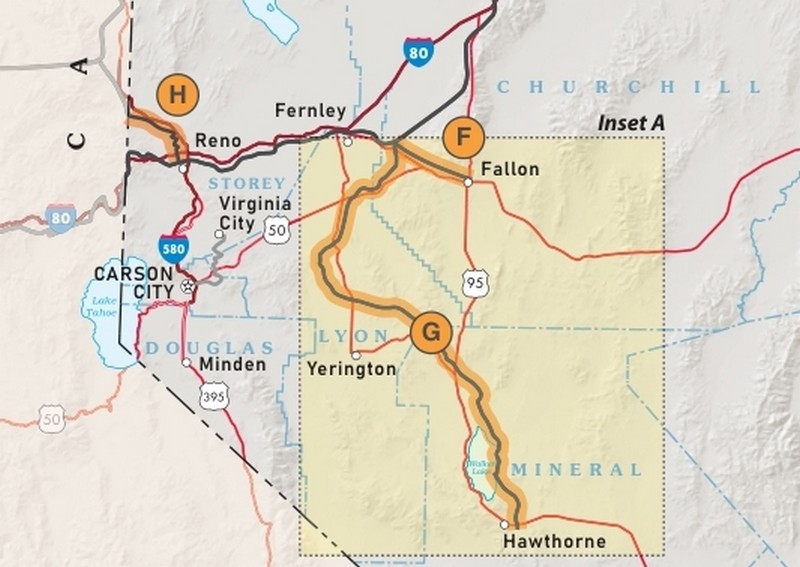
Ownership Changes: The line segment was later purchased by the U.S. Army (from Wabuska to Thorne) in 1991 and subsequently acquired by the Union Pacific in 1996.
Current Status and Operations
Active Service: The rail system continues to provide infrequent, military-dependent freight service between Wabuska and Thorne/Hawthorne.
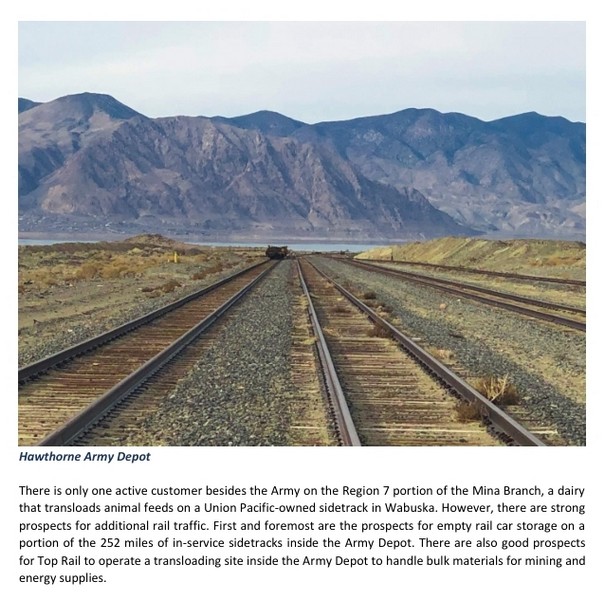
Depot Rail Capabilities: The Hawthorne Army Depot utilizes a portion of its extensive internal trackage for moving conventional munitions, fuel, and supplies to and from storage bunkers.
Interchange: Union Pacific runs traffic into Thorne, which serves as the primary interchange point for base operations.
Museum Preservation: Artifacts and history from the local rail line can be explored regionally, including pieces preserved via the Nevada State Railroad Museum and local displays at the Hawthorne Ordnance Museum.
Hawthorne was primarily a railway town from the arrival of the narrow gauge Carson and Colorado RR in 1881. The Southern Pacific purchased the C&C in 1900, and there were hundreds of miles of SP narrow gauge in the area to serve the mining boom towns of Tonopah, Goldfield and elsewhere. The SP converted the line to dual gauge and/or standard gauge in 1905. Most of the narrow gauge was abandoned by the late 1940's.
The Army purchased most of the branchline from SP in 1991, with the SP (now UP) providing service on the line as the US Army is now the only customer on the branch. Many years ago there was a bunch of slides of SP cab forward locomotives running freight trains along the shores of Walker Lake.
The main reason for Hawthorne's existence now is the US Army Depot just outside of town. The depot produces and stores ammunition for the US military. The highway runs right through the middle of the storage facility, with bunkers full of exploding stuff as far as the eye can see. It is quite interesting to drive through, although I suspect it would be a very big explosion if everything stored there was put in a big pile and blown up at the same time.
Regularly driving through Hawthorne I would check to see what was lurking around the railway tracks in the area. Generally there was nothing other than the odd flatcar or boxcar in the facility, and I thought it wise not to be taking photos of the Army facility through the fence from the highway.
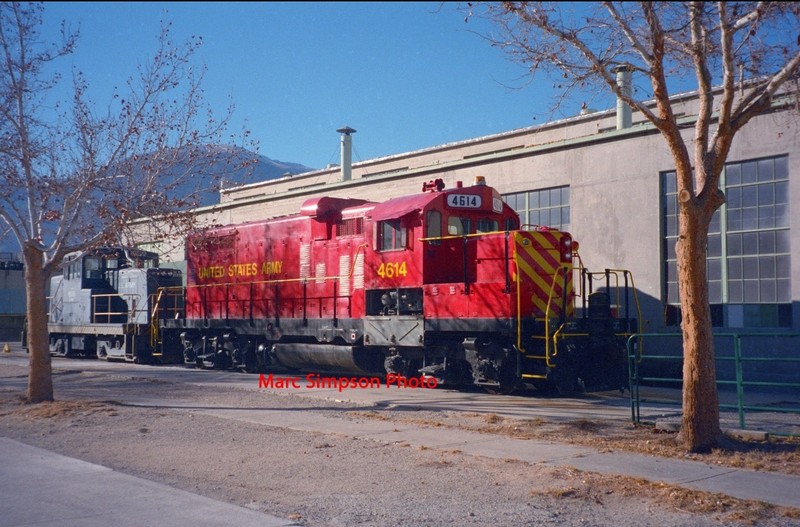
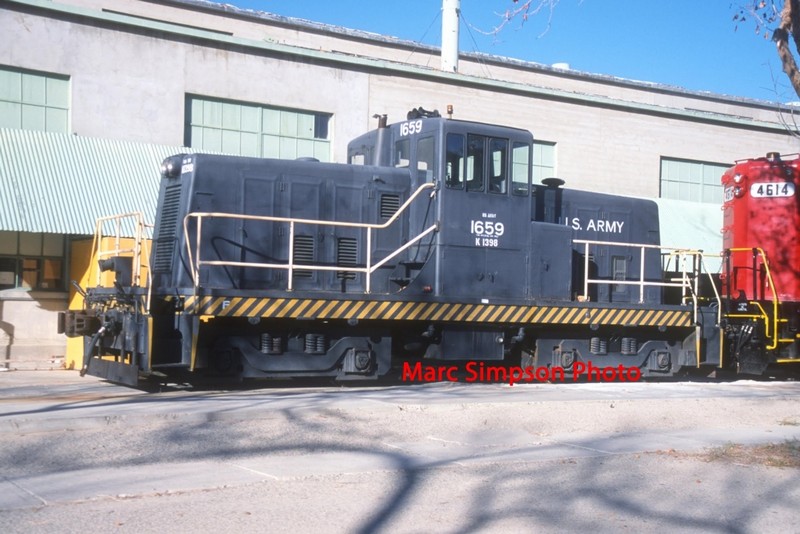
On one occasion I saw two locomotives sitting besidea brick building in the Army base just north of Hawthorne. "What the hell" I thought, "I'll drive up and ask if I can take some photos of the locomotives. What's the worst that could happen?"
I wheeled up to the base gate, rolled down my window and asked the civilian guard in the shack if I could go take some photos of the locomotives. "Sure, no problem." was the answer. I gave them my drivers license to make a photocopy, and off I went.
A dark grey black GE 80T and a former Illinois Central GP10 (ex 8010) sat in nice light on the base track, and I took a few shots of the locomotives. Both were immaculate and likely only saw limited use on the base switching cars.
I am somewhat doubtful that in this post 9/11 world I would be able to wheel up to an army base and take photos of trains. I'm glad I did so when I had the chance.
