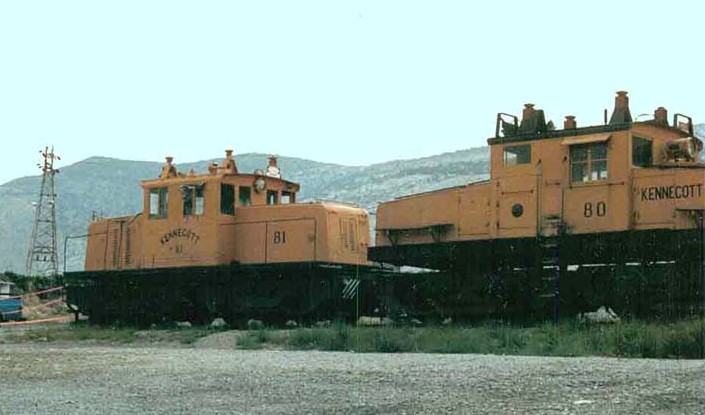
In autumn 1902, the Ruth property was sold to Mark Requa, the manager of the Eureka & Palisade Railroad. In 1903 Requa organized the White Pine Copper Company to further develop the White Pine property, which included the original Ruth claim, and several adjacent claims, a total of 19 claims on 304 acres. Together, the White Pine company became known as the Ruth Group of mines.
Adjacent to the Ruth claim was the Copper Flat group of claims, which was organized as the Copper Flat Mining Company. Later, after eastern capital investment became involved, the New York & Nevada Copper Company was organized to develop and operate the Copper Flat property. This company was later reorganized as the Boston & Nevada Copper Company after Boston investors became involved, and as investment capital became available, many more adjacent claims were purchased, and became known as the Copper Flat Group, with a total of seven claims on 133 acres.
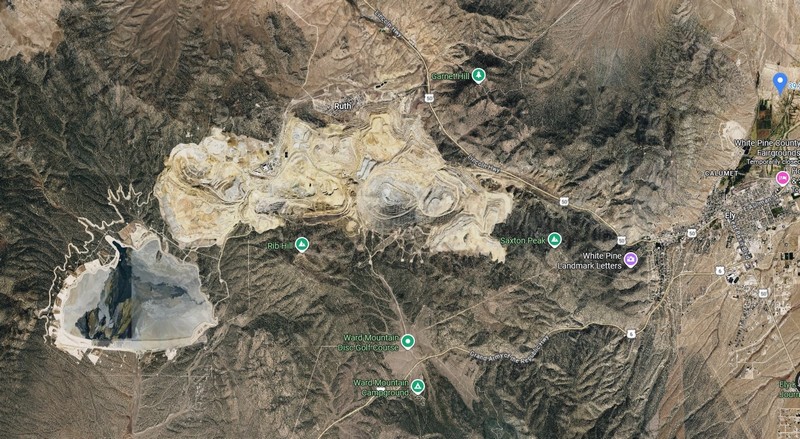
Ever since full scale operations commenced in 1908, most of the tonnage handled over the railroad has been copper ore bound from the Eureka-Liberty Pit at Copper Flat to the concentrator at McGill. In earlier days steam shovels loaded the ore directly into gondolas which were then assembled into trains for the winding, 11-mile climb up and around the sides of the pit, then over the edge to the assembly yard at Copper Flat. At this point heavier power replaced the pit locomotives, and road crews took over the train operations for the balance of the journey to the McGill concentrator. On April 1, 1958, the procedure was altered. Pit trains were discontinued, and trucks and a skip hoist were instituted to lift the ore and deliver it to the waiting gondolas in the Copper Flat yards.
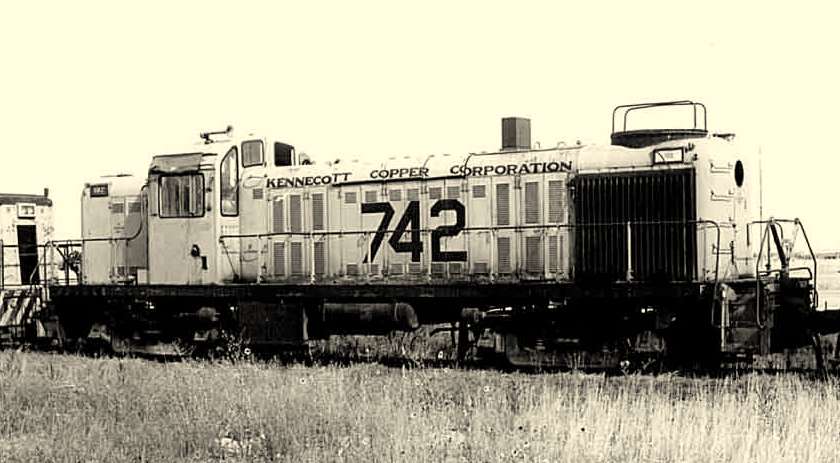
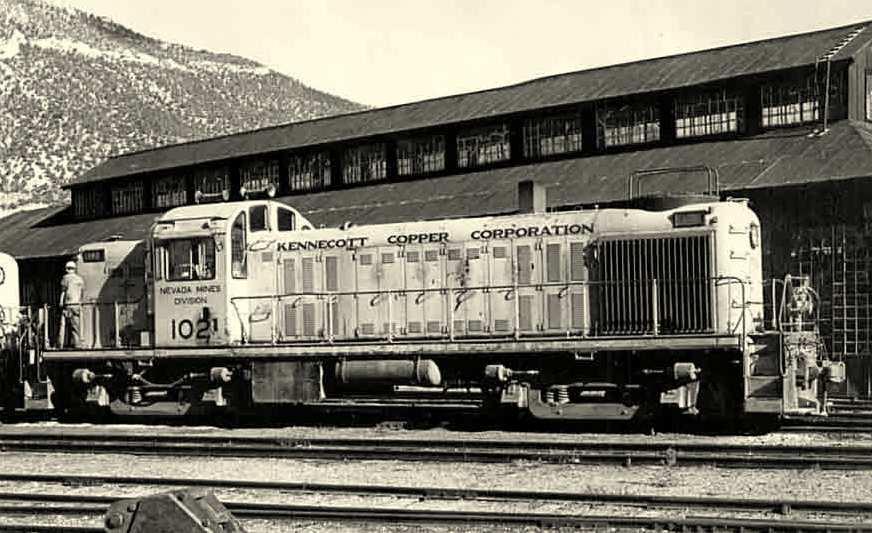
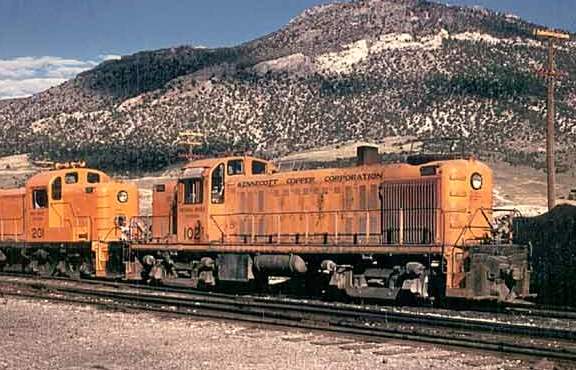
Starting in 1920, the Nevada Consolidated Copper Co. operated over the Nevada Northern with its own locomotives and crews from Copper Flat all the way to the concentrator at McGill, a practice which continued after the shift from steam to diesel power and greater locomotive utilization and change of name to Kennecott in 1943. Today, Kennecott Copper diesel units in pairs escort trainloads of 40 to 50 gondolas, each loaded with 80 tons of ore, to the yard near the McGill concentrator. Here a solitary electric locomotive switches the cars to the concentrator over approximately a mile of electrified trackage. Eight trains a day constitute normal operations for the line, thus feeding the McGill plant with some 300 to 350 carloads. To handle this traffic, Kennecott maintains a fleet of over 600 ore cars, distinctive with their metal serial numbers welded to the car sides in lieu of being painted in the customary manner.
In spite of the concentrator's voracious appetite (some 20,000 tons of ore daily), it disgorges a comparatively minuscule three carloads a day of blister copper which moves out on the three-mile line from McGill via McGill Junction. Three trains a week are sufficient to transport the tonnage to Cobre for forwarding to the refinery, as well as to pick up the return loads of inbound freight consisting of approximately 50 carloads of coal, 7 carloads of coke, and miscellaneous loads of machinery, lumber, gasoline and diesel fuel, weekly.
Various are the insignia of equipment which have traversed the lines of the Nevada Northern. The early Nevada Consolidated Copper Co. (NCCCo. ) joined hands with the Cumberland-Ely Co. at the instigation of the Guggenheim interests, and each owned a half-interest in the Nevada Northern. At the McGill smelter, the early steam locomotives bore the name of Steptoe Valley Mining & Smelting Co., another affiliated company. In 1909-10, the NCCCo purchased the C-ECo, and in turn itself became a subsidiary of the Utah Copper Co. The Kennecott Copper Corporation entered the picture in 1915 through an exchange of stock with the Guggenheim Exploration Co., acquiring full control of Utah Copper in 1923 and absorbing its assets in 1936. During this period, the Ray Consolidated Copper Company in 1926, including its subsidiary, the Ray & Gila Valley Railroad, both located in southern Arizona was merged with NCCCo. With acquisition of the assets of NCCCo in 1932, Kennecott formed the Nevada Consolidated Copper Corporation to manage its properties in Nevada, Arizona and New Mexico, ultimately dissolving the entity on December 31, 1942, to group the properties at Ely, McGill and Copper Flat under the cognomen of the Nevada Mines Division of the Kennecott Copper Corporation.
-- Grading started, September 11, 1905
-- Laying rails started, December 15, 1905
-- Operations began, June 2, 1906 ("To start regular service today")
-- Formal operation began, October
-- Construction formally completed, January 9, 1908
The diamond at Shafter, where the Nevada Northern and the WP crossed, was removed by Union Pacific because of something WP did during construction of the two lines. Utah Construction had the contract for both lines, and the WP somehow convinced the construction company to lay rails on the WP grade first thus giving WP rights to first crossing. UP inherited those rights upon assimilation of the WP and used that to remove the diamond when the NN closed. Of further note, the NN was never formally abandoned but did not contest removal of the diamond since the connection at Shafter was left in place.
The president and minority directors of Nevada Consolidated objected to the exchange, stating that the Nevada property had more value. The Nevada property was removed from the merger pending a determination of its value. After a meeting of the board of directors of Nevada Consolidated on February 1, 1910, in which the directors voted to agree to the proposed exchange rate, the company president, James Phillips, remained convinced that the property was being undervalued. Utah Copper Company already had four seats, a majority, on the Nevada Consolidated's board. By February 5th, a total of 824,277 shares of Nevada Consolidated had been traded for shares in Utah Copper Company, including 379,416 by Guggenheim Exploration Co., and 263,683 by M. Guggenheim & Sons, the majority shareholders.
Copper Flat and Ruth porphyry copper mines
10 steam shovels and 15 steam locomotives at Copper Flat pit
12 trolley locomotives at Ruth shaft mine
12 miles of standard gauge railroad at McGill smelter, with 10 steam locomotives
165 miles of Nevada Northern railroad, with 10 steam locomotives
On March 1, 1920, the United States Railway Administration had returned control of the nation's railroads, from government control due to World War I, back to the railroad companies. Included in the enabling Esch-Cummins Act was a provision to allow the ICC to control the railroads profits and rate of return for investments.
Copper Flat Group, 355 acres
Ruth Group, 455 acres (underground mine)
Liberty Group, 46 acres
Veteran Group, 14 claims
Jupiter group, 22 claims
Regular passenger service on Nevada Northern Railway between Ely and Cobre was discontinued.
When Magma/BHP reopened the mines and the railroad in 1995 they were shipping the ore to a smelter that no longer exists in San Manuel, Arizona. They did a lot of tie and ballast work on the old NN main line, but the original 60-pound rail still on the line simply wasn't enough to support those heavy trains, and even at 10 mph or less they were on the ground a lot. Shortly before the operation shut down BHP was building a truck scale at the concentrator and planned to start trucking the ore east to a reload on the LA&SL somewhere in Utah and stop using the old NN altogether but the end came in 1999, before that came to pass.
The mines reopened again in 2004, but by that point a whole lot of issues rendered the railroad unusable, so they opened the Wendover reload. The ore is shipped in unit trains to the port at Vancouver, Washington, for shipment to Asia. The loaded trains go from Wendover to Salt Lake City, then up UP's old OSL/OWR&N to the Northwest. Return empties can go either by that route or down the old SP Shasta Route to Roseville and then east to Wendover.
KGHM is derived from the company's historical name, Kombinat Górniczo-Hutniczy Miedz, based in Lubin, Poland, which formally changed its name to KGHM in May 1961. Copper production remained focused on mines in Poland until 1991, when KGHM was reorganized as KGHM Polska Miedz S.A. The company privatized and opened an office in London. In 1997 KGHM went public and shares in the company were offered on the Warsaw and London stock markets.
KGHM expanded outside of Poland in 2003 with the exploration of a deposit in Sudbury, Ontario, Canada, with production starting in 2005. A joint venture with Quadra Mining was started in 2010 at the Ajax mine in British Columbia, Canada, and in 2012, KGHM purchased Quadra Mining's 49 percent interest in the joint venture, which along with KGHM's 51 percent, gave KGHM 100 percent ownership of the mine. In 2014 KGHM began production at its Sierra Gorda mine in Chile.
Quadra Mining had purchased the Robinson mine from BHP in 2004 and reopened the mine that same year. A molybdenum recovery circuit was constructed by Quadra and began operation in December 2005, so the Robinson mine now also produces molybdenum along with copper, gold, and some silver.
In 2004, KGHM took over production of the Robinson mine near Ely, Nevada, as part of its joint venture with Quadra Mining. The Robinson mine includes three large pits: the currently active Ruth pit, and the inactive Tripp-Veteran and Liberty pits. The current production was resumed in 2004 after mining operations had ceased in 1999 due to low global metal prices. Mining is conducted by conventional open-pit methods, including extraction using blasting materials, ore loading and transport to a processing plant. The ore is crushed and ground, and then concentrated by the flotation process. The concentrate produced is then thickened and filtered. Concentrates are transported to storage and transload facilities in Wendover, Nevada, at a site formally known as the Wendover Bulk Transhipment Company.
The copper concentrate is trucked from the Robinson mine, north to the Wendover transload site, then moved by rail in solid blocks of forty or more tarped gondolas to the port of Vancouver, Washington. The forty-plus blocks of tarped gondolas are moved about once per week, reportedly because Union Pacific gave Broken Arrow, and now KGHM a better rate on moves of forty cars or more. The cars are covered with tarps instead of fiberglass gondola covers common for moving mineral concentrates because UP couldn't assure them of enough gondolas in good enough condition to allow the covers to fit properly. The loads are tarped, which increases the labor costs.
