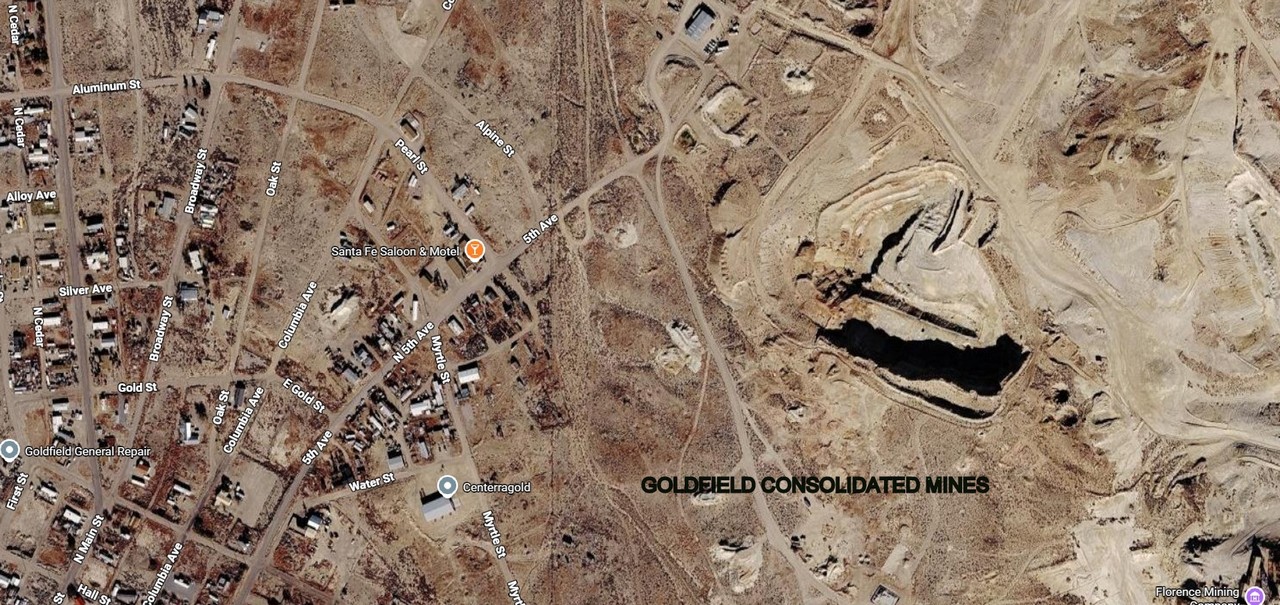

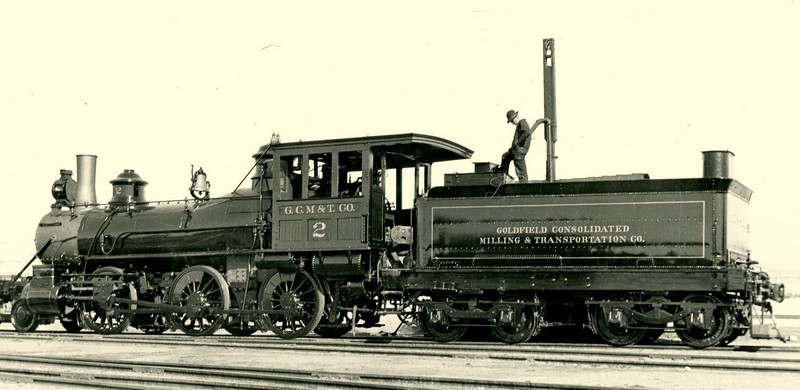
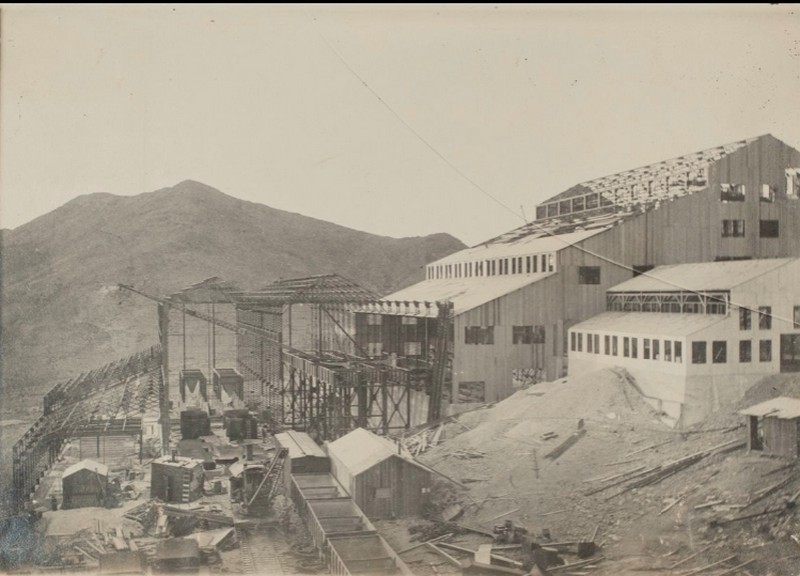
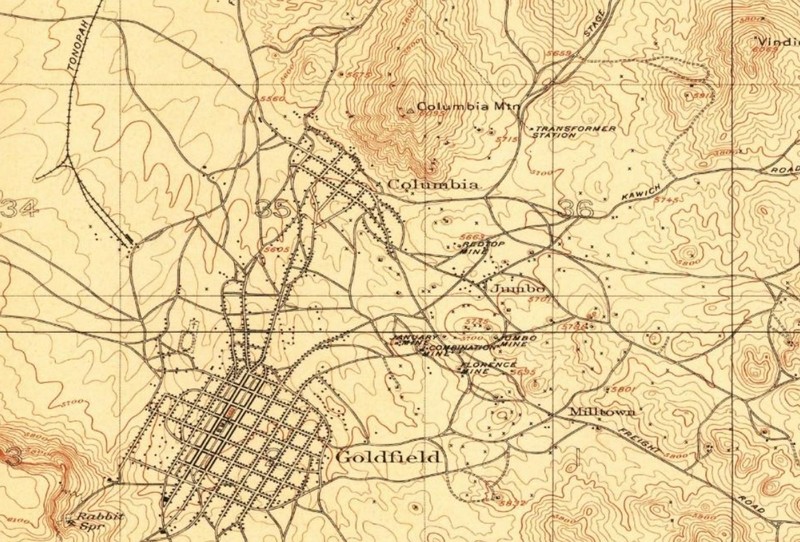
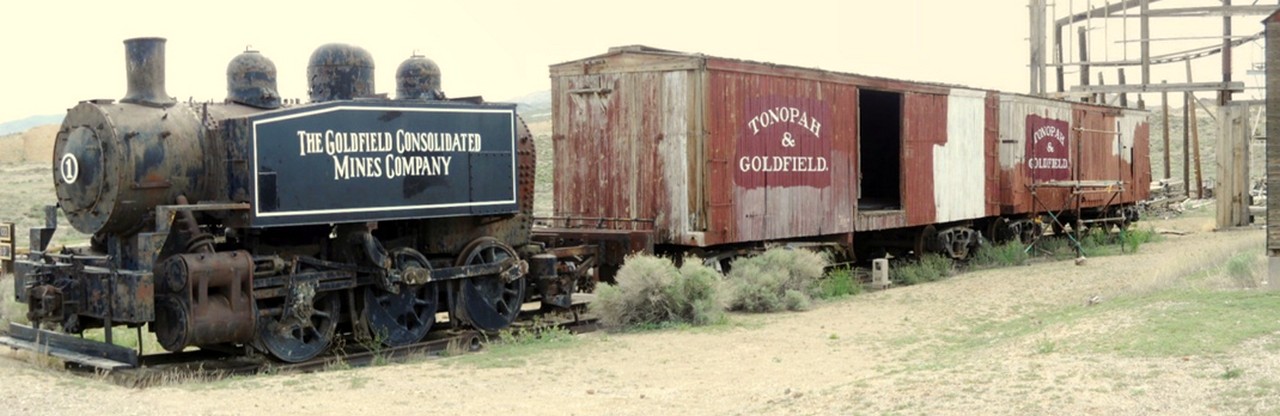
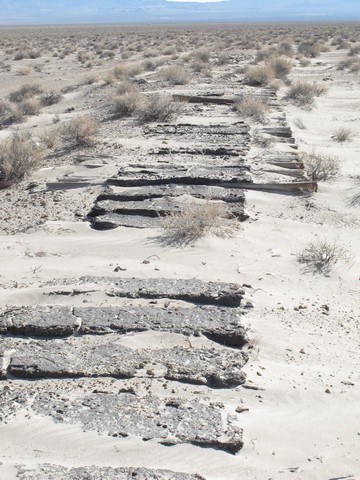
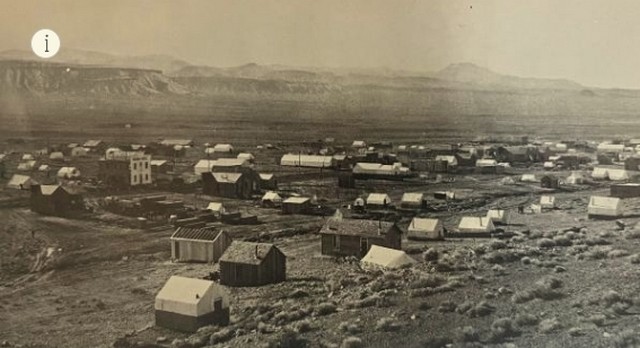
The Goldfield Consolidated Mill, erected by the Goldfield Consolidated Mines Company, was placed into operation on December 26, 1908. It had 100 stamps and a capacity of 600-1000 tons per day. The Goldfield Consolidated Milling and Transportation Company operated nearly two miles of standard-gauge railroad connecting the mill to the rest of the district. A fire on April 8, 1910 caused $250,000 worth of damage and brought a temporary closure to the mill, but it was back in operation on June 1. In 1916, to process sulphide ores found at the lower levels of the mines, a 50-ton flotation plant was added to the mill. It finally came to a close in January 1919, after processing over 2.8 million tons of ore; a value of over $48.5 million. Although the mill was never again operated by the Goldfield Consolidated Mines Company or at full capacity, the Bradshaw Incorporated Company leased the tailings and used part of the facility from 1927 until 1940. Overall, more than half of Goldfield's ore output to that time passed through the mill.
The Goldfield Consolidated Milling & Transportation Company operated a private, 4-mile standard-gauge railroad in Goldfield, Nevada. Built around 1908-1909, its main job was to haul gold ore straight from the deep mine shafts to their massive 100-stamp mill on Columbia Mountain. How it worked:The Route: The little railroad connected the busy mines (like the Mohawk and January mines) to the mill. It was like a fast delivery belt for heavy rocks. The Trains: The company owned at least four steam engines and hauled hundreds of tons of rock each day. The Output: The mill processed over 2.8 million tons of gold ore. This was worth more than $48 million at the time. The End: The private rail line closed by 1916. The big mill officially shut down in January 1919.
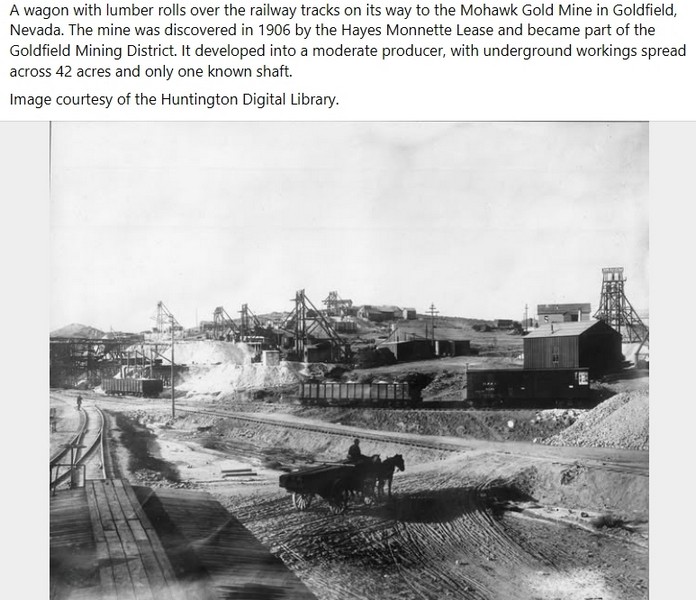
Goldfield was a wild boomtown, once served by five different railroads! To learn more or explore the historic remnants of these tracks, visit the Goldfield Historical Society. You can also check out the Travel Nevada guide to see where the old railroad yards and train engines still sit today. Goldfield Consolidated Mill - Nevada ExpeditionsThe mill processed over 2.8 million tons of ore, which was worth over $48.5 million. The mill closed in January 1919. The 100-stamp Goldfield Consolidated Mill was constructed on the side of Columbia Mountain. Structures including the Esmeralda Cou? A wagon with lumber rolls over the railway tracks on its way to the .... Goldfield Nevada at one time had 5 railroads Tonopah Railroad Goldfield Railroad (both merged) Tonopah and Tidewater Bullfrog and ...
Often overlooked, these corner monuments were extremely important in corroborating the legal mineral rights of the claim holder. In fact, a 1908 lawsuit filed in Utah hinged on whether the dimensions of the claim, as detailed in official mineral survey paperwork, or the claim monuments themselves should dictate the legal location. The Conklin Mining Co. sued the Silver King Coalition Mines Company on the grounds that the Silver King had encroached into the lode contained within the Conklin claim. The ensuing 13-year legal battle went all the way to the Supreme Court. Additional surveys were ordered and specialists testified. Ultimately, the verdict was decided based on the presence and location of the physical claim monuments.
Large waste rock piles indicate a deep excavation, usually a mine shaft or adit. Some shafts are supported by a frame of timbers called "cribbing." Others exhibit openings topped by a small windlass or a wooden headframe to support hoisting equipment. Most, however, contain no superstructure, either because it was removed and repurposed elsewhere, or because the shaft was abandoned before reaching any bodies of ore.
Wood framing ("cribbing") often lines the shaft, preventing collapse.
Mine shafts, adits, and waste rock still dot the desert, which can be tempting to explore. However, exercise caution because exploring abandoned mines can be extremely dangerous due to collapse hazards, hantavirus exposure from rat and mice droppings, potential for noxious gases, and limited oxygen underground. A more extensive list of hazards can be viewed here , and current measures to mitigate these risks here .
A headframe may be constructed of timber, metal, or concrete members. The structure is topped with a sheave wheel, which is a large pulley that supports and operates the hoisting cable. At the end of the cable is a bucket or cage to be filled and hoisted. Steam, gasoline, and electric engines typically provided the motive power required for hoisting with a headframe.
The materials and dimensions of headframes are, once again, determined by resource availability and the demands of physics. The method of construction is more important than its materials. For instance, components of headframes intended for long-term service would likely be welded or nailed together, while a headframe built for a prospect or temporary shaft of similar dimensions would be bolted or riveted.
Ore bins located at mining sites are often situated near shafts, a convenient configuration for stowing ore after it is hoisted to the surface and before it is transported to the mill. Ore bins also exist at mill sites, holding ore prior to processing. Grizzlies, which are large grates, were sometimes installed in ore bins for preliminary sorting.
Mills reduce raw ore to make it suitable for the extraction of precious metals. The milling process starts with the crusher, which breaks up the ore into chunks the size of a fist or smaller. While many crusher varieties were used in historic mills, the gyratory crusher was the most common type and is still used today. It works by feeding the ore through a small space between the funnel-shaped housing and bell-shaped rotating shaft. The shaft is set on an eccentric gear, causing it to gyrate as it rotates within the stationary housing.
Stamping is the next step after crushing. From the crusher, the ore is fed into large, rectangular mortar boxes. Made of iron, the mortar boxes have an opening on the top to allow the stamps to come down, as well as openings on the front and back to let the ore in and out. Cams set on a revolving, flywheel-driven shaft regulate the stamping via tappets fastened to the stamp stems. As the camshaft turns, elevating the stamp assembly, the reduced ore is fed into the mortar box through the back opening (the feed inlet) and the stamp is dropped, pulverizing the ore to the size of pebbles. As the crushed ore accumulates in the mortar box, it spills out the side opposite the feed inlet, where it descends onto mercury amalgamation tables. Here, mercury adheres to the exposed gold creating the “amalgam” of gold and mercury. These chunks are then removed by hand and the amalgam is distilled, leaving behind pure gold. Excess mercury is collected at the bottom of the table, saved, and reused.
Gold that does not adhere to the mercury, because microscopic gold remains inside the small fragments of rock, is then further reduced in tube mills or ball mills, which are large rotating cylinders containing iron or steel balls. This grinds the ore to a fine powder, where it is then processed in large chemical leaching tanks using cyanide or chlorine solutions, or in a water bath with chemical reagents - a process called flotation.
To minimize the energy needed to send ore through this process, mills were often built on slopes, using gravity to transport the ore through the progressive sequence.
Because milling machinery was extremely expensive, it was often disassembled and repurposed at other mills when ore veins had been mined out. As such, most mills today are represented only by their concrete foundations. However, some examples of intact mills are still present. In the Goldfield Mining District, the Florence Mill is an example of an intact mill. The following section, Mines and Mills of Goldfield, describes a selected few of the remaining architecture in and around Goldfield.
The machine shop and hoist house dates to the early days of the Florence Mine. The Florence Mining Company constructed the building as early as 1908. As the name suggests, the building consists of a machine shop and hoist house connected by a central addition. The hoist works consist of a round double-drum rope hoist and a small generator. Cables from the hoist travel through small openings in the eastern side and extend to the top of the Florence-Newmont Headframe. The Florence-Newmont Headframe is constructed in the traditional gallows style, but its large size and sturdy construction suggests that it was used to raise and lower substantial loads. Ore was lifted out of the mine by two one-inch-diameter cables extending from the hoist works building. As ore was lifted from the shaft in buckets, small ears on the ore bucket would catch in two inverted J-shaped brackets on either side. These brackets would guide the bucket up to the top of the ore bin and then dump the ore automatically. This process was controlled from the hoist works.
A robustly constructed wooden ore bin is adjacent to the Florence-Newmont headframe. Although its date of construction is unknown, the bin appears to have been reused through various successions of the mine’s use. Wooden ladders provide access from the ground to the higher levels of the bin. The base of the bin is steeply angled, forcing the ore brought up by the headframe to flow downward. At the bottom of the eastern side is a metal chute through which the ore would have exited the bin and been carried by conveyor to the nearby Florence-Newmont Mill.
A second ore bin, the Florence-Newmont Lessee Ore Bin, is located on the periphery of the district in an area of the Florence claims that was leased and mined throughout the early twentieth century. Miners brought ore to the bin in carts via an overhead trestle. Only a small fragment of trestle survives, terminating under a sheltered area at the top of the ore bin. Once inside the trestle shelter, the ore was dumped down into the ore bin. The base of the bin is steeply angled, forcing the ore inside to flow down toward two metal chutes providing an exit route for the ore. A series of cables and counterweights raised and lowered the chutes, allowing miners to control the flow of ore.
The district’s privy is a rectangular four-seat outhouse positioned over a large pit. A cupola is centered in the roof and features horizontal rows of wooden planks that are angled downwards to provide light and ventilation to the interior while keeping out rain and snow. Two large cylindrical exhaust pipes on the western side extend up from the privy cistern and were designed to vent gasses from the organic matter below. Because there were so many large mining operations in the immediate vicinity of the privy, it is impossible to know what mining company built it or when it was constructed. No matter who built it, the privy would have been a necessity for mine and mill workers.
The Newmont Deep Mines Company constructed the mill in 1948. Highlights of the structure include a wooden gangway and ore conveyor, gyratory ore crusher, ore bins and storage boxes, and a ball mill with an electric motor. The mill’s history is described in greater detail below.
The mill site lay dormant until 1948, when the Newmont Deep Mines Company acquired the property and constructed a new mill. The mill processed gold for a short period of time before federal subsidies for tungsten production and the relatively low price of gold spurred the Newmont Company to investigate the feasibility of converting from gold to tungsten production. It is unlikely that the mill was retrofitted to process tungsten, as Newmont shut down its Goldfield operation in 1951.
Born in San Francisco in 1868, Francis Laurence Bosqui served in the National Guard before attending the University of California in Berkeley, where he earned degrees both from the College of Physicians and Surgeons as well as the College of Mining. In the late 1890s Bosqui abandoned the practice of medicine and started a job at the Standard Consolidated Mining Co. in Bodie, California, where he eventually became mill superintendent. He went on to work as a metallurgical engineer at mines in the United States, England, and South Africa. He made seminal contributions to the cyanide process in precious metals extraction, and even authored an 1899 manuscript on the topic, titled Practical Notes on the Cyanide Process.
Bosqui, through experimentation conducted at the nearby Combination Mill, worked out a scheme of processing Goldfield’s notoriously complex sulfur-laden ores. Bosqui’s method, controversial among metallurgical engineers at the time, started with wet crushing, followed by treatment on amalgamation tables to recover the coarse gold, and culminated in cyaniding to recover the finer particles. With this method, Bosqui was able to recover 90 percent of the gold from Goldfield ores.
In 1916, GCM constructed a 50-ton flotation plant, which became the primary focus of mill production. However, by the late 1910s, Goldfield’s best ore had been mined out. The mill became unprofitable, and the mill shut down in January 1919. In its 11 years of operation between 1908 and 1919, the mill produced $53,970,400 worth of ore, which constitutes more than half of the total output of the district prior to 1940.
The mill sat idle from 1920 until 1927, when Bradshaw, Inc. began re-treating the tailings. Previously, several companies attempted to reprocess the tailings, but they deemed it uneconomical because transporting the material from the tailings pond to the plant was so expensive. In 1926, Bradshaw proposed transportation of the material by hydraulics, which proved cost-effective. The company continued to process the tailings until 1941 when the milling equipment was moved to Millers, Nevada to outfit a new 1,000-ton treatment mill. The company recovered a total of between $2.8 and $3 million from the Goldfield Consolidated tailings.
Today, only the large tailings pile and the tiered concrete foundation remain.
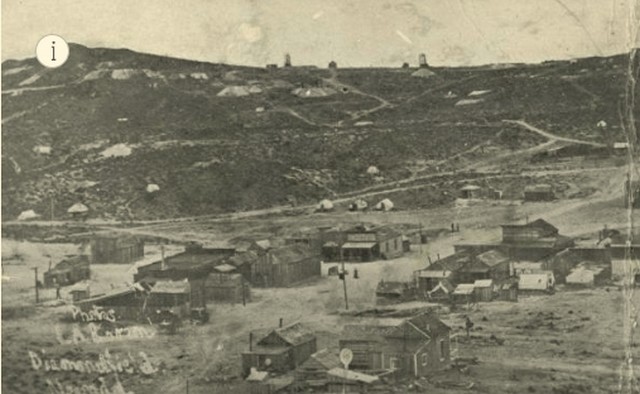
The Jumbo Extension Mining Company incorporated in 1904. The company’s interests were centered on the Daisy, Jumbo Extension, and Triangle mines in Diamondfield. It avoided acquisition by the behemoth GCMC, perhaps due to its limited early success. However, the company discovered a rich body of ore in 1914 after consulting engineer J.K. Turner advised deep exploration. Jumbo continued to work its claims into the 1930s, retimbering and reopening the Daisy shaft, as well as installing a new headframe and hoisting engine, in 1939.
Although the Gold Coin Mine adjoined the Jumbo Extension Company’s Daisy and Triangle claims, it remained independently owned and operated. By 1908, the mine was shipping ore valued at $1,000 per day. The original supervisor of the mine was Walter C. Geddes. Under his leadership, a hoist for the mine was constructed in July of 1911. Little is known about the early days of the Great Bend Mine. In early 1918, as mining excitement waned in the area, new workings of the Great Bend procured high-grade ore with much fanfare. The mine did not live up to the hype. By 1937, it had produced only $250,000. It reverted to a leasing operation. Later that year, a 100-ton mill was constructed at the site, recovering zinc and copper into the 1940s.
Mine Info
County: Esmeralda
Elevation: 5,699 Feet (1,737 Meters)
Commodity: Gold
Lat, Long: 37.7125, -117.22417
Secondary: Mohawk No. 1 and No. 2
Secondary: Combination
Secondary: Combination No. 2 and No. 3
Secondary: January
Secondary: February
Secondary: Hazel Queen
Secondary: Rustler Fraction
Secondary: Slim Jim Fraction
Secondary: Goldwedge
Secondary: Lucky Boy
Secondary: Red Top
Secondary: Grizzly Bear
Secondary: Clermont
Secondary: Vinegorone
Secondary: Miss Jessie
Secondary: Laguna
Secondary: Last Chance
Secondary: Golconda
Secondary: Wonder
Secondary: Goldstone
Secondary: Mammoth
Secondary: Red Boy.
Primary: Gold
Secondary: Copper
Secondary: Silver
Tertiary: Aluminum
Tertiary: Tellurium
Tertiary: Potassium
Location
State: Nevada
County: Esmeralda
District: Goldfield District
Land Status
Land ownership: Private
Owner Name: Noranda
Deposit
Record Type: Site
Operation Category: Past Producer
Operation Type: Unknown
Discovery Year: 1903
Years of Production:
Organization:
Significant: N
Deposit Size: M
Mineral Deposit Model
Orebody
Form: TABULAR TO IRREGULAR
Form: TABULAR TO IRREGULAR
Structure
Rocks
Name: Andesite
Role: Host
Age Type: Host Rock
Age in Years: 21.250000+-0.750000
Dating Method: K-Ar
Age Young: Early Miocene
Name: Dacite
Role: Host
Age Type: Host Rock
Age in Years: 21.250000+-0.750000
Dating Method: K-Ar
Age Young: Early Miocene
Analytical Data
Analytical Data: LIMITED X-RAY, THIN SECTION AND CHEM DATA SUGGEST GREAT HETER GENEITY AND LOW ALUNITE TENOR EXCEPT LOCALLY.
Materials
Ore: Alunite
Ore: Silver
Ore: Gold
Found in: University of Nevada, Reno. Special Collections Department
Collection Identifier: 2017-25
Dates: 1921-1924
Found in: University of Nevada, Reno. Special Collections Department
