Eureka & Palisade Railroad

Headquarters Palisade, Nevada

Locale Palisade - Eureka, Nevada

Dates of operation 1873-1938

Track gauge 3 ft (914 mm)


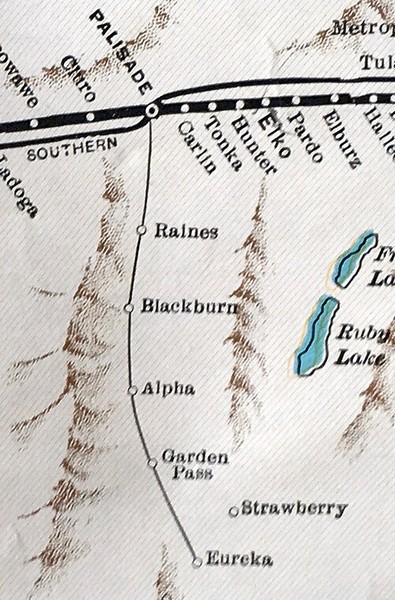
The railroad was constructed to connect Eureka, the center of a rich silver mining area, with the national railway network at Palisade. Later corporate reorganizations brought on by financial difficulties saw the line operated as the "Eureka and Palisade Railway" and the "Eureka-Nevada Railway." As early as 1871, shortly after the completion of the first transcontinental railroad in 1869, and just a year after the original strike was made, people in Eureka could see the advantages of building a railroad to connect them with the Central Pacific Railroad transcontinental line. Ore had to be shipped to Salt Lake City for final refining, and getting it north to Palisade, Nevada (the nearest point on the Central Pacific) by wagon was very expensive - about 20 dollars per ton. To get mining supplies southbound, the rates were twice as high. Building a railroad would result in significantly lower freight rates.

The Eureka & Palisade Railroad was built in 1875 to carry silver-lead ore from Eureka, Nevada, to the Central Pacific Railroad (later Southern Pacific Railroad) trunk line that ran through Palisade. Nevertheless, despite the determined and colorful management style of John Sexton, the line succumbed to the effects of flood, fire, competing road traffic, and dwindling amounts of ore extracted in Eureka. The rails and rolling stock of the railroad were removed in 1938.

The Eureka, one of the railroad's only surviving steam locomotives, is listed on the United States National Register of Historic Places. Eureka-Nevada Railway's second locomotive number 12 is preserved at the Nevada State Railroad Museum Boulder City. Another locomotive that has survived is #7, a 2-6-2 Prairie named Pufferbilly that was built in 1915 by the H.K. Porter Company. It is privately owned by Gary Norton and can be seen at Silverwood Theme Park in Athol, Idaho where it runs daily during theme park operation.


Eureka & Palisade Railroad

The financial panic that began in September 1873, created havoc for just about all railroad construction schemes. But Nevada's Eureka & Palisade Railroad, after several false starts, finally began construction in late November 1873. Jack Gilmer and Monroe Salisbury, well-known stage operators, had bought the franchise to build a railroad from Elko to Hamilton in January, and joined with Erastus Woodruff and William Ennors, of the other major Nevada stage company, in November to build the line from Palisade to Eureka instead. Construction was started immediately with the first ground moved on the 25th and the first spike was driven on Monday, February 2, 1874. By this time William L. Pritchard, the freighter, had also obtained an interest in the E. & P. (Eureka Daily Sentinel newspaper, Eureka, Nevada, January 4, 1873; November 24, 1873; November 28, 1873; January 9, 1874; January 11, 1874; February 7, 1874; June 23, 1874) The Eureka Sentinel reported in late December 1873 that "Twenty miles of iron is in San Francisco and negotiations are pending with one of the Narrow-Gauge companies of Utah for twenty more, including also a locomotive and several freight cars" and by the end of the month "a narrow gauge locomotive has already reached Palisade." (Eureka Daily Sentinel, December 24, 1873; December 30, 1873)


Eureka & Palisade Railroad Locomotives, and MISC.....

The Eureka & Palisade's first locomotive was named the Eureka, and was in the Central Pacific shops at Carlin for several weeks where "it [had] been undergoing repairs and been repainted." (Eureka Daily Sentinel, January 30, 1874; February 14, 1874; February 18, 1874) After passing through the Central Pacific's shops at Carlin for refurbishing and repainting, this engine appears on the Eureka & Palisade in early 1874 as that road's No. 1, named "Eureka." In 1875, upon the arrival of a new Baldwin 4-4-0, also named 'Eureka', which still exists, the Mason appears to have been renamed "Onward," possibly as a result of someone having discovered the name under several layers of paint on the engine. from its early days as a Mason demonstration locomotive. Severe winter storms prevented work on the roadbed and track from progressing very fast, and the engine's appearance in Palisade was delayed until April 18th when it arrived and was put on the track ready for work. The first run was made the same day with five flat cars over the first mile of track. (Eureka Daily Sentinel, April 19, 1874) A lucky break for the historian occurred in 1875 when a steam delivery "T-pipe" broke on one of the road's engines. In order to make the necessary repairs a new casting was required, and the Central Pacific Railroad made this part. The original C. P. "pattern" drawing (C.P.R.R. #1497) has survived and is now in the California State Railroad Museum at Sacramento. Very helpful, of course, is that the drawing's caption identifies it as a "Mason Eng." and that it was a "Fairlee." Even more fortuitous for the historian is that the broken part was rather unusual and it can be demonstrated to be unique: This part could only have been used on Mr. Mason's Onward. Kyle Wyatt, of the Nevada State Railroad Museum, wrote to George Pitchard on February 25, 1993, "I recently went through some original Central Pacific drawings at the California State Railroad Museum. Drawing #1497, dated June 8, 1875, is labeled as a "T-pipe for Mason Eng.", used on "Fairlee Eng. for Palasade (sic) RR" and matches "pattern No. 3074." I consider this fairly conclusive proof showing that a Mason Fairlie operated on the E&P, and probably was E&P #1." The Central Pacific drawing of the "T-pipe" part was compared to one of Mason's original "Onward" drawings in the Mason Machine Works collection at the Museum of American Textile History in North Andover, Massachusetts, and shows a part identical to the one made by the Central Pacific for the "Palasade R.R." engine. The uniqueness of the part means that Mr. Mason's Onward was now on the Eureka & Palisade with yet another name, the Eureka, having been purchased from the American Fork Railroad. All of the other E. & P. locomotives beginning with no. 2, the W. L. Pritchard, can be accounted for except no. 1, the Eureka. This, then, was the locomotive that arrived in late December 1873, and which had built the first several miles of the E. & P. Eureka celebrated the arrival of the railroad on October 22, 1875. The Sentinel of the 23rd, giving an account of the previous day's events, notes that a passenger train headed by the "Tybo" and a freight pulled by the "Onward" were the main railroad attraction as the trains pulled into town over the newly laid track, followed by the orations of the day. (Eureka Daily Sentinel, October 23, 1875) Gilbert Kneiss's 1941 account of the celebration was, without question, based on this article. When the Eureka & Palisade was completed to Eureka, there were four locomotives on the road, including a new Baldwin Mogul No. 4 that was also named Eureka. With a second Eureka and locomotives named Tybo and Onward, it appears the E. & P. had renamed (but did not renumber) its locomotives, probably early in 1875. It is known that no. 2, W. L. Pritchard, was renamed Tybo. It is not known if no. 1, the first Eureka, or no. 3, another Baldwin Mogul, became the "new" Onward.


Disclaimer: We search for HISTORY as a hobby. Endless souces. Much can come from others neverless endless sources. Does this website sell anything ? NO Donations ? NO. This is non-commercial. I consider my websites under copyright. Again..no money here !! Educational.


go back


==================================================================================================================================================
No, a 15-inch Samsung Galaxy device cannot serve as a phone in the traditional sense, because Samsung does not make a 15-inch phone. Devices of this size are either laptops (like the Samsung Galaxy Book series) or tablets (like the Galaxy Tab Ultra, which maxes out at 14.6 inches). Because these devices are built for computing and media, they lack the cellular hardware (and calling capabilities) needed to function as a primary smartphone. However, you can still "make calls" from a 15-inch device using the following workarounds: Companion Calling: If you own a Samsung smartphone, you can link your tablet or laptop using Samsung's Call and Text on Other Devices feature. This allows you to place and receive cellular calls from your tablet/laptop by routing them through your actual phone. VoIP & Messaging Apps: You can use services like Google Voice, Microsoft Teams, or WhatsApp Desktop to make internet-based calls and send messages independently of a smartphone plan. If you are looking for a large-format Samsung device and want to compare options, let me know if you are more interested in a: Tablet (for reading, media, and light productivity)Laptop (for heavy work and running desktop programs)2 sites Galaxy A15 Yellow 256 GB | Samsung LevantBattery * Internet Usage Time(LTE) (Hours) Up to 19. * Internet Usage Time(Wi-Fi) (Hours) Up to 19. * Video Playback Time (Hours) ...SamsungSamsung Galaxy Tab S11 UltraGalaxy Tab S11 Ultra is built for those who see having the latest and greatest tech as non negotiable. It packs an expansive 14.6”...GoogleSamsung Galaxy Book2 Pro & Pro 360 Series Laptops Official - The memory subsystem includes up to 32 GB of LPDDR5 configurations while storage options will include up to 1 TB of NVMe (Gen 4) VideosWHY is The Samsung GALAXY A15 5G TRULY Special in for its solid build, AMOLED display, 4 years of OS updates (up to Android 18), and budget gaming performance.Samsung Galaxy A15 5G Worth It In 2026?YouTube · Milo B.Apr 8, 20262:51should you buy the Samsung Galaxy A15 in 2025?YouTube · jOhnZoidJan 12, 20259:03For under $200, the A15 offers a 6.5" Super AMOLED display, 90Hz refresh rate, 50MP camera

The A15 5G offers a great screen, solid battery, and long-term updates for under $100 but performance and cameras hold it back.