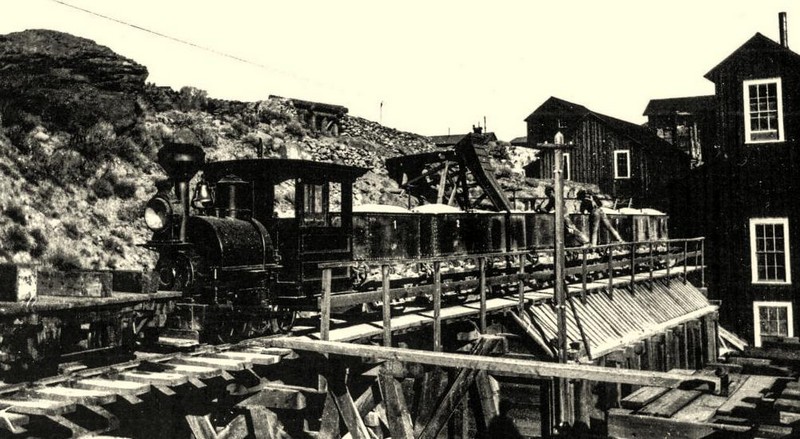
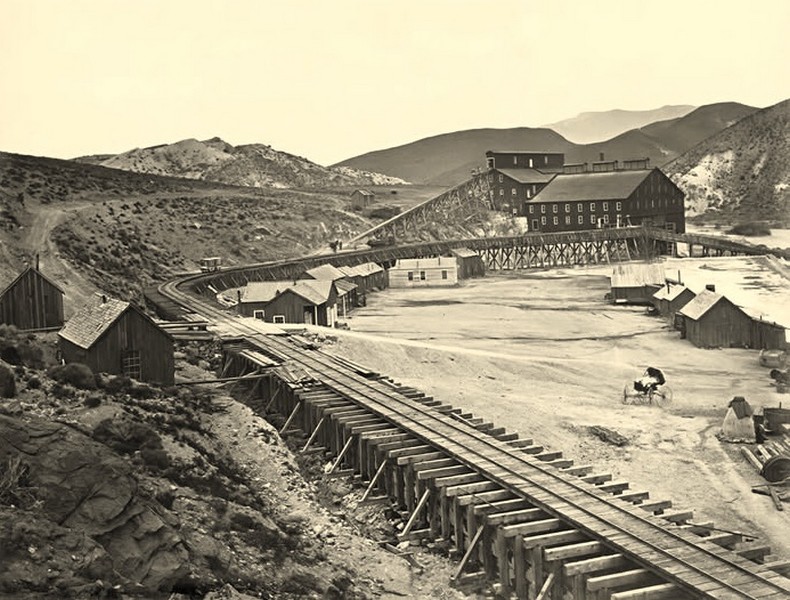
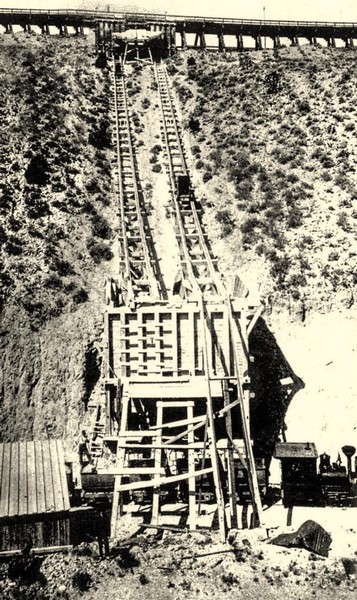
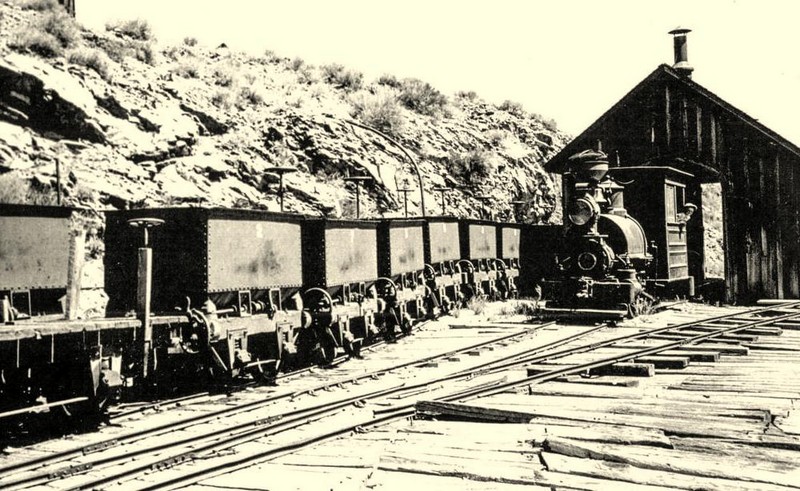
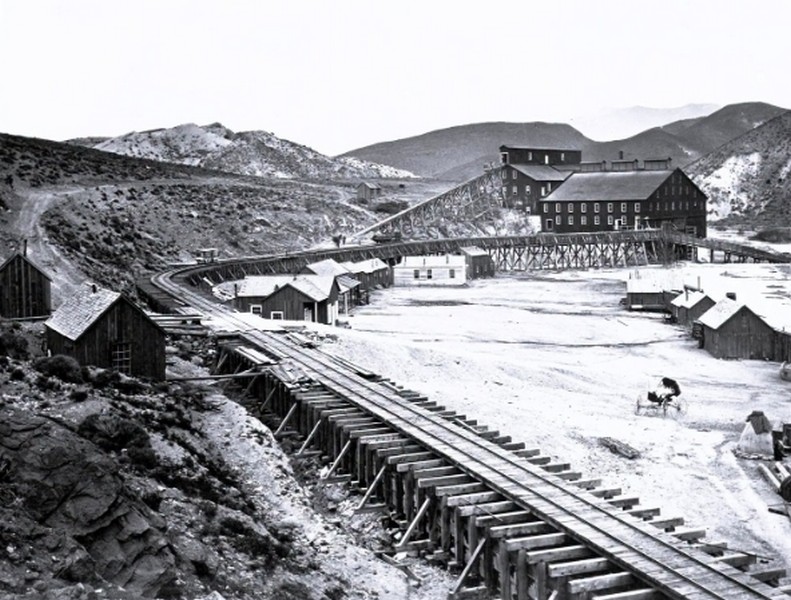
---there were several Eureka Mills. The first built in 1871 burned down, and was then rebuilt, and later improved. Ore was originally hauled in four wheel ore cars by horses to an incline railway, and hauled up to the top of the mill to be dumped into a sorting device called a "grizzly".
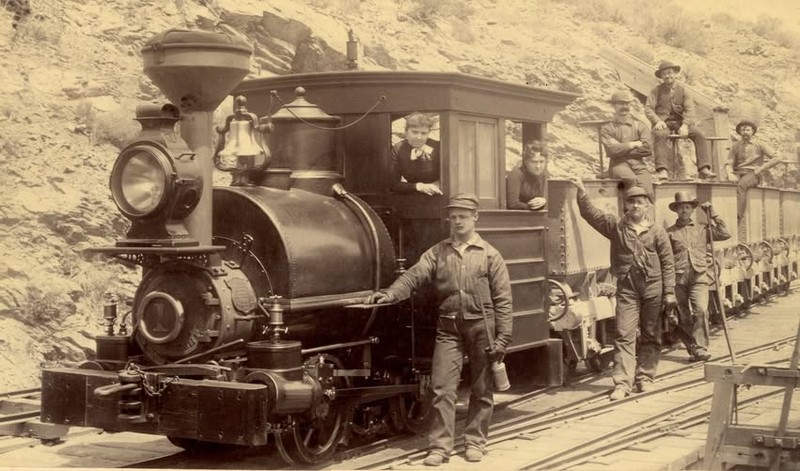
In 1887, a Porter was purchased and began operating along the top of the flume until it was realized that the locomotive was too heavy, and a new right of way was built on land, and a deck, parallel to the flume. Both on the horse-powered and steam-powered lines, the little ore cars were hauled up to the mill on the incline railway. Later photos show the incline gone and a track running through the engine house to an ore bin. I do not know how the ore got to the top of the mill from this bin so gravity could do its work. At the other end of the Eureka Mill Railroad, ore was delivered from the Virginia & Truckee Railroad over a branch above the Carson River. The ore came in standard gauge four-wheel ore cars designed and built in the V&T's shops in Carson City, Nevada. When the Eureka Mill Railroad needed ore cars, they ordered cars to be built by the V&T shops.
The ore was dumped into tubs at the top of an incline railroad. There were two parallel tracks, each with a tub. One tub was filled and its weight, as it descended down the incline, pulled the previously emptied tub on the other track up to be filled. Once filled, it was let down pulling the empty back up to be refilled. The ore went into a large ore bin where it was dumped into the Eureka Mill Railroad's ore cars as needed.
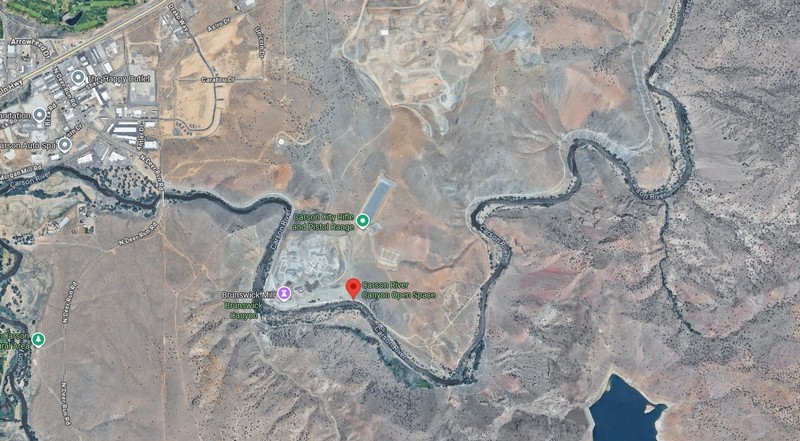
Carson River Canyon Open Space is one of Carson City's most historic Open Space properties. This extensive canyon stretches three miles along the Carson River following the historic Virginia and Truckee Railroad Grade. The area plays host to many outdoor activities including fishing, river rafting, swimming, off-highway vehicle exploration, horseback riding, and mountain biking. Enjoy breathtaking views and sandy beaches in one of the many day use areas.
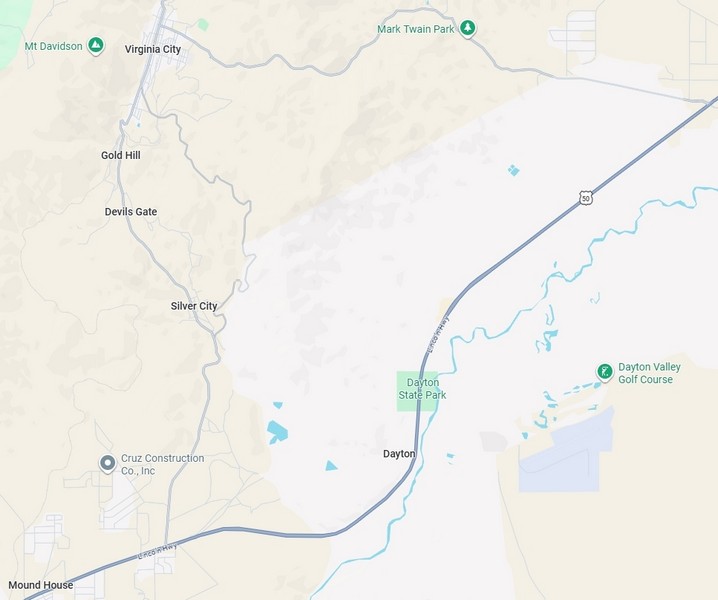
This beautiful canyon was once home to more than a dozen ore reduction mills and lumber mills. In 1869 the Virginia and Truckee Railroad made it's way into the canyon, hauling ore from mines in Virginia City to the mills and returning laden with timbers for the mines.
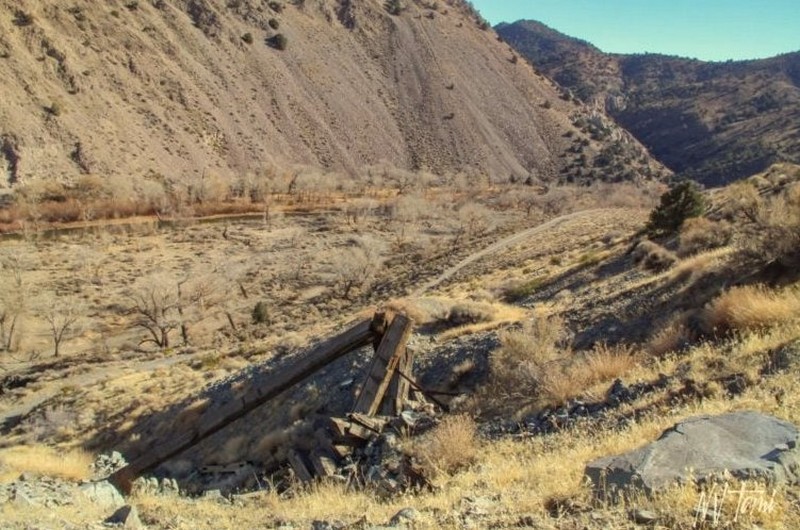
In 1860, the first dam and ditch were completed five miles upriver from Empire City (now the Empire Ranch Golf Course). Water from the Carson River, a necessary component in mill operation, was diverted to power the Mexican and Mead Mills. Soon after, numerous businesses followed suit. The most notable were the Brunswick Mill, Merrimac Mill, Copper Canyon/Blue Canyon Mill, Vivian Mill, Santiago Mill, and the Eureka Mill. Today, little evidence remains of these once powerful operations. Travel along the remaining Railroad Grade and imagine the canyon as it once was.
