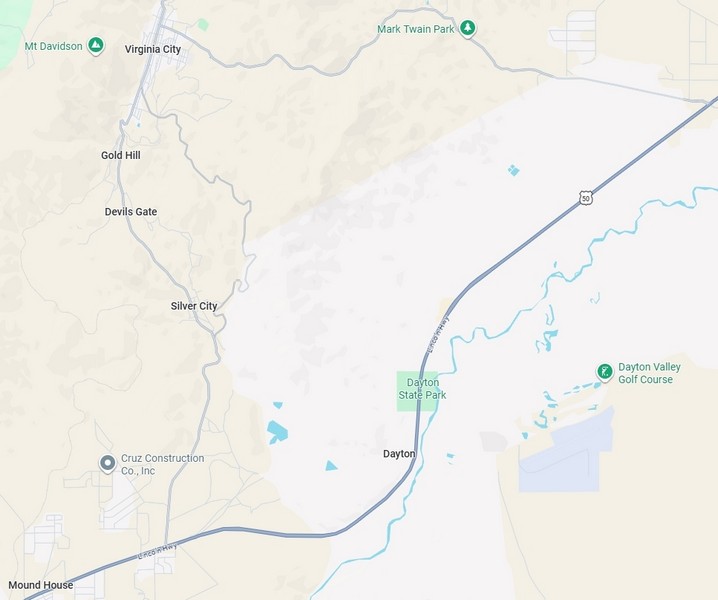
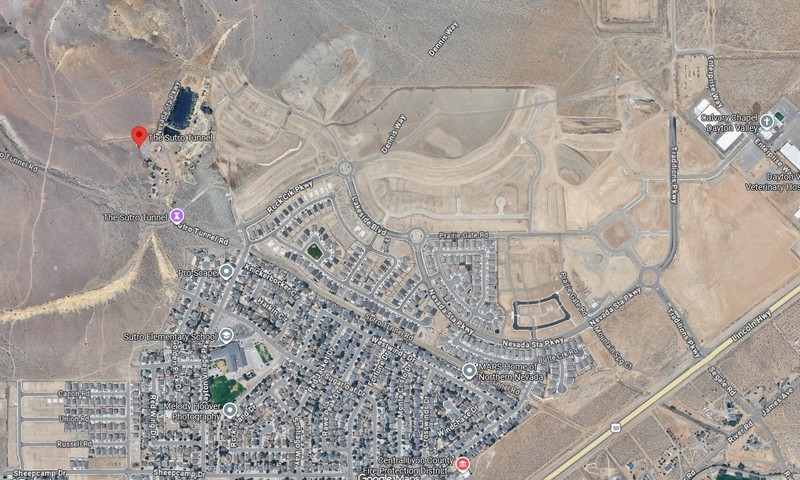
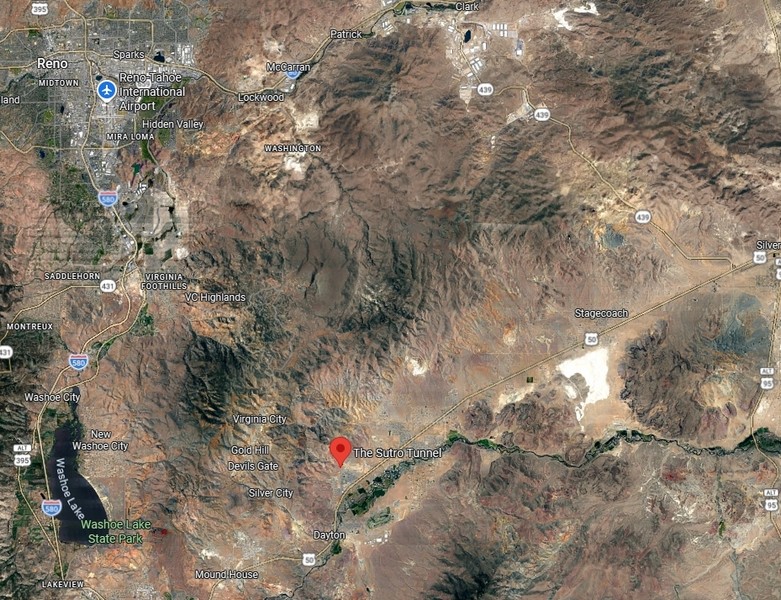
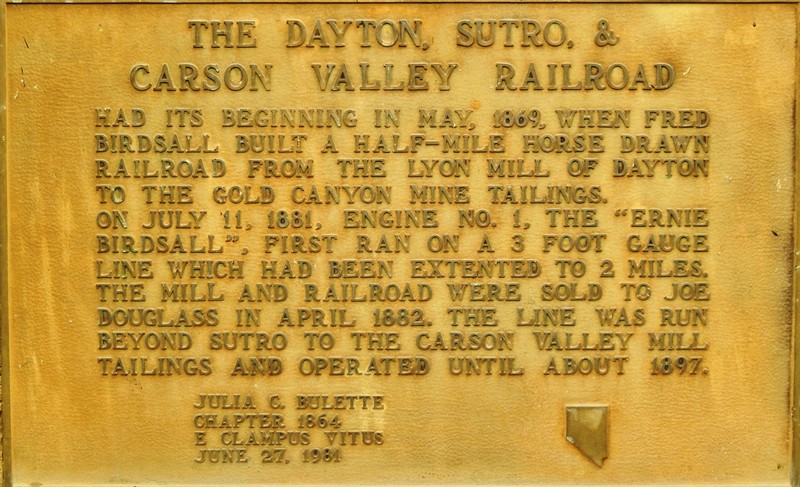
While the name might seem misleading today, in the 19th century, "Carson Valley" referred to the Carson River valleys and canyons extending all the way from today's Carson Valley in Douglas County through Churchill Canyon east of Dayton. From humble beginnings, the Dayton, Sutro and Carson Valley Railroad eventually went from old town Dayton to the Carson Valley Mill, which was located in Dayton Valley in the vicinity of the present-day Mark Twain neighborhood.
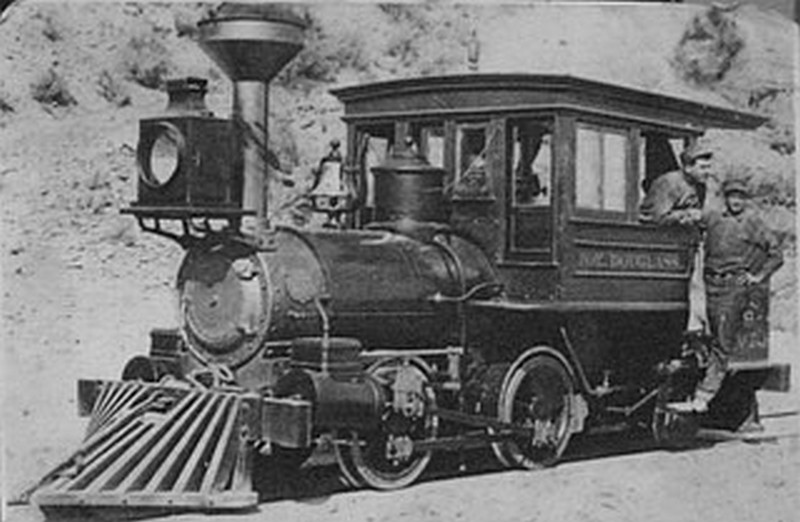
The railroad was purchased from Fred Birdsall by Joe Douglass of Virginia City in 1882. Douglas then changed the name of the Lyon Mill to the Douglass Mill after himself. He then set about to buy a new locomotive to run on the rails he had bought. Douglass ordered a small industrial locomotive from the H.K. Porter & Co. and named it the Joe. Douglass, also after himself.
Douglass decided to expand the reach of the railroad, and started surveying a line to the town of Sutro, where the Sutro Tunnel had just opened a few years before. He also aimed to reach the Carson Valley Mill east of Sutro, where there were large piles of tailings ripe for the picking. Construction started immediately, reaching Sutro by November and the end of the line at the Carson Valley Mill by February of 1883. Thus did the little railroad live up to the name Douglass had given it when he first bought it, the Dayton, Sutro and Carson Valley Railroad.
The railroad operated for about 15 years after Douglass took over. The Joe. Douglass and its three ore cars would make the trip out to the Carson Valley tailings and back as many as six times per day, trying to keep up with the Douglass Mill, which could process 160 tons of ore every day. They contracted with the V&T Shops for repairs to the locomotive, and at times the Joe. Douglass would find itself riding on a flatbed car into Carson City to be overhauled.
The exact date that operations shut down is not known, but production at the mill tapered off in the last few years of the century, and it might have closed as early as 1896. In 1900, Douglass sold his namesake locomotive to a company in Southern California, which used it in the construction of the Lake Arrowhead Dam. The locomotive then spent several decades on display, and fell into the hands of private owners who restored it to its 1882 appearance. In 1994, Nevada's smallest railroad locomotive was purchased by the Nevada State Railroad Museum, which now has it on display in Carson City.
Carson River Canyon Open Space is one of Carson City's most historic Open Space properties. This extensive canyon stretches three miles along the Carson River following the historic Virginia and Truckee Railroad Grade. The area plays host to many outdoor activities including fishing, river rafting, swimming, off-highway vehicle exploration, horseback riding, and mountain biking. Enjoy breathtaking views and sandy beaches in one of the many day use areas.
This beautiful canyon was once home to more than a dozen ore reduction mills and lumber mills. In 1869 the Virginia and Truckee Railroad made it's way into the canyon, hauling ore from mines in Virginia City to the mills and returning laden with timbers for the mines.
In 1860, the first dam and ditch were completed five miles upriver from Empire City (now the Empire Ranch Golf Course). Water from the Carson River, a necessary component in mill operation, was diverted to power the Mexican and Mead Mills. Soon after, numerous businesses followed suit. The most notable were the Brunswick Mill, Merrimac Mill, Copper Canyon/Blue Canyon Mill, Vivian Mill, Santiago Mill, and the Eureka Mill. Today, little evidence remains of these once powerful operations. Travel along the remaining Railroad Grade and imagine the canyon as it once was.
