
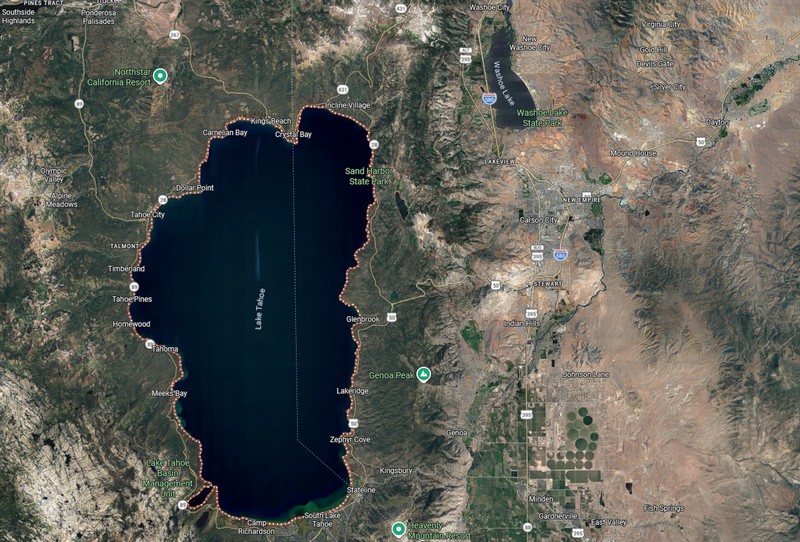
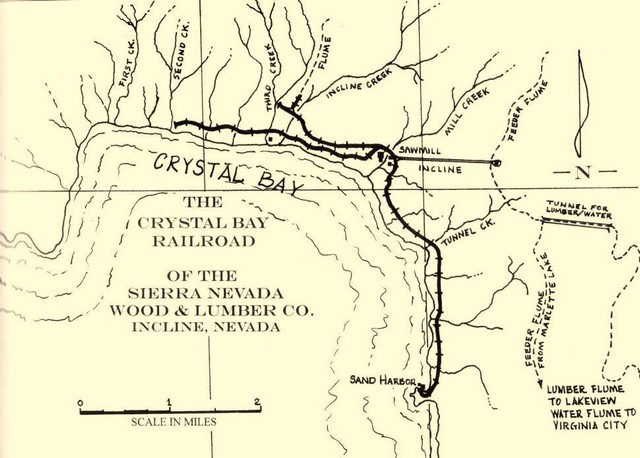
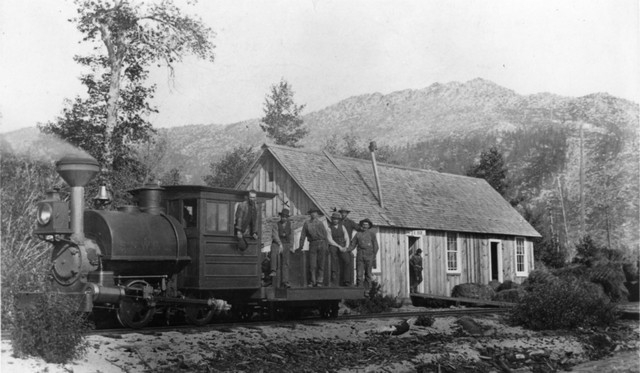
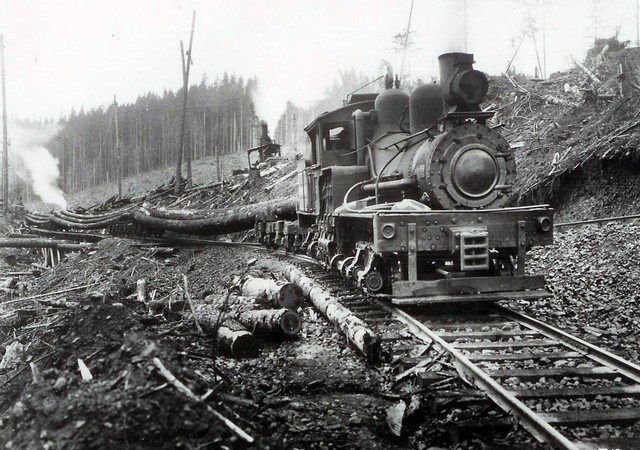
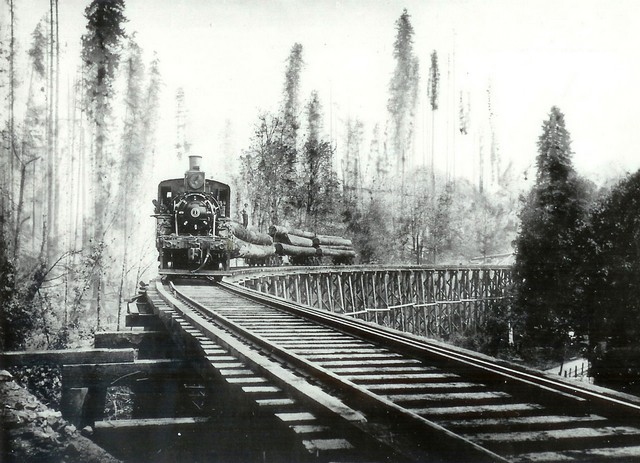
The SNW&L constructed a narrow gauge railroad along the shores of Lake Tahoe to gather logs being transported across Lake Tahoe. The railroad extended from Crystal Bay in the west and Sand Harbor in the south, with a few branches within Incline. Today, much of the current SNW&L railroad right-of-way is part of present day Nevada Highway 28.
The railroad operated from July 1881 until the end of the 1894 season when the logging operations in the Lake Tahoe Basin were in decline. The SNW&L moved their operations and the railroad equipment to Overton (later Hobart Mills), north of Truckee, California.
Walter Hobart and Seneca "Sam" Marlette were the first Tahoe loggers, opening a small sawmill in Little Valley in 1873. Their small business ran a two-and-a-half-mile flume to the valley floor and operated the Excelsior Mill. Hobart served on the board of the Virginia & Gold Hill Water Company and the mill manufactured the timbers used in the construction of the flume system between Hobart Creek and Virginia City. This system was initially successful, but proved inadequate for the needs of Virginia City after the great fire of 1875. In 1876 the Virginia & Gold Hill Water Co. purchased and enlarged the dam at Marlette Lake to provide a steady water supply. A flume was constructed from the lake to Tunnel Creek where the 3,994' long Incline Tunnel carried the water under the ridge to connect it with the existing system.
On April 22, 1878 the Sierra Nevada Wood & Lumber Company was formed by Hobart and Marlette with backing from Alvinza Hayward, a San Francisco capitalist. The company then purchased nearly ten thousand acres of timber along the eastern shore of Lake Tahoe. Construction of new mill at Incline, near Crystal Bay began in 1879. The project was overseen by J. B. Overton, who also served as Superintendent for the Virginia & Gold Hill Water Co. The first lumber built the mills, bunkhouses, cookhouses and other facilities on Mill Creek. Finished timber was then loaded onto a 4000-foot incline, climbing 1400 feet in elevation to the V-flume. Lumber floated down the V-flume, through Incline tunnel and on to Lakeview Station. There the lumber was loaded to the cars of the Virginia & Truckee Railroad, while the water from the flume continued along the rest of the system to Virginia City.
Initially oxen and horse teams performed the duty of hauling logs from the lake to the mill. To serve the new mill a railroad was constructed west 1.5 miles into the timber. The first locomotive, a 0-4-0T built by H. K. Porter arrived in 1881. The village of Incline continued growing and a store, boarding house and stable were built there in addition to cabins for 200 loggers who worked there seasonally. Surrounding the village were acres of potatoes, onions, lettuce, corn, cabbage, turnips, grain and hay growing on its gentle slopes to keep it supplied. In 1884 Incline was proud to boast the addition of a post office and steamboat service on the lake.
The railroad was extended south along mill creek towards the lake shore, however the sandy shore was found unsuitable to build a landing. Instead, a protected cove at Sand Harbor was chosen, and the railroad extended to the new landing in 1888. Logging operations were expanded to Zephyr Cove (formerly Hobart) along southern edge of the lake. From there the company steamboat Niagara brought log rafts north to Sand Harbor to be loaded on narrow gauge cars for the trip to the mill. To meet the increased work, a second 0-4-0T locomotive was purchased from [H.K. Porter] in 1889. At its peak, the Sierra Nevada Wood and Lumber owned nearly 65,000 acres of timber lands around Lake Tahoe, the second largest after the Carson & Tahoe, Lumber & Fluming Co.
The boom of the late 1880s was short lived and the best of the timber had been harvested by 1893. In 1894 they sold the dam at Marlette lake to the Carson & Tahoe Lumber Company and the mill at Incline shipped its final loads and shut down. The company also traded 5,000 acres between Truckee and Lake Tahoe were traded to the Truckee Lumber Company in exchange for 5,000 acres north of Truckee neighboring lands they had purchased 20 years prior. The mill and railroad were then disassembled and moved moved five miles north of Truckee alongside Prosser Creek at the site of the new town of Hobart Mills (Overton). By the end of 1897 the traces of the operation were gone except for the scar of the incline and bullhead wheels, of which can be seen today above the former mill site.
