

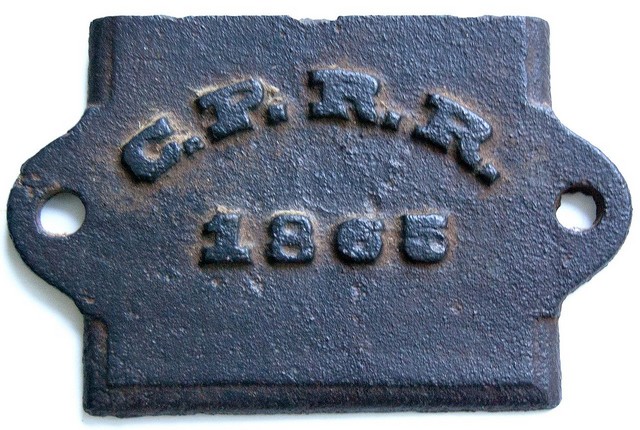

Headquarters Sacramento, CA; San Francisco, California
Locale Sacramento, California-Ogden, Utah
Dates of operation June 28, 1861-April 1, 1885 continued as an SP leased line until June 30, 1959
Successor Southern Pacific
Following the completion of the Pacific Railroad Surveys in 1855, several national proposals to build a transcontinental railroad failed because of political disputes over slavery. With the secession of the South in 1861, the modernizers in the Republican Party controlled the US Congress. They passed legislation in 1862 authorizing the central rail route with financing in the form of land grants and government railroad bond, which were all eventually repaid with interest. The government and the railroads both shared in the increased value of the land grants, which the railroads developed. The construction of the railroad also secured for the government the economical "safe and speedy transportation of the mails, troops, munitions of war, and public stores".
In December 1860 or early January 1861, Marsh met with Judah and Daniel Strong in Strong's drug store in Dutch Flat, California, to discuss the project, which they called the Central Pacific Railroad of California. James Bailey, a friend of Judah, told Leland Stanford that Judah had a feasible route for a railroad across the Sierras, and urged Stanford to meet with Judah. In early 1861, Marsh, Judah and Strong met with Collis P. Huntington, Leland Stanford, Mark Hopkins Jr. and Charles Crocker to obtain financial backing. Papers were filed to incorporate the new company, and on April 30, 1861, the eight of them, along with Lucius Anson Booth, became the first board of directors of the Central Pacific Railroad.
Planned by Judah, the Central Pacific Railroad was promoted by Congress by the Pacific Railway Act of 1862 which authorized the issuance of government bonds and land grants for each mile that was constructed. Stanford served as president (at the same time he was elected governor of California), Huntington served as vice-president in charge of fundraising and purchasing, Hopkins was treasurer and Crocker was in charge of construction. They called themselves "The Associates", but became known as "The Big Four". Construction began in 1863 when the first rails were laid in Sacramento.
The Truckee River at Verdi, Nevada, c. 1868–75. When the Central Pacific Railroad reached its site in 1868, Charles Crocker pulled a slip of paper from a hat and read the name of Giuseppe Verdi; so, the town was named after the Italian opera composer. Construction proceeded in earnest in 1865 when James Harvey Strobridge, the head of the construction work force, hired the first Cantonese emigrant workers at Crocker's suggestion. The construction crew grew to include 12,000 Chinese laborers by 1868, when they breached Donner summit and constituted eighty percent of the entire work force. The "Golden spike", connecting the western railroad to the Union Pacific Railroad at Promontory, Utah, was hammered on May 10, 1869. Coast-to-coast train travel in eight days became possible, replacing months-long sea voyages and lengthy, hazardous travel by wagon trains.
In 1885, the Central Pacific Railroad was acquired by the Southern Pacific Company as a leased line. Technically the CPRR remained a corporate entity until 1959, when it was formally merged into Southern Pacific. (It was reorganized in 1899 as the Central Pacific "Railway".) The original right-of-way is now controlled by the Union Pacific, which bought Southern Pacific in 1996.
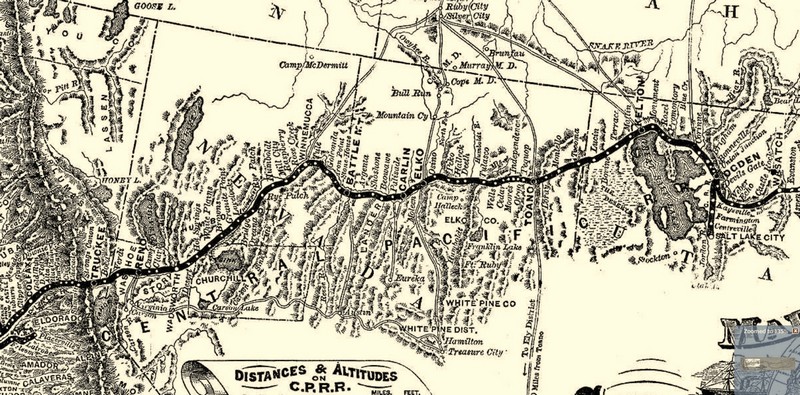
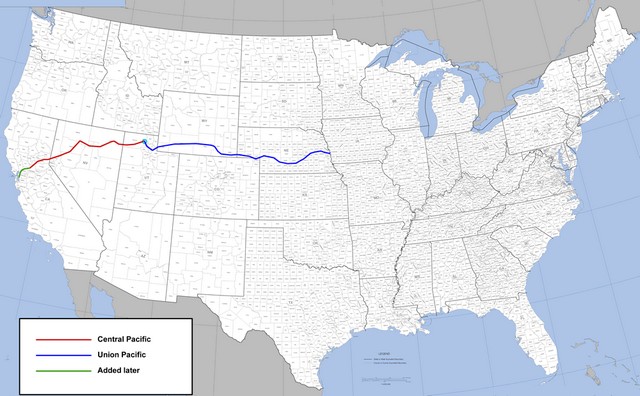
The Union Pacific-Central Pacific (Southern Pacific) main line followed the historic Overland Route from Omaha, Nebraska, to San Francisco Bay.
Chinese labor was the most vital source for constructing the railroad. Most of the railroad workers in the west were Chinese, as they could be hired at a lower cost to do the difficult work. Fifty Cantonese emigrant workers were hired by the Central Pacific Railroad in February 1865 on a trial basis, and soon more and more Cantonese emigrants were hired. Working conditions were harsh, and Chinese were compensated less than their white counterparts, leading to far less white workers being hired. Chinese laborers were paid thirty-one dollars each month ($1,111 in 2025), and while white workers were paid the same, they were also given room and board. In time, CPRR came to see the advantage of good workers employed at low wages: "Chinese labor proved to be Central Pacific's salvation."
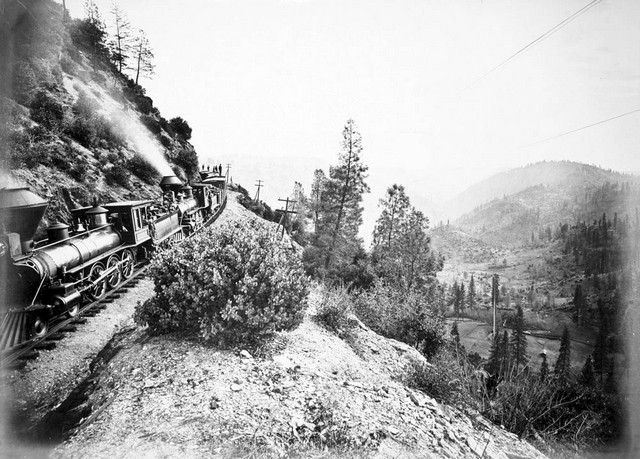
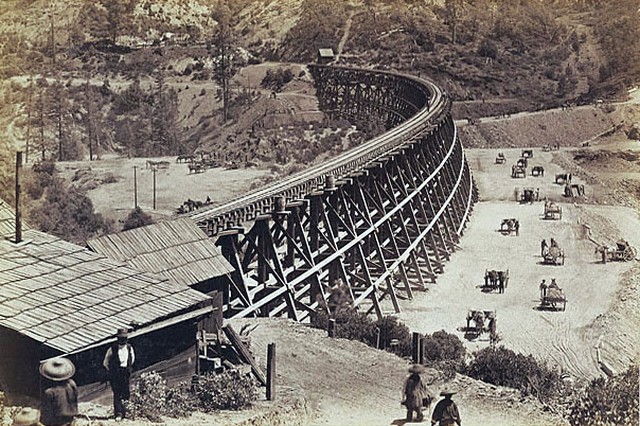
The difficulties faced by the Central Pacific in the Sierra Nevada - particularly the extensive tunneling required - were far more formidable than those encountered by the Union Pacific Railroad in the Rocky Mountains. The story that Chinese workers were suspended in wicker baskets over vertical granite cliffs at Cape Horn, California, to drill and blast a ledge for the Central Pacific has been repeated and exaggerated by uncritical historians.
Despite the frequently repeated myth of Chinese workers being blown to bits here while suspended in wicker baskets, it never happened. The cliff here isn't vertical, the rock isn't granite, and no one was lowered over the edge in wicker baskets to set dynamite charges. The cut was dug down from the top and from each end, not blasted from the side. There is reliable, primary-source evidence stating that surveyors used safety ropes while staking out the route, but nothing about construction workers using ropes. Digging the cut was done downward from the top, and from each horizontal end of the cut. It is conceivable that a safety rope would have been useful when digging an initial footpath, that could then be enlarged into a shelf, but there was no reason to be suspended by ropes to dig or drill into the face of the cut. It wasn't done that way. And, most of the Chinese labor was not hired until later. So, the gangs that did the digging at Cape Horn may have been Irish.
Central Pacific Director Charles Marsh had extensive civil engineering experience in projects of this nature, both from planning an earlier proposed railroad into the Sierras, and from building ditches and flumes through those mountains for his water company.
Financing
Construction of the road was financed primarily by 30-year, 6% U.S. government bonds authorized by Sec. 5 of the Pacific Railroad Act of 1862. They were issued at the rate of $16,000 ($265,000 in 2017 dollars) per mile of tracked grade completed east of the designated base of the Sierra Nevada range near Roseville, California, that state geologist Josiah Whitney had determined was the geologic start of the Sierras' foothills. Sec. 11 of the Act also provided that the issuance of bonds "shall be treble the number per mile" (to $48,000) for tracked grade completed over and within the two mountain ranges (but limited to a total of 300 miles (480 km) at this rate), and "doubled" (to $32,000) per mile of completed grade laid between the two mountain ranges. The U.S. Government Bonds, which constituted a lien upon the railroads and all their fixtures, were repaid in full (and with interest) by the company as and when they became due.
Sec. 10 of the 1864 amending Pacific Railroad Act (13 Statutes at Large, 356) additionally authorized the company to issue its own "First Mortgage Bonds" in total amounts up to (but not exceeding) that of the bonds issued by the United States. Such company-issued securities had priority over the original Government Bonds. (Local and state governments also aided the financing, although the City and County of San Francisco did not do so willingly. This materially slowed early construction efforts.) Sec. 3 of the 1862 Act granted the railroads 10 square miles (26 km2) of public land for every mile laid, except where railroads ran through cities and crossed rivers. This grant was apportioned in 5 sections on alternating sides of the railroad, with each section measuring 0.2 miles (320 m) by 10 miles (16 km). These grants were later doubled to 20 square miles (52 km2) per mile of grade by the 1864 Act.
Although the Pacific Railroad eventually benefited the Bay Area, the City and County of San Francisco obstructed financing it during the early years of 1863-865. When Stanford was Governor of California, the Legislature passed on April 22, 1863, "An Act to Authorize the Board of Supervisors of the City and County of San Francisco to take and subscribe One Million Dollars to the Capital Stock of the Western Pacific Rail Road Company and the Central Pacific Rail Road Company of California and to provide for the payment of the same and other matters relating thereto" (which was later amended by Section Five of the "Compromise Act" of April 4, 1864). On May 19, 1863, the electors of the City and County of San Francisco passed this bond by a vote of 6,329 to 3,116, in a highly controversial Special Election. The City and County's financing of the investment through the issuance and delivery of Bonds was delayed for two years, when Mayor Henry P. Coon, and the County Clerk, Wilhelm Loewy, each refused to countersign the Bonds. It took legal actions to force them to do so: in 1864 the Supreme Court of the State of California ordered them under Writs of Mandamus (The People of the State of California ex rel the Central Pacific Railroad Company vs. Henry P. Coon, Mayor; Henry M. Hale, Auditor; and Joseph S. Paxson, Treasurer, of the City and County of San Francisco. 25 Cal. 635) and in 1865, a legal judgment against Loewy (The People ex rel The Central Pacific Railroad Company of California vs. The Board of Supervisors of the City and County of San Francisco, and Wilhelm Lowey, Clerk 27 Cal. 655) directing that the Bonds be countersigned and delivered.
In 1863 the State legislature's forcing of City and County action became known as the "Dutch Flat Swindle". Critics claimed the CPRR's Big Four intended to build a railroad only as far as Dutch Flat, California, to connect to the Dutch Flat-Donner Pass Wagon Road to monopolize the lucrative mining traffic, and not push the track east of Dutch Flat into the more challenging and expensive High Sierra effort. CPRR's chief engineer, Theodore Judah, also argued against such a road and hence against the Big Four, fearing that its construction would siphon money from CPRR's paramount trans-Sierra railroad effort. Despite Judah's strong objection, he Big Four incorporated in August 1863 the Dutch Flat-onner Lake Wagon Road Company. Frustrated, Judah headed off for New York via Panama to raise funds to buy out the Big Four from CPRR and build his trans-sierra railroad. Unfortunately, Judah contracted yellow fever in Panama and died in New York in November 1863.
Stockton and Copperopolis Railroad[49]
Stockton and Visalia Railroad[50]
Western Pacific Railroad (1862-1870)
