Overview

Parent company Southern Pacific Company (1900-1996)

Union Pacific Railroad (1996-present)

Locale Nevada and California

Dates of operation 1880-1960 (narrow gauge)

Length 293 miles (470 km)


Nevada Subdivision

Hazen

Fallon branch

Virginia & Truckee Railroad

Mound House

route change & converted 1905

Mound House Plaster Co.

Marbelite Spur

Dayton

Dayton, Sutro & Carson Valley RR

Rock Point

Carson River

Clifton

Hazen cutoff

Fort Churchill

Washout

Copper Belt Railway

Wabuska

Fort Churchill Generating Station

Walker River

Lux

Mason

Rio Vista

Reservation

Schurz

Walker River

Rawhide Junction

Stuckley

Gillis

Nolan

Magnus

Walker

1905 bypass

Thorne

Hawthorne Army Depot

Hawthorne

Cottonwood

Dover

Stansfield

Kinkead

Luning

New Boston

Mina

== end of dual gauge

Soda Springs

Rhodes

Rhodes salt marsh

Tonopah Junction

Tonopah and Goldfield Railroad

Belleville

Filben

Candelaria

Little Summit

Raydel

Bassalt

Mt. Montgomery

Sunland

elev. 7,141 ft (2,177 m)

Montgomery Pass tunnel

247 ft

75.3 m

Silex

Queen

Nevada-Border

California-Border

Benton

Chalfant

Laws (Bishop)

Alvord

Monola

rerouted c. 1920s

Owens River

Tinemaha Reservoir

Owens River

Independence

Owenyo

Lone Pine Subdivision

Lone Pine

Keeler


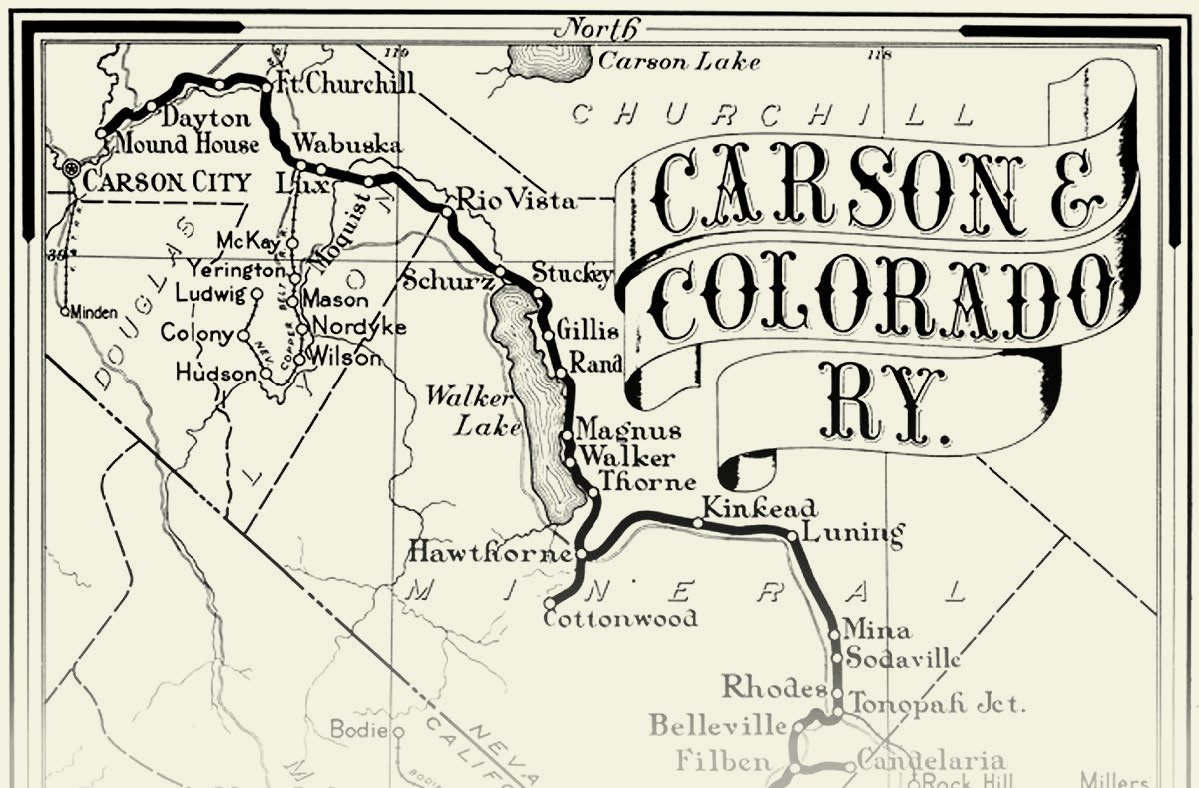
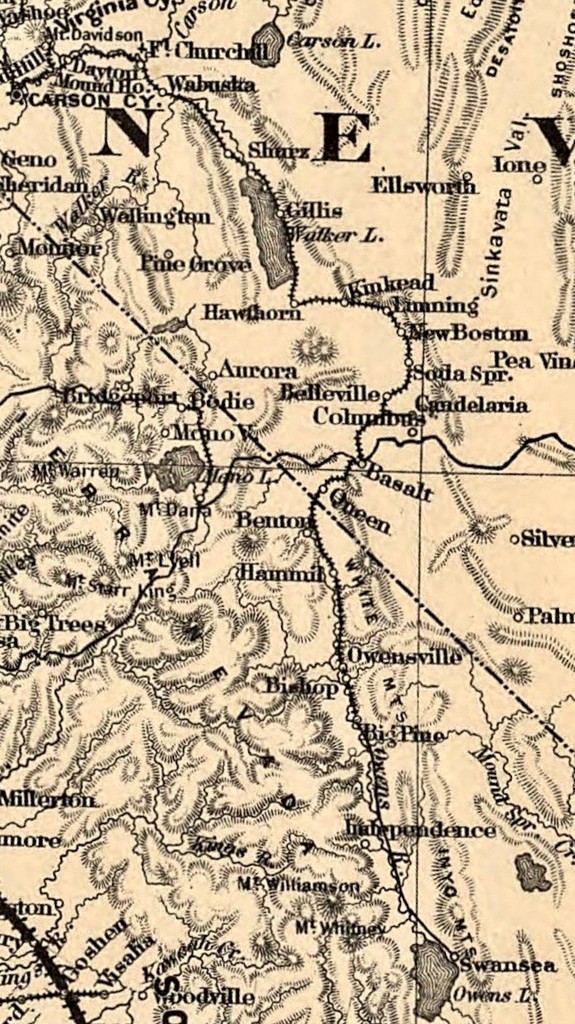
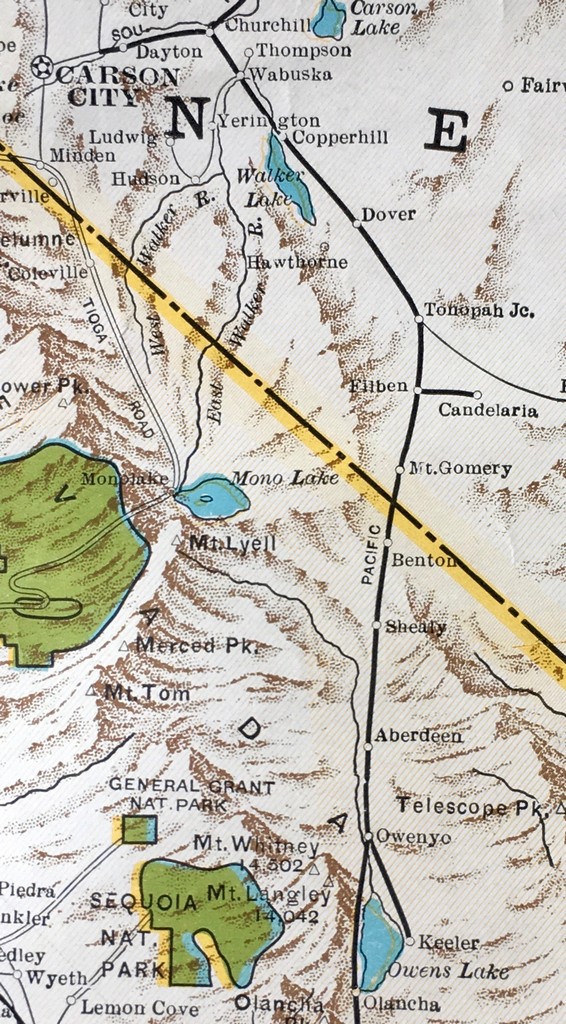
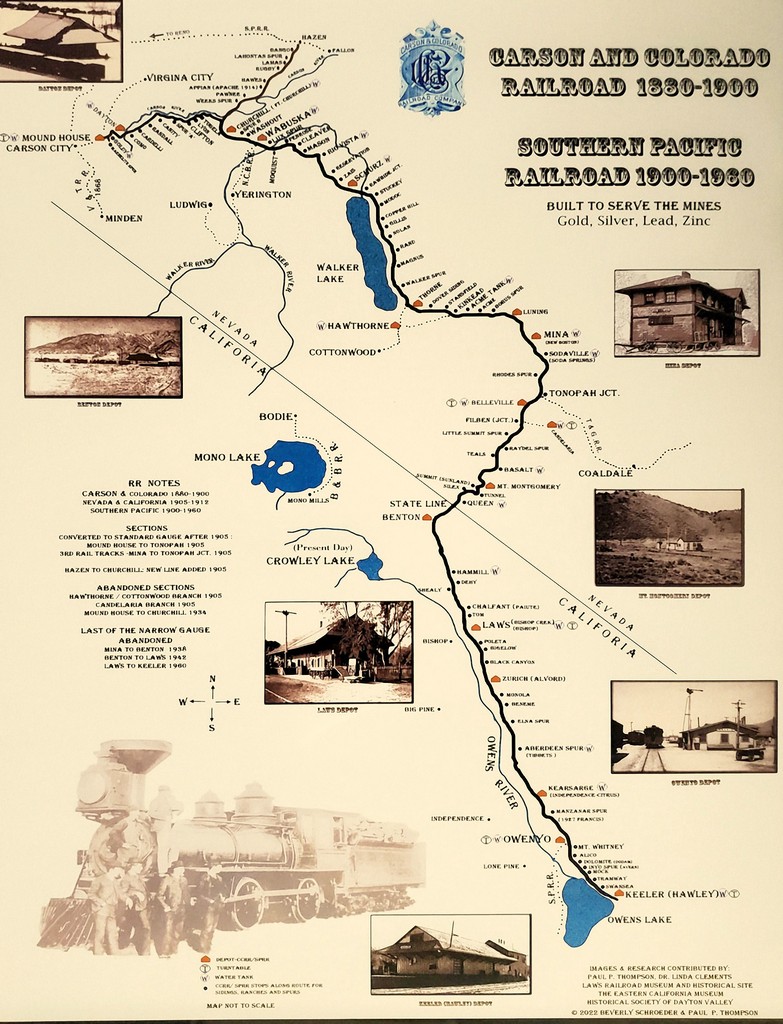
The Carson and Colorado Railway was a U.S. 3 ft (914 mm) narrow gauge railroad that ran from Mound House, Nevada, to Keeler, California, below the Cerro Gordo Mines. The narrow gauge track was chosen to reduce cost. The railroad served an arid area heavily dependent on mineral resources for economic activity. Much of the route now parallels U.S. Route 95 Alternate, U.S. Route 95, Nevada State Route 360, U.S. Route 6, and U.S. Route 395. After it was acquired by the Southern Pacific Railroad, the sprawling company romantically dubbed the route as the Slim Princess.

History

The original company

As the Comstock Lode was winding down, a group which had benefited from the strike with connections to the Bank of California sought to exploit further potential strikes to the south. The company was incorporated on May 10, 1880, as the Carson and Colorado Railroad, and construction on the railroad began on May 31, 1880. The Carson and Colorado began operations with a single Baldwin 4-4-0, the Candelaria. The first passenger train ran to Hawthorne in 1880 to show off the town site. Construction commenced in the second half of 1881, building south to Belleville by that December, then finally to Candelaria the following March. This was initially indicated to be the road's terminal for a time, but the company began construction south into the Owens Valley in 1882 with the intention to connect to the Southern Pacific Railroad at Mojave. Interchanging with the railroads under the same corporate control at both ends of the railway seemed unlikely, but even an incomplete line was seen as having potential for mineral traffic. Finally, trains arrived at Keeler on August 1, 1883. The route reached an altitude of 7,100 feet (2,200 m) in Montgomery Pass. A short spur line from Hawthorne to Cottonwood was built to carry lumber, operating between 1891 and 1902. The line showed profit for its first few years, even in an incomplete state, but the mining districts served had already bust. The three constituent companies which built and operated the line were reorganized as the Carson and Colorado Railway in 1892 to reduce accumulated debt.

Sale to the Southern Pacific

Within a few years after its inception, the Carson and Colorado became a hindrance to the Virginia and Truckee Railroad (V&T), the parent company of the C&C, which sold the line to the Southern Pacific Company in 1900. Darius Ogden Mills (part owner) was once quoted saying "Gentlemen, we either built the line 300 miles too long, or 300 years too soon!". Silver and gold discoveries at Tonopah, Nevada and Goldfield, Nevada provided a major boost of revenues shortly after the Southern Pacific purchase. Initially planned as part of the railroad's more direct route between Los Angeles and Salt Lake City, the death of C.P. Huntington in 1901 would doom those plans as the Union Pacific Railroad became more tightly integrated to the Southern Pacific. From the time of the purchase until 1905, all of the C&C's freight traveled over the V&T's trackage from Mound House to Reno, and vice versa. Because of the changeover from 3-foot (0.91 m) narrow gauge to standard gauge cars, all the freight had to be handled by hand at Mound House, which caused a great bottleneck, especially after the mining booms of Tonopah and Goldfield. Southern Pacific (SP) proffered an offer to purchase the V&T, but the price was considered too high. As a result, the SP began constructing the Hazen cutoff, which circumvented the V&T entirely after it opened. The northern 140 miles (230 km) from Mound House to Mina, Nevada was converted to 4 ft 8+1⁄2 in (1,435 mm) standard gauge in 1905; and the remaining C&C was merged into the Southern Pacific's 3 ft (914 mm) narrow gauge subsidiary, the Nevada and California Railroad. (The line between Tonopah Junction and Mina was laid to a dual gauge, allowing access to Mina's shops.) A new standard gauge line was run south of Owenyo after 1911, but it was mostly constructed to facilitate construction of the Los Angeles Aqueduct. This left a break of gauge where passengers were forced to transfer to the narrow gauge line to travel through the Owens Valley, and Southern Pacific did not intend to rectify this situation. The Nevada and California Railroad was reorganized into the Central Pacific Railroad in 1912.

End of narrow gauge operations

Carson & Colorado #10, originally a combination business car and caboose, later named the "Esmeralda," at the Southern California Railway Museum. In the early 20th century, it operated under the name "Southern Pacific Keeler Branch". Traffic on the north end was bolstered with the construction of the U.S. Naval Ammunition Depot at Hawthorne in 1928. Portions of the line were abandoned in the 1930s and the 1940s. The Mixed train service ceased in 1956. The last narrow gauge common carrier made its final run on April 29, 1960. The rails were removed in January, 1961.

The modern line

The northern segment of line continued operation to serve the Hawthorne Army Depot. Tracks between Mina and Thorne were abandoned in the late 1980s, bringing the active line to 57 miles (92 km) in length. The United States Army purchased the remaining segment of the line south of Wabuska in 1991 and set about upgrading tracks and bridges. By 2016, trains ran weekly as far south as Wabuska, with infrequent runs further to the Army Depot.

Towns and railroad stations served

The following were towns or stops along the line:

Mound House, Nevada (V&T Railroad to Carson City and Virginia City)

Dayton, Nevada

Fort Churchill, Nevada

Wabuska, Nevada (Copper Belt Railway to Yerington)

Lux, Nevada

Moquist, Nevada

Rio Vista, Nevada

Schurz, Nevada

Stuckey, Nevada

Copperhill, Nevada

Gillis, Nevada

Rand, Nevada

Magnus, Nevada

Walker, Nevada

Thorne, Nevada

Hawthorne, Nevada (branch to Cottonwood)

Cottonwood, Nevada (branch only)

Kinkead, Nevada

Luning, Nevada

New Boston, Nevada

Mina, Nevada

Sodaville, Nevada (Soda Springs)

Rhodes, Nevada

Tonopah Junction, Nevada (Tonopah and Goldfield Railroad)

Belleville, Nevada

Filben, Nevada (spur to Candelaria)

Candelaria, Nevada (spur only)

Basalt, Nevada

Summit, Nevada (Mt. Montgomery)

Queen, Nevada

Benton, California

Hammil Valley, California

Laws, California, Owensville

Zurich, California

Monola, California (formerly Alvord)

Kearsarge, California

Manzanar, California

Owenyo, California (Southern Pacific Railroad to Lone Pine, Ridgecrest, and Los Angeles)

Alico, California

Dolomite, California

Mock, California

Swansea, California

Keeler, California


Disclaimer: We search for HISTORY as a hobby. Endless souces. Much can come from others neverless endless sources. Does this website sell anything ? NO Donations ? NO. This is non-commercial. I consider my websites under copyright. Again..no money here !! Educational.


go back