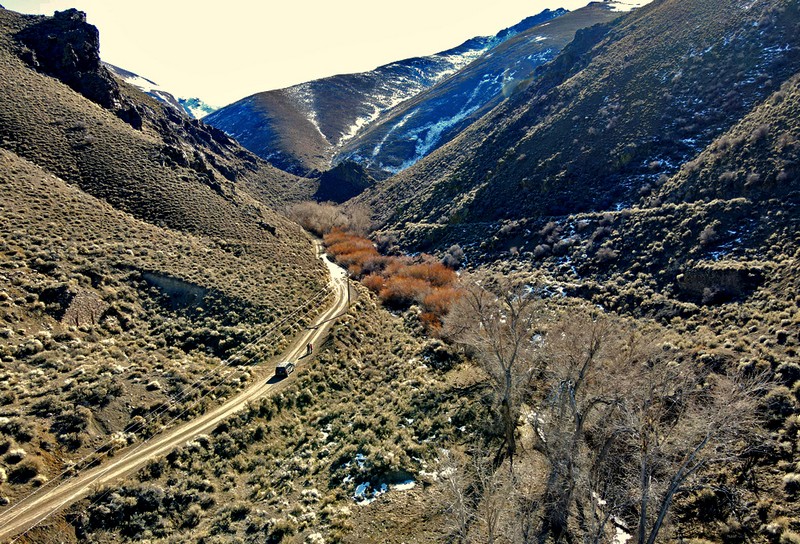
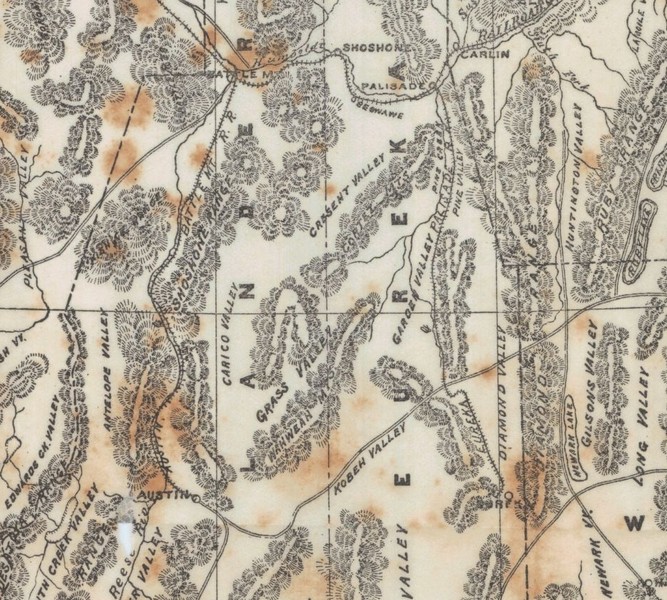
In August 1872 the first mining claim was filed in Lewis Canyon, 10 miles southeast of Battle Mountain, Nevada. By 1876 two mills and three communities were in place: Lewis (Lower Town) at the canyon's mouth, a mile further up was Middle Town (aka Starr) and another half mile further was Upper Town (aka Dean). Consolidation of the major mines and two mills in 1879 led to a sale to East Coast investors who created the Starr & Grove Company. Lewis boomed.

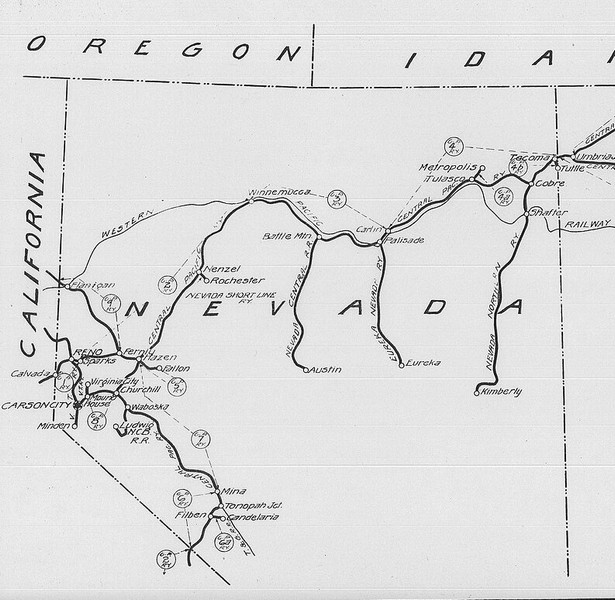
The Nevada Central Railway, completed in February 1880, passed 9 miles west of Lewis. The Starr & Grove Company filed papers to build a rail connection, the Battle Mountain & Lewis Railway. Grading began in January 1881 at the Nevada Central's Galena station, which was renamed Lewis Junction and given a siding, wye and depot. The line was pushed eight miles east, reaching Lewis in June. A switchback in town gave access to the mills and started the climb to the mines, which required two miles of stiff grades, sharp curves, bridging and several switchbacks; it took 10 more months to complete on March 10,1882.

The official opening to Lewis was July 31, 1881, with two carded runs connecting with the Nevada Central and timed to meet Central Pacific trains. Heavy freight traffic was reported; passenger service levels weren't reported.

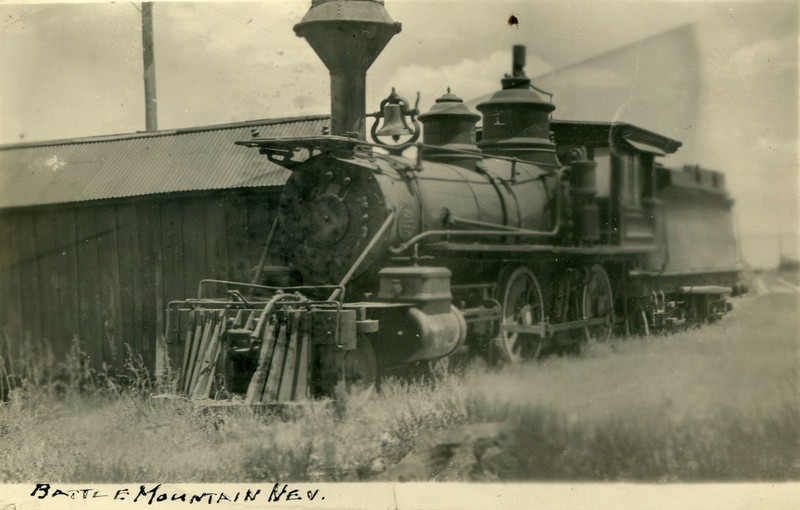
Before the engine ordered from San Francisco’s Union Iron Works arrived, Nevada Central engines were leased: First 4-4-0 #4, the DB Hatch, and then 4-4-0 #5, the Jos. Collett. When the John D. Hall arrived in August, 1881, the 2-4-0 was described as substantially built but "strange looking." It was unsuccessful on the grades and sent back to the builder for modification in September. It never returned. A proposed 0-6-0, Starr Grove, was never shipped to the line. NC #5 ran all subsequent trains.

The Starr & Grove Company and the nearby Betty O'Neal company were dealing with labor issues, racial strife, mine explosions and embezzlement. Revenues stalled and on March 31, 1882, the Nevada Central filed an attachment suit against the BM&L for unpaid freight charges, locomotive rental and coal. Operations stopped. In an act of bravado a new line into Battle Mountain bypassing the Nevada Central was surveyed. It didn’t matter: The property was bought on April 26 th by the local interests who sold it originally. They also bought the Starr & Grove Company's mills and mines. Lewis declined.

The BM&L went dormant, with intermittent periods of operation. There were brief flurries of operation on the tracks by the Nevada Central-in 1883, 1885, 1890 and 1891-but only to Lewis. Track to the mines was left to decay and in 1887 was sold, pulled out and sent to Cortez for the 30" gauge line there. There were recurring rumors of rebuilding and pending sales. 1891 saw the final known operation, cars of lumber arriving in Lewis during a short-lived boom. In 1892 the Lewis Junction station burned down; the agency had already been closed. Finally in -------

1895 a contract was let to pull out the remaining track. The BM&L was done. But there was still one last railroad scheme to come.

Lewis District mining staggered on for 25 years until Noble Getchel inherited the flooded Betty O’Neil mine in 1920. It was drained, a floatation mill built and a community set up. A top silver producer in Nevada, it was crippled by the bad road to Battle Mountain. In 1923 Getchel talked of building a railroad from Lewis Junction to the Betty O’Neil. The Nevada Central, on its last legs, was more troubled than excited by this news. Sensing an opportunity to unload the failing Nevada Central they discussed selling the entire right of way, equipment and the Battle Mountain shops to Getchel for $250,000. Nothing happened and Lewis' railroad history finally ended.


Battle Mountain & Lewis Railway.


During February 1880, shortly after the completion of the Nevada Central Railway prospectors found Gold in Lewis Canyon, Nevada. The canyon was about 10 miles east of the N.C. Line and 10.5 miles south of Battle Mountain. The Starr Grove Mining Company, holders of the claims proposed a 12 mile railroad to service the mines. The Battle Mountain & Lewis was to start at Lewis Junction, on the Nevada Central Line and extend to the Canyon. Grading began on January 28, 1881 with flat terrain and easy construction made it to Lewis by April 25. With the rail laid, service began on July 30, 1881. The first locomotive was rented from the Nevada Central with a second one purchased and in operation during the next month in August. During early 1882 additional track was laid up Lewis Canyon to better service the mines via switchback.

The line was never able to operate profitably due to insufficient mining success and traffic. By March 1882 action was brought against the road by the Nevada Central to recover locomotive rental charges and additional unpaid interchange fees. Additionally, the Nevada Central prohibited the continuation of Battle Mountain & Lewis traffic on the N.C. line to Battle Mountain. This was a crushing blow to the little road. The Starr Grove Mining Company went bankrupt, was sold off at a sheriff's sale. H.D. Gates of Lewis purchased the ROW. The Nevada Central periodically operated on the line to provide mine service during the years 1883 and 1885 but after that, nothing. The line was dead. Shortly after, another sheriff's sale and purchase of the ROW by Landers County and by 1890, the line was dismantled.


Battle Mountain’s name derives from the mountain range to the southwest where in the 1850s some California emigrants were allegedly ambushed by a band of Native Americans. As a town, Battle Mountain sprung into existence in January 1870. In October 1868, the railroad established the Reese River siding here, and made Argenta, five miles eastward, its principle station and point of departure for the busy mining camps to the south. However, early in 1870, the station at Argenta was moved to this location, and the Reese River siding was renamed Battle Mountain Switch. Stage and freight roads north and south teemed with "mud wagon" stages and massive freight wagons.

From 1880 to 1938, Battle Mountain was the operating headquarters for the Central Nevada Railway, as well as the Battle Mountain and Lewis Railroad from 1881 to 1890. The town's first copper boom developed in 1897, in the Galena (Battle Mountain) range. Battle Mountain steadily outgrew the mining town of Austin to the south, until voters moved the county seat here in 1979.


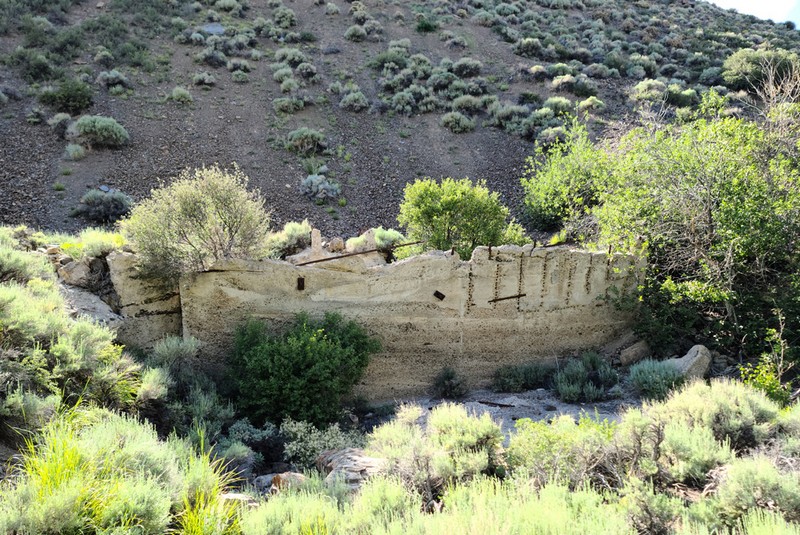
Although discoveries were made in the area as early as 1867, no real activity took place here until 1874. By that time, several mines were producing. Other producing mines continued to be discovered into 1875. The ten-stamp Eagle Mill was soon built at the mouth of the canyon. There were three separate portions of Lewis located in the canyon called Lower Town, Middle Town and Upper Town. These three sections of town eventually included stores, a hotel, boarding houses, meat market, lumberyard, saloons, dance hall, drugstore and a miner's union hall. Apparently, Lewis had an opium problem as well. By 1878, the population of the entire stretch of Lewis was approximately 200 residents. By 1880, the Nevada Central Railroad was completed. Plans were soon made to create a spur line into Lewis Canyon. The was completed by 1881 and was named the Battle Mountain and Lewis Railway. The population grew to approximately 700 residents. Two more mills were built in the area. These were the Highland Chief (40 stamps) and the Star Grove (15 stamps). The Eagle Mill also expanded to 15 stamps as well. By 1881, a jail, school and brewery also came to Lewis. A newspaper called the Lewis Weekly Herald began publishing. Unfortunately for Lewis, a major labor dispute broke out at the Star Grove Mine. Wages were cut and miners refused to work. This caused the closing of the mine. When it was later re-opened, a violent conflict broke out. Three men were shot, one of which died from his wounds. This caused a major uproar. Hundreds of miners from Austin supposedly headed towards Lewis to aid their fellow miners. Wages were restored and the dispute was resolved before any further violence occurred. Although the mining dispute was resolved, Lewis was in serious trouble. In 1881, a boiler explosion caused serious damage to the Betty O'Neal Mine located not too far from Lewis Canyon. In late 1881, a fire destroyed much of the town. By early 1882, the Battle Mountain and Lewis Railway was suffering major financial difficulties and closed the line. During that same period of time, the Star Grove Mining Company and the Eagle Mill both went bankrupt. By 1883, the newspaper stopped publishing, the Star Grove Mill was torn down and the Highland Chief Mill closed. A small revival in 1885 saw a little bit of activity, to include use of the railway again. This was short lived. A miners strike put a stop to any new production. The railway was torn up in 1890. By 1894, there were only a couple dozen residents left in Lewis Canyon and the post office moved to Dean. Not much has occurred in the canyon since. Although the Betty O'Neal Mine did operate and produce well into the early half of the 20th century.


Post Office: Gamett and Paher's post office book states that the post office didn't leave Lewis until 1901. But in Paher's Nevada ghost towns book, he said that the post office moved to Dean in 1894. Shawn Hall backed that date up, saying it moved in 1894 as well. The dates listed in the Gamett/ Paher post office book are as follows: Lewis: April 5, 1878 to August 31, 1901, with a note that says 'Mail to Dean'. Dean: October 18, 1894 to November 30, 1905.


Disclaimer: We search for HISTORY as a hobby. Endless souces. Much can come from others neverless endless sources. Does this website sell anything ? NO Donations ? NO. This is non-commercial. I consider my websites under copyright. Again..no money here !! Educational.


go back